Quick Summary: Are Agate Slab Countertops Durable Enough for Daily Use?
Agate Countertops Look Luxurious, But Can They Handle Real Life?
Agate slab countertops are one of those materials that immediately stop people in their tracks. The rich bands, translucent layers, gemstone colors, and backlit effects can turn a kitchen island, bathroom vanity, hotel bar, or reception counter into a visual centerpiece. In luxury interiors, agate does not whisper. It politely walks in wearing a velvet jacket and steals the room.
But beauty is only one part of the buying decision. For homeowners, interior designers, hotel contractors, villa developers, and stone importers, the more serious question is durability. Can agate slab countertops resist daily scratches, water, heat, cosmetics, wine, coffee, bathroom moisture, and occasional impact? The answer is yes, but with conditions. Agate is durable when it is used in the right application, fabricated correctly, supported properly, and cleaned with the right method.
Unlike standard granite or quartz surfaces, agate slabs are often made from selected semi-precious agate pieces that are cut, arranged, bonded, polished, and sometimes reinforced. That means countertop performance depends not only on the stone itself, but also on resin quality, backing structure, thickness, edge design, cutout planning, and installation support. If you are comparing decorative stone options, understanding the supplier’s fabrication experience matters as much as choosing the color. A professional agate slab countertops manufacturer should be able to explain material construction, project applications, inspection steps, and export packing before you place a bulk order.
What Are Agate Slab Countertops?
Agate is a semi-precious natural stone associated with chalcedony, a fine-grained quartz-family material. It is known for beautiful banding, layered colors, and translucent depth. Agate forms over long geological periods when silica-rich fluids fill cavities in rocks and gradually crystallize. The changing mineral content and formation conditions create the unique bands and colors that make every piece different.
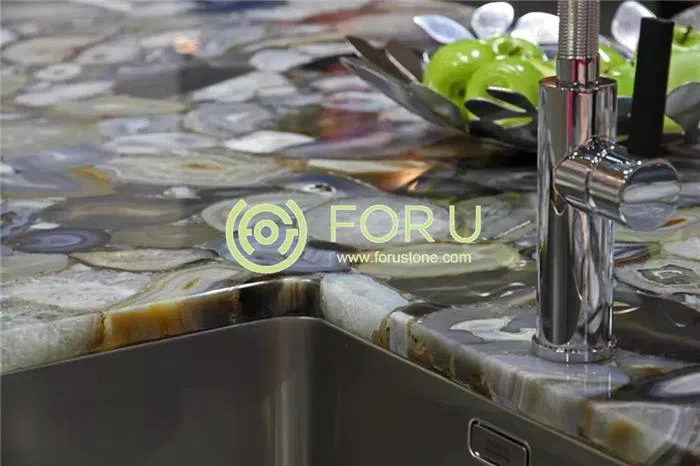
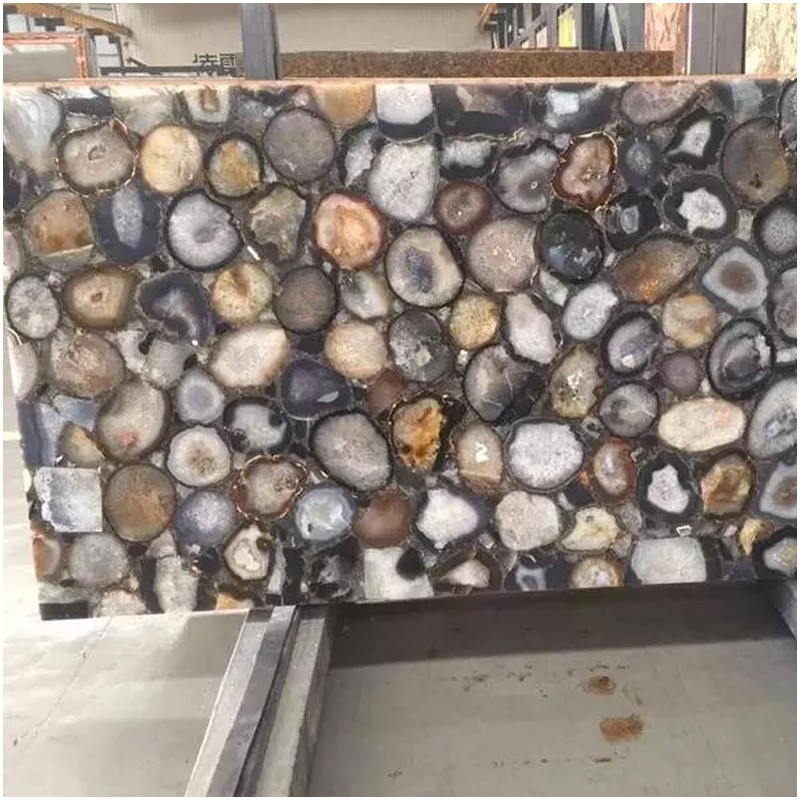
Agate slab countertops are usually not cut from one giant solid block in the same way many granite or marble slabs are. In many cases, selected agate pieces are carefully arranged into slab form, bonded with resin, polished, and reinforced. This makes the final surface visually dramatic, but it also means the slab must be judged as a complete engineered-natural stone system.
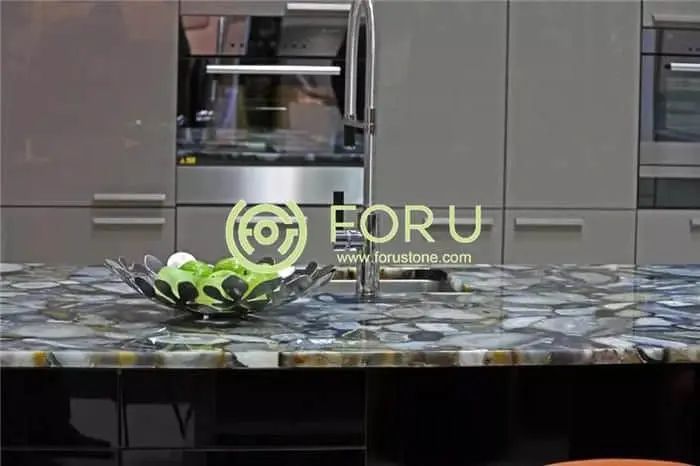
That construction method is one reason agate is popular for backlit design. When used with lighting, agate can show depth, movement, and color layers that ordinary stone cannot match. It is widely used in luxury villas, hotel bars, boutique reception desks, bathroom vanities, feature walls, private clubs, spa interiors, and high-end residential projects.
How Agate Slabs Are Made from Stone to Countertop
The production of agate slab countertops starts with stone selection. Agate pieces are sorted by color, translucency, banding, size, and visual continuity. After selection, the pieces are cut and arranged into a slab layout. The design may be random, bookmatched, color-blocked, or organized to create a flowing visual pattern.
Next, the agate pieces are bonded using resin systems. Depending on the slab type and final application, the material may receive backing support such as glass, fiberglass, stone reinforcement, or honeycomb structure. The surface is then ground, polished, inspected, and prepared for fabrication into countertops, bar tops, vanity tops, wall panels, or backlit features.
This is why buyer inspection matters. With agate, you are not only buying a stone; you are buying the craftsmanship behind the slab. A beautiful agate surface with weak resin bonding, poor backing, sharp unsupported corners, or careless packing can become a costly problem. In B2B projects, always ask for actual slab photos, thickness details, backing information, edge options, and packing photos before shipment.
Are Agate Slab Countertops Actually Durable?
Yes, agate slab countertops can be durable for many residential and commercial applications. Agate itself has good hardness because it belongs to the quartz/chalcedony family. It can resist normal daily wear better than many softer decorative stones. However, countertop durability is not only about mineral hardness. It also includes impact resistance, heat behavior, stain resistance, edge strength, bonding quality, repairability, and maintenance requirements.
For a bathroom vanity, powder room, hotel bar, reception desk, decorative kitchen island, or backlit feature counter, agate can be an excellent choice. These applications benefit from visual impact while usually avoiding the harshest kitchen abuse. For a high-use family kitchen where people place hot pans directly on the surface, chop food without cutting boards, spill acidic sauces, and drag heavy cookware across the island, granite or engineered quartz may be safer.
The smartest way to judge agate slab countertop durability is to match the material to the project. Agate is durable enough when the countertop is designed as a luxury surface, not abused like a factory workbench. That is not a weakness; it is a sourcing reality. A Ferrari is also durable, but you still do not use it to deliver gravel.
Scientific Durability Factors Buyers Should Understand
Hardness and Scratch Resistance
Agate generally has good scratch resistance because it is related to quartz-family minerals. Its typical Mohs hardness is often around 6.5–7, depending on the specific material and structure. This makes agate harder than marble and limestone, and close to granite and quartz-based materials. For daily bathroom use, decorative bars, and light kitchen service, this hardness is usually sufficient.
However, scratch resistance does not mean scratch-proof. Harder objects, metal tools, ceramic items, rough-bottomed cookware, or abrasive cleaning pads can still damage the surface or polish. Buyers should also remember that resin-filled areas, bonded joints, and edges may not behave exactly like solid mineral material.
| 재료 | Typical Mohs Hardness | Durability Meaning for Countertops |
|---|---|---|
| Agate / Chalcedony | About 6.5–7 | Good scratch resistance for luxury surfaces |
| 화강암 | About 6–7 | Strong daily-use durability for kitchens |
| 엔지니어드 쿼츠 | Quartz mineral around 7 | Consistent and practical for large projects |
| Marble | About 3–4 | More sensitive to scratches and acid etching |
| 석회암 | About 3–4 | Softer and more porous for countertop use |
Density, Resin Bonding, and Slab Stability
Agate is naturally dense, but most agate slabs used for countertops include resin bonding or backing support. This means the final performance depends on both natural stone quality and processing quality. For this reason, buyers should never judge agate slab countertops by mineral hardness alone.
| 성능 요소 | 중요한 이유 | Buyer Question to Ask |
|---|---|---|
| Agate hardness | Supports scratch resistance | What type of agate is used? |
| Resin bonding | Affects long-term slab integrity | What resin system is used? |
| Backing support | Improves structural stability | Is the slab reinforced? |
| 두께 | Affects countertop strength | Is it suitable for the span and overhang? |
| Edge design | Reduces chipping risk | Are edges eased, polished, or reinforced? |
| Surface sealing | Helps resist staining | What sealing and cleaning method is recommended? |
내열성
Agate mineral material can handle moderate heat better than many softer stones, but countertop performance is affected by resin, backing material, adhesive, and sealer. Direct heat from hot pans, commercial equipment, or styling tools may damage resin-filled areas or cause thermal stress over time.
For kitchens, always use trivets or heat pads. For bathrooms, avoid placing hot hair tools directly on the surface for long periods. For bars and reception counters, heat risk is usually lower, but lighting systems in backlit agate projects should still be designed carefully to prevent heat buildup.
Impact Resistance and Edge Strength
Agate can resist normal daily contact, but impact damage is still possible at edges, corners, sink cutouts, faucet holes, seams, and unsupported overhangs. Many countertop failures happen not in the center of the slab, but around weak details. This is true for many stone materials, but it is especially important for high-value decorative agate.
For better durability, use radiused internal corners, avoid sharp unsupported edges, support overhangs properly, and choose an edge profile that balances beauty with strength. In commercial settings, edge protection is not optional. It is the difference between luxury and a repair bill with attitude.
Best Applications for Agate Slab Countertops
Luxury Bathroom Vanities
Bathroom vanities are one of the best applications for agate slab countertops. The use environment is usually less aggressive than a busy kitchen, and the visual effect can be dramatic. Agate works beautifully in powder rooms, hotel suites, luxury bathrooms, spa interiors, and private villa vanities.
Compared with marble, agate is harder and can offer stronger visual depth. Compared with standard quartz, agate feels more exclusive and artistic. If the vanity is used for cosmetics, water, decorative objects, and daily grooming, agate can perform well with proper sealing and cleaning.
Backlit Bar Counters and Hotel Reception Desks
Backlit agate is one of the strongest reasons designers choose this material. When light passes through the semi-translucent stone, the countertop becomes more than a surface; it becomes a design feature. Luxury hotels, restaurants, clubs, showrooms, and private bars often use agate for this reason.
Blue agate is especially popular in statement interiors because it brings color, movement, and gemstone-like depth. A design-focused guide on backlit blue agate slabs can help project buyers understand how lighting, color temperature, slab thickness, and layout planning affect the final interior result.
Kitchen Islands and Decorative Worktops
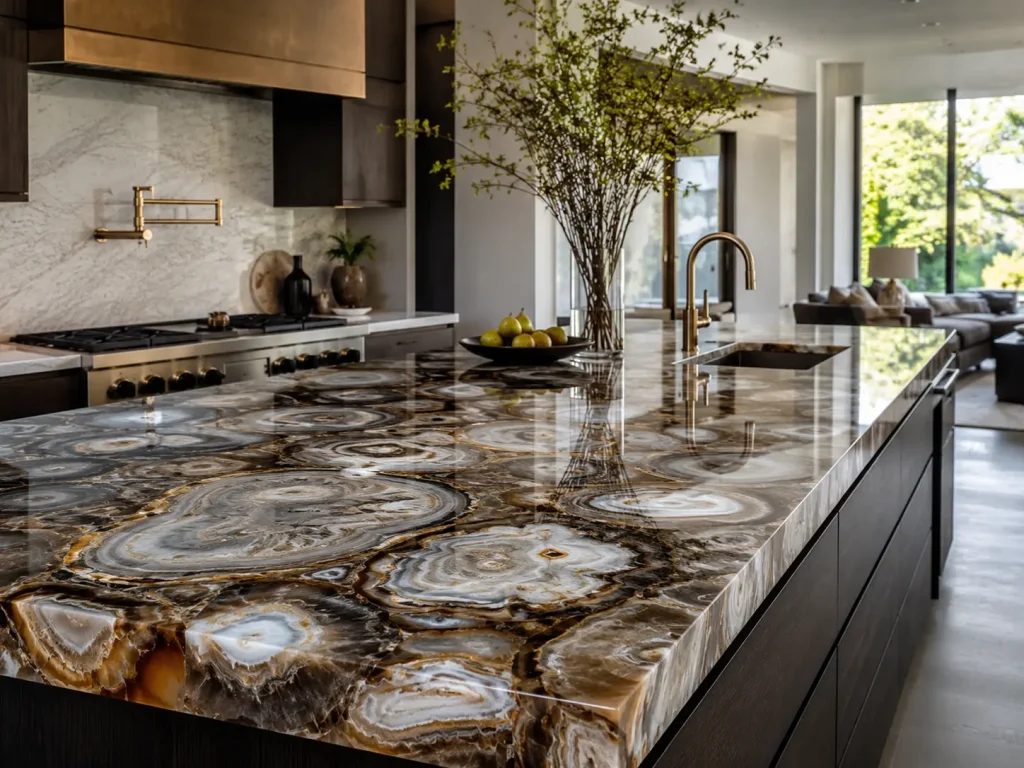
Agate can be used for kitchen islands, but buyers should be honest about how the island will be used. If the island is mostly for serving, entertaining, wine display, breakfast seating, or visual impact, agate can be an excellent luxury choice. If the island is used for chopping, heavy cooking, hot cookware, acidic sauces, and rough daily use, granite or engineered quartz may be more practical.
This does not mean agate cannot be used in kitchens. It means agate should be used thoughtfully. In many premium kitchens, designers use agate as a feature island surface and choose quartz, granite, or porcelain for heavy prep zones. That combination protects both beauty and function.
Agate Countertops vs Granite, Quartz, Marble, and Granite Tiles
Agate vs Granite Countertops
Granite is usually more practical for heavy-use kitchens, outdoor counters, and commercial worktops. It has strong scratch resistance, heat tolerance, and long-term durability. Agate, on the other hand, creates stronger visual luxury, especially when backlit or used in feature areas.
If the buyer wants lower maintenance and everyday performance, granite is often safer. If the project needs a showpiece surface for a hotel bar, luxury vanity, or private villa island, agate may deliver higher design value. The right choice depends on whether the surface is mainly functional or emotional. Yes, countertops can be emotional. Designers have known this for years.
Agate vs Quartz Countertops
Engineered quartz countertops are consistent, non-porous, and easy to maintain. They are excellent for apartments, hotels, kitchens, and large commercial projects where repeatability matters. Agate countertops are more unique, artistic, and premium, but they require more careful inspection and project planning.
If your project needs large-scale standardized supply, quartz may be better. If your project needs a one-of-a-kind focal point, agate is stronger. For hotel chains, quartz works well in standard rooms. For flagship suites, presidential villas, bar counters, or luxury reception areas, agate can create a stronger brand impression.
Agate vs Marble Countertops
Marble offers classic beauty, but it is softer and more sensitive to acidic liquids. Agate generally has better scratch resistance than marble and a more gemstone-like effect. Marble is elegant and timeless; agate is dramatic and exclusive.
For bathroom vanities, both materials can work beautifully. For kitchens, both need care, but agate is usually harder while marble is more vulnerable to acid etching. The selection should depend on color preference, design intent, maintenance expectations, and supplier fabrication quality.
Agate vs Granite Tiles
Granite tiles are more practical for floors, stairs, outdoor paving, public areas, and heavy-traffic commercial spaces. Agate slab countertops are not usually chosen for floors or outdoor paving. They are selected for luxury counters, feature surfaces, wall panels, and backlit interiors.
| Material Option | Main Strength | Main Risk | Best Application |
|---|---|---|---|
| 마노 석판 카운터탑 | Luxury gemstone look and backlighting | High cost, resin seams, impact risk | Bars, vanities, reception counters |
| 화강암 조리대 | Strong daily-use durability | Less translucent visual effect | Kitchens and commercial counters |
| 석영 조리대 | Non-porous and consistent | Less natural uniqueness | Apartments, hotels, kitchens |
| 대리석 조리대 | Elegant veining | Acid etching and staining | Bathrooms and luxury interiors |
| 화강암 타일 | Durable and practical flooring | Grout lines and finish choice | Floors, stairs, outdoor paving |
For buyers comparing semi-precious stone with other natural stones, a material-focused resource on the advantages of agate slabs compared with natural stones can help clarify where agate is worth the investment and where more practical alternatives may be better.
Color and Design Options for Agate Slab Countertops
Blue Agate for Luxury Visual Impact
Blue agate is often selected for luxury bars, hotel reception desks, feature countertops, and backlit walls. It creates a cool, dramatic atmosphere and works well with brass, black metal, dark wood, glass, and modern lighting. In commercial hospitality projects, blue agate can become the material guests remember.
Pink Agate for Modern Homes and Boutique Interiors
Pink agate has a softer and warmer design language. It works well in modern homes, boutique hotels, powder rooms, feminine luxury interiors, spa spaces, and artistic countertops. It can feel romantic without becoming old-fashioned when paired with clean cabinetry, warm metal, and soft lighting.
For residential and boutique design ideas, a guide on pink agate slabs for modern home design can help buyers understand which tones and patterns are easier to apply in real interiors. Pink agate is not only decorative; when used correctly, it can support a softer luxury style that feels personal and high-end.
Green Agate for Nature-Inspired Luxury
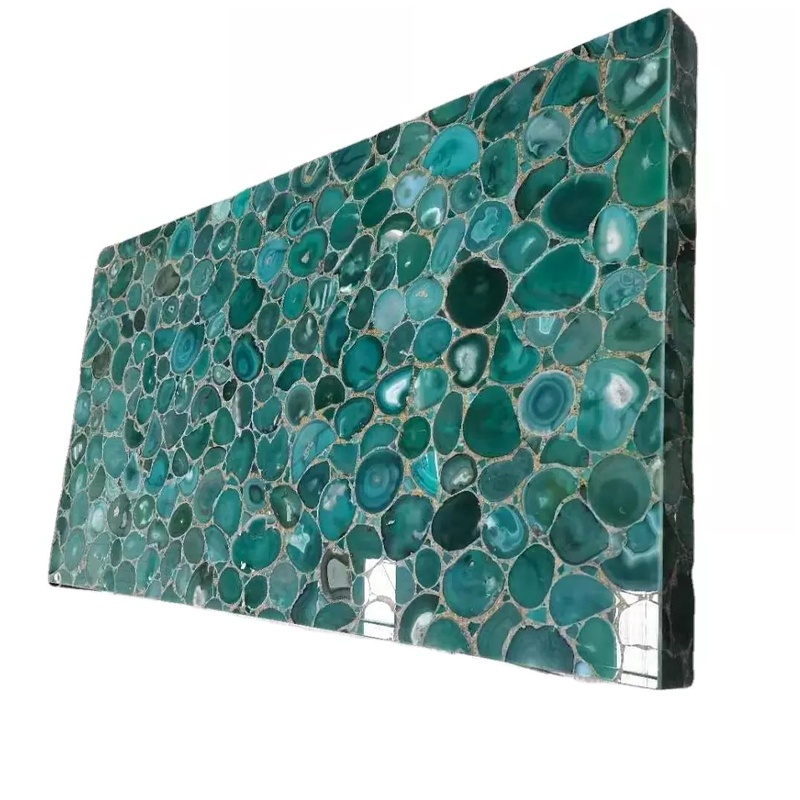
Green agate works well in spa interiors, luxury bathrooms, feature walls, reception counters, and hospitality projects that want a natural but premium mood. Its layered green tones can pair beautifully with cream stone, walnut wood, bronze metal, and warm lighting.
For buyers exploring natural color palettes, the design logic behind green agate slab applications is useful because green agate is not a standard neutral surface. It should be used where the design intentionally wants calm, depth, and gemstone character.
From Raw Stone to Finished Artwork
Agate countertops often feel closer to artwork than standard surfacing material. The final effect depends heavily on selection, layout, bonding, polishing, lighting, and edge fabrication. Two slabs with similar colors can look completely different after layout and lighting.
This is especially true for pink agate, where soft color transitions and banding need careful arrangement. A behind-the-scenes look at the transformation of a pink agate slab helps explain why workmanship is a major part of the final value. With agate, the factory is not just cutting stone; it is building a visual composition.
Technical Parameters to Ask Before Buying Agate Slab Countertops
Because agate slabs may include bonding and reinforcement, buyers should request more than simple size and price. For B2B projects, especially hotels, villas, restaurants, bars, and luxury apartments, the technical discussion should include thickness, resin type, backing structure, edge detail, lighting plan, packing method, and maintenance guidance.
| Project Use | Suggested Structure | Buyer Note |
|---|---|---|
| Bathroom vanity | 18–20mm or reinforced slab | Good for light to medium daily use |
| Bar counter | 20–30mm or reinforced build-up | Edge protection is important |
| Backlit counter | Translucent slab with lighting support | Lighting and access must be planned |
| Kitchen island | 20–30mm with strong support | Avoid unsupported overhangs |
| Reception desk | Reinforced slab and durable edge profile | Plan cleaning and visitor contact |
Ask the supplier whether the slab is suitable for backlighting, whether the resin is UV-stable, whether the backing is moisture-resistant, and whether the material can be cut safely for sinks, faucets, or lighting details. If the supplier cannot answer these questions, do not rush. Expensive stone should not be ordered with cheap information.
Common Mistakes When Buying Agate Slab Countertops
Mistake 1: Treating Agate Like Standard Granite
Agate is not simply another granite-style countertop. It is a semi-precious decorative surface, often made with resin bonding and reinforcement. It should be used where visual value matters and where proper care is realistic.
Mistake 2: Ignoring Resin and Backing Quality
The agate itself may be hard, but weak bonding or poor backing can reduce countertop stability. Always ask how the slab is made, what backing is used, and whether the construction suits your application.
Mistake 3: Using Agate in the Wrong Kitchen Zone
Agate can be beautiful in kitchens, but it is better for islands, serving zones, and design features than for rough food preparation. Use cutting boards, trivets, and proper cleaning methods.
Mistake 4: Not Planning Backlighting Correctly
Backlit agate needs LED placement, diffusion, color temperature, heat management, waterproofing in wet areas, and maintenance access. Poor lighting can make an expensive slab look patchy.
Mistake 5: Buying Without Actual Slab Photos
Agate is highly variable. Samples can help, but actual slab photos, videos, and dry layout approval are much more important. Never assume the final slab will look exactly like a small sample.
Maintenance Guide for Agate Slab Countertops
매일 청소
Clean agate countertops with a soft cloth, mild soap, and pH-neutral cleaner. Avoid acidic cleaners, abrasive powders, strong solvents, and rough pads. Wipe spills quickly, especially coffee, wine, oil, cosmetics, and colored liquids.
Heat Protection
Use trivets under hot pans, kettles, hair tools, or commercial equipment. The stone may handle moderate heat, but resin systems, backing, sealers, and adhesives may be more sensitive.
Stain and Surface Protection
Agate surfaces should be sealed or treated according to the supplier’s recommendation. Bathroom vanities and bar counters should be inspected regularly for moisture exposure, edge wear, and surface dullness.
Repair and Long-Term Care
Minor scratches or dull spots may be polished professionally. Deep cracks, edge chips, or resin issues should be repaired by specialists. Because agate is a high-value material, DIY repair is usually not the best idea unless your hobby is making luxury problems worse.
Why Buyers Choose Agate Slab Countertops
Buyers choose agate not because it is the cheapest countertop material, but because it creates a signature design effect. In luxury homes, boutique hotels, premium restaurants, and commercial reception areas, material emotion matters. Agate adds exclusivity, depth, color, and natural artwork value.
There are practical reasons too. Agate offers good hardness, a polished premium surface, strong decorative identity, and excellent backlighting potential. A detailed guide on why you should buy agate slabs countertops can support buyers who are evaluating both visual value and project return. For luxury projects, agate is not just a surface cost; it is part of the design story.
|
|
|


How to Choose an Agate Slab Supplier
A professional agate slab supplier should provide more than attractive photos. For project buyers, the supplier should support actual slab selection, layout confirmation, backing details, polishing quality, edge fabrication, cutout guidance, packing protection, and installation recommendations.
Before ordering, prepare the application area, slab size, thickness, edge profile, sink or faucet cutouts, lighting plan, expected traffic level, and maintenance expectations. A technical agate countertop project consultation can help prevent common sourcing mistakes, especially when the project involves custom fabrication, backlighting, or export delivery.
For B2B buyers, supplier reliability affects both cost and schedule. Ask for production photos, finished slab inspection, crate packing details, loading photos, and replacement or damage-handling policy. Agate is high-value and should be treated that way from factory to installation.
Buyer Decision Table: Are Agate Slab Countertops Right for Your Project?
| 프로젝트 요구사항 | Choose Agate If… | Consider Alternatives If… |
|---|---|---|
| Luxury bathroom vanity | You want gemstone beauty and moderate use | Budget and low maintenance are the only priorities |
| Hotel bar counter | You need a backlit statement surface | Heavy impact and rough service are expected |
| Kitchen island | It is mainly for display and light use | It is a heavy prep and cooking zone |
| Reception desk | First impression matters | The surface will face rough public abuse |
| Outdoor counter | Only with special evaluation | Weather exposure is high |
| Apartment project | Premium upgrade areas need visual value | Standardized repeatability is required |
| 바닥재 | Not usually recommended | Use granite tiles or porcelain instead |
| Budget project | Not the best fit | Use quartz, granite, or porcelain |
Final Recommendation: Durable, Yes — But Only for the Right Use
Agate slab countertops are durable enough for selected luxury applications when properly fabricated, supported, sealed, and maintained. They are especially strong for bathroom vanities, bar counters, reception desks, feature islands, backlit surfaces, and high-end interior design. Their value comes from the combination of hardness, beauty, translucency, exclusivity, and craftsmanship.
However, agate should not be sold as a universal heavy-duty countertop for every kitchen. If the project needs maximum abuse resistance, low maintenance, and standardized large-scale supply, engineered quartz or granite may be safer. If the project needs flooring, stairs, or outdoor paving, granite tiles or porcelain are usually more practical.
The best buying decision starts with application. Define how the surface will be used, how much heat or impact it may face, whether it needs backlighting, what edge profile is required, and whether the owner accepts normal stone care. Then choose the slab, backing, finish, and supplier accordingly. Agate is not for every project. But in the right project, it can be unforgettable.
|
|
|
FAQ About Agate Slab Countertop Durability
1. 마노 슬래브 조리대는 주방용으로 내구성이 있나요?
아게이트 슬래브 조리대는 적절히 제작되고 지지되며 밀봉되고 유지관리된다면 고급 주방 아일랜드와 가벼운부터 중간 정도의 주방 사용에 내구성이 뛰어날 수 있습니다. 이들은 무심코 사용하는 격렬한 조리 구역보다는 특징적인 표면, 서빙 아일랜드 또는 장식용 조리대 등으로 활용하는 것이 가장 좋습니다. 뜨거운 팬, 다듬기 작업, 산성 소스 및 무거운 조리기구가 자주 사용되는 바쁜 주방에서는 구매자들이 트라이베트, 도마를 사용하고 세심하게 청소하거나, 아게이트를 선택하기 전에 화강암 및 엔지니어드 석영과 비교해 보는 것이 좋습니다.
2. 마노 조리대는 쉽게 흠집이 생기나요?
마노 조리대는 일반적인 사용 환경에서는 쉽게 긁히지 않습니다. 마노는 석영 계열의 재료인 칼세도니와 관련이 있으며 경도가 뛰어나기 때문입니다. 그러나 완전한 스크래치 방지 효과를 보장하는 것은 아닙니다. 더 단단한 물체, 거친 조리기구, 연마제가 함유된 패드, 세라믹 제품을 사용하거나 무거운 물건을 표면 위로 끌어당기면 광택이나 수지가 채워진 부분이 손상될 수 있습니다. 표면을 보호하려면 도마를 사용하고 부드러운 청소용 천을 사용하며, 연마성 세제는 피해야 합니다.
3. 마노 조리대는 열에 강한가요?
아가테 자체는 많은 부드러운 장식용 석재보다 중간 정도의 열을 더 잘 견딜 수 있지만, 전체 조리대 시스템에는 수지, 백킹 재료, 접착제 및 실런트 등이 포함되어 있어 직접적인 열에 더욱 민감할 수 있습니다. 따라서 뜨거운 냄비, 헤어 스타일링 도구, 주전자 및 가열된 상업용 장비를 아가테 조리대에 바로 올려놓지 말아야 합니다. 트라이베트와 열 보호 패드를 사용하면 열 스트레스, 변색 또는 수지 관련 손상을 예방하는 데 도움이 됩니다.
4. 마노 조리대가 화강암 조리대보다 낫나요?
아게이트 조리대는 럭셔리한 시각적 효과, 보석 같은 색상, 반투명성 및 백라이트 디자인이 필요한 프로젝트에서는 화강암 조리대보다 우수합니다. 반면, 고강도의 주방 내구성, 낮은 유지보수 비용, 야외 사용 성능 및 일상적인 손상에 대한 강한 내구성을 필요로 하는 프로젝트에서는 보통 화강암 조리대가 더 적합합니다. 어떤 재료가 더 나은지는 사용 용도에 따라 달라집니다. 호텔 바, 욕실 세면대, 리셉션 데스크 등에서는 아게이트가 더욱 뛰어난 디자인 가치를 만들어낼 수 있습니다. 반면, 바쁜 주방이나 야외 카운터에서는 보통 화강암이 더 실용적입니다.
5. 마노 슬래브 조리대를 구매하기 전에 무엇을 물어봐야 하나요?
마노 슬래브 조리대를 구매하기 전에 실제 슬래브 사진, 동영상, 두께 상세 정보, 백킹 구조, 수지 종류, 연마 품질, 가장자리 프로필 옵션, 컷아웃 제한 사항, 열 노출 안내, 밀봉 권장사항, 백라이트 호환성, 포장 방법 및 설치 요령을 요청하세요. B2B 프로젝트의 경우, 건식 레이아웃 승인, 검사 사진, 수출용 크레이트 세부사항 및 명확한 생산 일정도 요청하여 소싱 및 설치 위험을 줄이세요.
참조
- “Chalcedony: Agate, Quartz and Jasper” — Encyclopaedia Britannica Editors — Encyclopaedia Britannica — Mineral Science Reference
- “The Mohs Hardness Scale and Chart for Select Gems” — International Gem Society Editorial Team — International Gem Society — Gemology Education Resource
- “Dimension Stone Design Manual” — Natural Stone Institute Technical Committee — Natural Stone Institute — Dimension Stone Design Manual
- “NSF/ANSI 51: Food Equipment Materials” — NSF Standards Team — NSF International — Food Equipment Standards Portfolio
- “ASTM C97/C97M Standard Test Methods for Absorption and Bulk Specific Gravity of Dimension Stone” — ASTM Committee C18 — ASTM International — Stone Testing Standards
- “ASTM C880/C880M Standard Test Method for Flexural Strength of Dimension Stone” — ASTM Committee C18 — ASTM International — Stone Testing Standards
- “Guide to Stone Countertops: Price, Installation, Maintenance, and More” — Better Homes & Gardens Editorial Team — Dotdash Meredith — Home Improvement Guide
- “Natural Stone Countertop Care and Maintenance Guidance” — Natural Stone Institute Education Team — Natural Stone Institute — Technical Resource Library
Ready Buyer Insight for Agate Slab Countertops
What should buyers understand first? Agate slab countertops are luxury semi-precious stone surfaces known for gemstone colors, banded patterns, translucency, and backlit design potential. They can be durable for selected interior applications, but they must be fabricated, supported, sealed, and maintained correctly.
Why does durability depend on more than stone hardness? Agate itself has good scratch resistance, but countertop performance also depends on resin bonding, backing structure, slab thickness, edge profile, cutout design, heat exposure, installation support, and cleaning habits. A hard stone can still fail if the slab system is poorly made.
How should agate be used? Use agate for bathroom vanities, luxury bar counters, reception desks, feature kitchen islands, backlit wall counters, and boutique hospitality interiors. Avoid using it as a careless heavy-duty prep surface unless the design includes proper protection, support, and maintenance expectations.
Option insight: Blue agate works well for dramatic backlit interiors. Pink agate supports warm boutique and residential design. Green agate creates a nature-inspired luxury mood. Mixed-color agate can become a strong signature material for bars, hotels, villas, and showrooms.
Consideration insight: Buyers should request actual slab photos, videos, thickness details, backing information, resin quality, edge options, lighting compatibility, packing photos, and cleaning recommendations before production. This is especially important for wholesale agate slabs, custom agate countertops, and export projects.
Recommendation: Choose agate slab countertops when the project values luxury impact, artistic uniqueness, and high-end visual identity. Choose granite, quartz, or porcelain when low maintenance, standardized supply, or heavy-use durability is the main priority.
If your project involves agate vanities, backlit counters, hotel bars, luxury islands, or custom reception desks, share the application area, slab size, edge profile, lighting plan, and maintenance expectations with a professional supplier before ordering. A project-based recommendation helps protect both design value and installation performance.