
빠른 요약
Lemurian Blue vs. Azul Bahia Granite 2026: Which Exotic Blue Stone Dominates Luxury Architecture?
The 2026 luxury stone market is being shaped by a clear shift away from anonymous grey surfaces and toward materials with geological personality. Designers want movement, optical depth, and a stronger emotional signature. That is why 레무리아 블루 화강암 그리고 아줄 바이아 화강암 have become the two most talked-about names in the blue-stone category. Both stones sit far above ordinary decorative materials because they offer rarity, visual force, and strong project identity.

The question is not whether they are beautiful. The question is which one is better for the intended architectural role. A backlit feature wall, a luxury hotel lobby, a yacht salon, and a statement kitchen island all demand different performance characteristics. In some settings, the optical “flash” of Blue Labradorite Granite is the defining advantage. In others, the deep pigment of Azul Bahia becomes the stronger design move.
At FOR U STONE, this comparison is treated as a sourcing and specification decision, not just a color preference. Buyers evaluating wholesale Blue Labradorite slabs, bulk exotic blue granite또는 맞춤형 블루 스톤 제작 need clear technical guidance, because the wrong choice can affect not only aesthetics but also installation, maintenance, and long-term satisfaction.
1. The 2026 “Blue Era”: Why Luxury Architecture is Pivoting to Exoticism
Luxury interiors in 2026 are moving toward materials that create visible energy instead of quiet neutrality alone. Blue, in particular, has become one of the strongest emotional colors in hospitality design. It signals calm, depth, prestige, and a certain level of controlled drama. That is one reason 블루 화강암 is now being specified more aggressively in premium projects than it was a few years ago.
This trend is not a passing mood. Developers are increasingly tired of monochromatic grey surfaces that blend into each other. They want what designers often call geological drama: stones that feel rare, natural, and memorable. The best examples of that shift are exotic blue granite materials with visible optical character or rich mineral pigment.

In this market, the role of a premium supplier is critical. A good 프리미엄 블루 스톤 공급업체 does not simply offer blocks or slabs. It helps determine which stone family fits the project’s lighting, use intensity, and brand identity. In a hotel lobby, for example, the right blue stone can become part of the property’s signature language. In a private residence, it can transform a kitchen island into the visual anchor of the entire interior.
That is why this discussion matters. Blue stones are no longer niche novelty products. They are architectural assets, and in many cases, they are now treated as investment-grade finishes.
2. Origin Intelligence: Madagascar’s Anorthosite vs. Brazil’s Sodalite
The first major difference between these stones is origin. 레무리아 블루 화강암 comes from Madagascar and is generally associated with labradorite-rich anorthosite systems. 아줄 바이아 화강암, by contrast, comes from Brazil and is known for its sodalite-rich mineral character and deep saturated blue pigment. That geological difference is what gives each stone its own visual and technical identity.
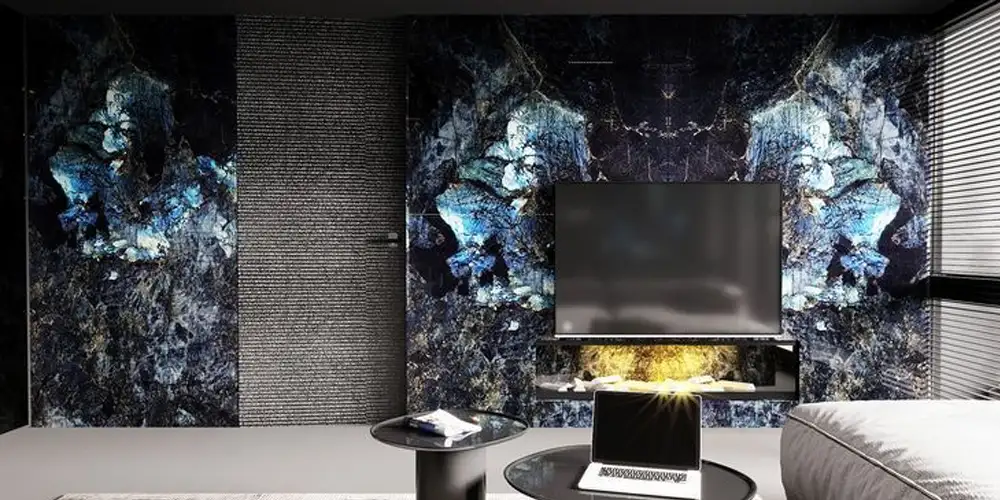
Madagascar’s Antsirabe region is especially important to the story of Lemurian Blue. The stone’s optical flash depends on large feldspar crystals formed by slow cooling and specific mineral layering. The result is a surface that can glow, flash, or shift depending on angle and light source. That is why a good Lemurian Blue Granite exporter must carefully manage crystal orientation and block selection before the slab is even cut.
Brazilian Azul Bahia, on the other hand, is prized for its pigment depth. The color is visually powerful even without lighting tricks. It can read as a strong, saturated blue that feels architectural and luxurious in a different way. For many designers, it is the better choice when they want richness of color rather than optical flash. For others, the luminous behavior of Madagascar Labradorite granite wins because it offers a changing experience rather than a fixed one.

Both origins are rare. Both require technical sourcing. And both benefit from a supplier who understands not only stone aesthetics but also quarry logistics, slab grading, and project sequencing. When buyers compare Lemurian Blue Granite vs Azul Bahia, they are really comparing optical drama to pigment depth.
3. Technical Specifications: The Quantified Engineering Hub
Beauty alone is not enough for commercial specification. Buyers need measurable performance data. The matrix below provides a practical comparison for 2026 procurement.
| 속성 | 레무리아 블루 화강암 (Labradorite) | 아줄 바이아 화강암 (Sodalite Syenite) | Testing Standard |
|---|---|---|---|
| 모스 경도 | 6.5 – 7.0 | 5.5 – 6.0 | 스크래치 방지 |
| 수분 흡수 | 0.05% – 0.12% | 0.15% – 0.25% | ASTM C97 |
| 밀도(kg/m³) | 2,750 | 2,600 | Structural Load |
| 압축 강도 | 190 – 210 MPa | 140 – 160 MPa | ASTM C170 |
| 내산성 | High (Quartz-based) | Moderate (Mineral-rich) | 24-Hour Test |
The technical verdict is straightforward. Lemurian Blue Granite hardness gives it a stronger advantage in high-traffic environments, especially where surfaces may be exposed to daily use, cleaning, and impact. That is one reason many designers prefer it over softer blue stones for kitchen countertops and public zones. It also explains why buyers of bulk Lemurian Blue tiles often plan these materials for floors, walls, and feature surfaces that must perform as well as they impress.
Azul Bahia remains exceptional, but its mineral behavior is different. It rewards deep color appreciation and luxurious visual impact. Lemurian Blue rewards interaction, light movement, and premium backlit effects. For many developers, that distinction defines the whole decision.
4. Visual Identity: The Battle of Light vs. Pigment
The most important visual difference is the one that buyers notice immediately. Labradorescence granite changes under light. It flashes. It responds. It creates the sense that the stone is alive. That is why a Lemurian Blue Granite slab can become the focal point of a room even before backlighting is added. With the right angle, the crystal “eyes” generate blue, green, gold, and silver reflections that make the material feel cinematic.
Azul Bahia works differently. Its power lies in saturation. It does not need to glow to dominate a space. Its deep pigment can carry a wall, countertop, or island with strong color authority. For non-lit surfaces, that is often enough. It is especially effective when the design brief calls for a rich, stable, luxury-blue expression rather than a shifting optical event.
The “scarcity of whiteness” also matters. In the best Lemurian selections, clean matrix and strong flash are not always easy to combine. The more visually balanced the slab, the more valuable it becomes. That is why premium blue Labradorite material with high flash intensity can command strong market interest in 2026.
For architects, the question becomes one of atmosphere. Do you want the stone to change with the room, or do you want the room to be anchored by a fixed field of pigment? That is the real difference between these two exceptional stones.

5. The “Granite” Misnomer: Mineralogical Truths for Professionals
Professionals know that naming in the stone trade is not always strictly geological. 레무리아 블루 화강암 is widely sold as granite, but it is more accurately described as an anorthosite or labradorite-rich stone. Azul Bahia is also technically closer to syenite or sodalite-bearing material than to classic granite. That does not reduce their value. It simply makes the naming more commercial than scientific.
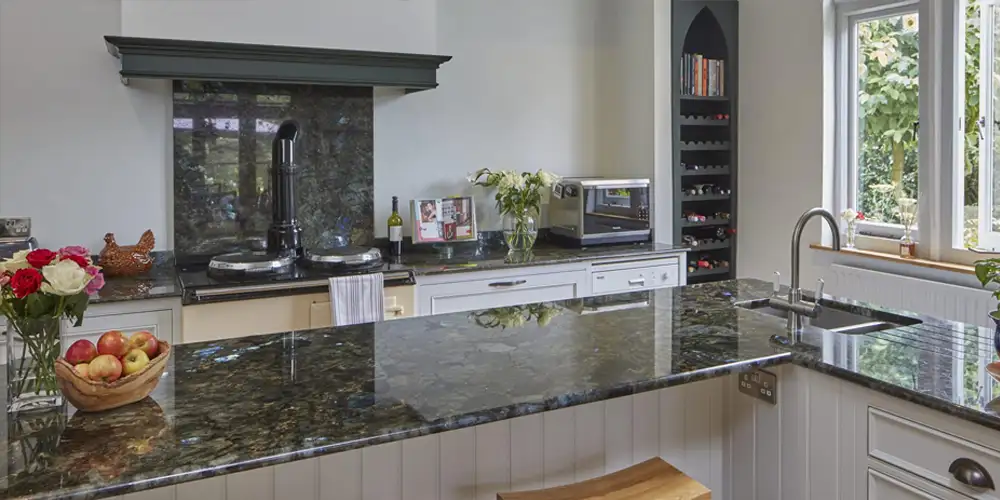
This matters because mineralogy affects performance. A more quartz-based stone usually behaves differently from a sodalite-rich one. Quartz contributes to hardness and chemical stability. Sodalite-rich material may offer dramatic color but can be more sensitive in certain environments. That is one reason Blue Labradorite Granite fabrication is often preferred for active commercial zones and kitchen use, while Azul Bahia may be selected for more controlled luxury environments.
In high-traffic 2026 commercial zones, the durability edge goes to Lemurian. That is why many buyers see it as the stronger long-term choice for floors, counters, and feature walls that must endure heavy use. Azul Bahia remains beautiful, but its strength is different: pigment and visual authority.
For buyers who want a stone that can perform as a real architectural material rather than just a visual accent, Blue Labradorite Granite is frequently the safer technical choice.
6. Real-World Scenarios: Where Each Stone Dominates
A backlit penthouse bar is one of the most effective use cases for Lemurian Blue Granite backlit applications. The optical flash becomes part of the room’s identity, especially when integrated with adjustable LED systems. In a setting like this, the slab behaves almost like a luminous mineral installation. That is why many designers prefer a backlit blue granite feature wall or bar front when the goal is to create a strong visual memory.
Azul Bahia, by contrast, is often extraordinary in a luxury yacht galley or a nautical-inspired suite. The deep blue pigment aligns naturally with water, marine themes, and refined coastal luxury. It reads as rich and confident without relying on backlighting. This makes it ideal for clients who want color depth and material presence more than optical flash.
For multi-room luxury developments, the decision may be hybrid. Some zones can use wholesale Blue Labradorite slabs for backlit statement pieces, while other zones can use Azul Bahia for pigment-rich counters or wall details. This approach lets developers build a layered blue story across a property rather than forcing one material to do every job.
To explore the product family directly, buyers may review 래브라도라이트 마다가스카르 화강암, 래브라도라이트 블루 화강암, 래브라도라이트 레무리아 블루 화강암 석판및 래브라도라이트 레무리아 블루 화강암.
7. 2026 Pricing Intelligence: The Economics of Rarity
Pricing is one of the strongest differentiators between the two materials. In 2026, the market for premium blue stone can range widely, with some wholesale slab programs landing between $800 and $2,500 per square meter depending on flash grade, slab size, finish, and export complexity. That is a boutique market, not a commodity market.
For Lemurian, the Lemurian Blue Granite price is tied closely to flash quality and slab yield. A slab with strong, even flash and good backlighting potential is much more valuable than one that looks flat or uneven. That means the cost is not just about size. It is about optical performance.
Azul Bahia follows a different logic. It is priced for pigment richness and visual depth. Buyers comparing Lemurian Blue Granite vs Azul Bahia should not expect identical cost structures, because one is a light-reactive stone and the other is a pigment-dominant one. Both can be expensive, but for different reasons.
For developers, the strategic move is often to work directly with the factory rather than through multiple layers of traders. A Lemurian Blue Granite manufacturer direct-factory price can reduce middleman markups and give buyers more control over slab selection, packing, and fabrication timelines. That is especially important when the order includes fragile premium material and a strict project schedule.
8. Manufacturing Excellence: The Factory Workflow
High-end blue stone is not simply cut. It is curated. In 맞춤형 블루 스톤 제작, the polish level, slab orientation, backing strategy, and edge treatment all affect the final result. A deep mirror finish can enhance the richness of Azul Bahia and amplify the flash behavior of Lemurian Blue.
For Lemurian, resin reinforcement and vacuum-sealing protocols are critical because the stone’s value is tied to both structural integrity and optical purity. If the slab is weakened during fabrication, the project loses both strength and beauty. That is why the best Blue Labradorite factory will think in terms of protection, not only production.
International shipping is another critical step. A reliable Lemurian Blue Granite exporter must ensure international crate safety, edge protection, and slab stabilization, especially for high-value, large-format stone. Damage during transit is not just a logistics issue. It is a quality-control failure that can erase the value of a premium slab.
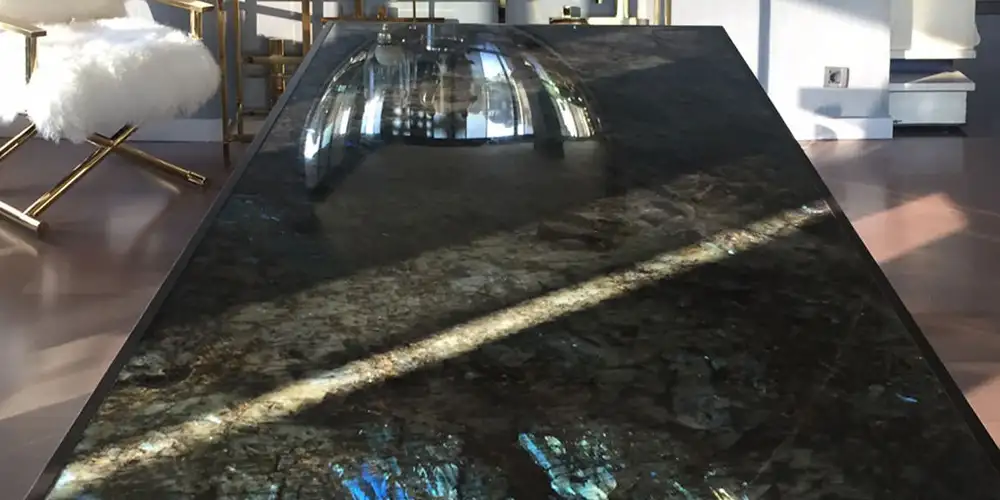
Buyers can also review related product categories such as 래브라도라이트 비앙카 화강암, 래브라도라이트 블루 화강암 테이블, 브라질리아 블랙 화강암 식탁및 그래니트 레무리안 블루 when planning broader material comparisons.
9. Installation and Structural Engineering
Installation is where most luxury stone projects either succeed or become expensive callbacks. For wholesale Blue Labradorite slabs, clear-set, high-polymer resins are often used because they support strong bonding while keeping the visual face clean. A dark adhesive can shadow through translucent sections and ruin the intended effect, especially on backlit applications.
Substrate engineering matters as well. A 30mm slab is heavy, and modern cabinetry or wall systems must be designed to carry the load safely. This is true whether the slab is used for a kitchen island, a bar front, a vanity, or a feature wall. The wrong support system can create stress points and long-term failure.
Sealing remains essential. Even with low absorption, nano-technologies can help preserve the <0.12% absorption performance and maintain the stone’s appearance over time. The goal is not to hide the stone’s character. It is to protect it while preserving the crystal effect that makes the material valuable.
For buyers asking about Lemurian Blue Granite outdoor use, the answer is generally yes when the climate, finish, and support detail are appropriate. However, outdoor use should always be validated against UV exposure, freeze-thaw conditions, and the exact installation environment.
10. Sustainability and ESG in Exotic Stone Sourcing
Today’s premium buyers increasingly want more than a beautiful stone. They want a responsible one. Sustainable sourcing, quarry transparency, packaging efficiency, and low-VOC materials all matter in modern specification. That is especially true for premium material imported across long distances.
FOR U STONE supports sustainable blue granite sourcing by tracking the quarry-to-project footprint and aligning procurement with clearer environmental documentation. Natural stone has a strong ESG argument because it is durable, repairable, and generational. When installed properly, it can serve for decades with minimal replacement pressure.
That matters for LEED v5 and similar frameworks because durable natural stone can support low-carbon, non-toxic luxury interiors. It is not a disposable surface. It is a long-life architectural material. For premium hotels and branded residences, that longevity is one of the strongest sustainability arguments available.
In other words, the environmental value of stone is not just in how it is mined. It is also in how long it remains in service.

11. 2026 Industry Forecast: The Future of Blue Stone
The next phase of the market is about digital certainty. Architects increasingly want digital slab twins so they can pre-install surfaces in VR before fabrication begins. That is especially useful for rare stone categories where slab matching, light response, and visual continuity are critical.
Supply is also tightening. By Q4 2026, many buyers expect “Madagascar Extra” yields to become even more limited, which means premium flash material may command stronger attention from the market. That is one reason buyers planning luxury projects should reserve early and confirm their grade family as soon as possible.
Custom blue stone fabrication is also becoming more standard. Developers want bespoke reception desks, monolithic vanity systems, yacht interiors, and signature island designs. This makes the role of the supplier more important than ever. A modern blue granite slabs supplier 그리고 blue granite tiles factory should be able to support both material quality and architectural interpretation.
For project buyers, the market signal is clear: blue stone is moving from decorative accent to core luxury language.
12. High-Intent Industry FAQ
1. Is Lemurian Blue Granite or Azul Bahia more durable?
In most technical comparisons, 레무리아 블루 화강암 is the more durable option because it has a higher Mohs hardness and stronger compressive performance. That makes it better for high-traffic applications, countertops, and commercial use. Azul Bahia remains a premium luxury stone, but its mineral profile is generally more sensitive. If durability is the primary requirement, Lemurian usually wins. If pigment depth and bold color are the priority, Azul Bahia may be the better aesthetic choice.
2. Why is wholesale Blue Labradorite Granite so expensive?
The price reflects rarity, flash quality, slab yield, handling risk, and export complexity. High-flash slabs are not easy to source because the best material depends on crystal orientation and visual return. In addition, the stone is fragile to transport, especially when sold as large-format premium stock. That is why wholesale Blue Labradorite slabs often command a boutique market price rather than a commodity one.
3. Can these stones be used for exterior cladding?
Yes, in many cases they can, but the application must be engineered correctly. Outdoor or facade use depends on climate, UV exposure, anchor design, slab thickness, and finish selection. Lemurian Blue Granite outdoor use is generally more straightforward because the stone is harder and denser. Azul Bahia can also be used externally when the project conditions are appropriate, but the team should confirm the exact slab family and installation method before committing.
4. How to identify a verified Lemurian Blue Granite manufacturer?
A verified manufacturer should be able to show real slab inventory, flash grading standards, crystal orientation knowledge, reinforcement methods, export packing systems, and project references. If the supplier cannot explain how it selects high-flash slabs or how it prepares them for backlighting, that is a warning sign. A real Lemurian Blue Granite manufacturer is not just a seller. It is a technical partner who understands optical stone behavior from quarry to crate.

5. What is the best blue stone for luxury hotels in 2026?
The answer depends on the design goal. If the hotel wants light-reactive drama, then Lemurian Blue Granite for luxury hotels is extremely compelling because it creates a memorable guest experience. If the hotel wants pigment depth and a more saturated, stable blue presence, Azul Bahia may be the better fit. Many luxury projects will use both: Lemurian for signature feature pieces and Azul Bahia for pigment-rich supporting zones.
13. Conclusion: The Final Verdict for 2026
There is no single winner in every blue-stone project. The right answer depends on whether the design needs interactive light or pigment depth. Lemurian Blue is the material for movement, flash, and optical theater. Azul Bahia is the material for saturated color and bold visual identity. Both are exceptional, but they solve different architectural problems.
For luxury developers, the strategic choice is often not “which stone is better?” but “which stone is better for this room, this brand, and this lighting concept?” That is the mindset that leads to stronger outcomes. It is also why buyers increasingly rely on experienced sourcing partners rather than generic stone sellers.
At FOR U STONE, this is where material selection becomes a service. Whether the project requires Lemurian Blue Granite countertops, a backlit blue granite feature wall, blue granite countertops customized for a luxury residence, or large blue granite wholesales programs for hospitality, the sourcing decision should be grounded in engineering, design, and supply-chain realism.

To master the light-bending science of Madagascar’s pride, visit 레무리안 블루 그라나이트 2026: 백라이트 럭셔리 기능을 위한 라브라도레센스 효과 완벽 가이드. For a broader context on blue natural stones, also review 2026년 럭셔리 건축을 위한 최고의 이색 블루 천연석 10선, 아줄 바히아 화강암: 2026년 럭셔리 주방 island를 위한 이국적인 브라질 명작및 10 Luxury Blue Stone Countertops You Should Buy for Kitchen and Bathroom.
Recommended Product Resources
Related Blog Recommendations
- 레무리안 블루 그라나이트 2026: 백라이트 럭셔리 기능을 위한 라브라도레센스 효과 완벽 가이드
- 2026년 럭셔리 건축을 위한 최고의 이색 블루 천연석 10선
- 아줄 바히아 화강암: 2026년 럭셔리 주방 island를 위한 이국적인 브라질 명작
- Top 8 Recommended Granite Colors to Match Interior Decoration Styles
- 10 Luxury Blue Stone Countertops You Should Buy for Kitchen and Bathroom
- Common Uses of Labradorite Madagascar Granite in Architecture and Decoration
- 모든 디자이너가 알아야 할 8가지 프리미엄 천연 화강암 및 규암 석재
Semantic Closure: How to Read the Blue Stone Market in 2026
What is the real difference between Lemurian Blue and Azul Bahia?
Lemurian Blue is about interactive light. Azul Bahia is about deep pigment. Both stones are premium, but they solve different design problems. Lemurian shines in settings where the material must move visually as the viewer moves. Azul Bahia shines in settings where the material must hold a rich blue field consistently.
Why does this comparison matter for luxury architecture?
Because the wrong stone can flatten a premium design concept. A hotel lobby, penthouse bar, or yacht salon should not feel generic. It should feel intentional. Choosing between optical flash and pigment depth is part of building that intentional experience.
Option: Which stone should be used where?
사용 레무리아 블루 화강암 for backlit feature walls, signature islands, illuminated bars, and spaces where motion matters. Use Azul Bahia for dramatic counters, luxury wall panels, and marine-inspired interiors where color saturation is the hero.
Consideration: What should buyers verify before ordering?
Buyers should verify flash grade, slab orientation, transmittance, reinforcement, crate protection, and export traceability. They should also confirm whether the factory can support Blue Labradorite Granite fabrication and project-level customization from raw slab to installed surface.
How does the 2026 market reward better sourcing?
The market rewards clarity. Clear provenance, clear grading, clear fabrication standards, and clear logistics produce better outcomes. That is why buyers are increasingly choosing specialist suppliers rather than generalized stone traders. In a boutique market, precision is the real value.
참조
- ASTM C97 / C97M — ASTM International — Standard Test Methods for Absorption and Bulk Specific Gravity of Dimension Stone.
- ASTM C170 / C170M — ASTM International — Standard Test Method for Compressive Strength of Dimension Stone.
- ASTM C880 / C880M — ASTM International — Standard Test Method for Flexural Strength of Dimension Stone.
- 디멘션 스톤 디자인 매뉴얼 — Natural Stone Institute — Technical reference for stone use and specification.
- Natural Stone Sustainability Standard — NSF / Natural Stone Council — Sustainability and responsible sourcing framework.
- Geology of Anorthosite and Labradorite Systems — Geological Society publications — Mineralogical reference.
- Optical Effects in Feldspar Minerals — Mineralogy reference literature — Labradorescence and crystal optics source.
- Natural Stone in Luxury Interiors — Architectural materials publications — Design and specification reference.
Frequently Asked Questions About Lemurian Blue vs. Azul Bahia Granite
1. Why is blue granite so expensive?
Blue granite is expensive because it is rare, visually distinctive, and often difficult to quarry and process in consistent quality. Stones like 레무리아 블루 화강암 그리고 아줄 바이아 화강암 require careful block selection, grading, and fabrication because the best slabs are not only beautiful but also structurally reliable. The market price rises when flash quality, pigment depth, and export logistics all align in a limited supply environment.
2. Which is more durable: Lemurian Blue Granite or Azul Bahia?
In most technical comparisons, Lemurian Blue is more durable because it has higher hardness and stronger compressive performance. That makes it better for high-traffic flooring, kitchen countertops, and many commercial applications. Azul Bahia remains premium and visually powerful, but its mineral profile is generally more sensitive. If durability is the priority, Lemurian usually wins.
3. Can these stones be used for exterior cladding?
Yes, both can be used externally when the project is properly engineered. For Lemurian Blue Granite outdoor use, the high hardness and low absorption are strong advantages, especially in ventilated facades or sheltered exterior zones. Azul Bahia can also work in cladding if the climate, finish, and anchoring details are correct. The final decision should be based on UV exposure, thermal cycling, and the exact installation method.
4. How do I verify an authentic Azul Bahia?
Start by checking quarry origin, slab family consistency, and color saturation under different light conditions. A genuine Azul Bahia should show strong blue pigment depth and stable visual character without looking artificially dyed or over-processed. Buyers should request actual slab photos, project references, and export documentation from a verified supplier. Transparency from the supplier is one of the best indicators of authenticity.
5. How do I find a verified Lemurian Blue Granite manufacturer?
Look for a supplier that can explain crystal orientation, flash grading, reinforcement, packaging, and shipping in technical detail. A legitimate Lemurian Blue Granite manufacturer should offer live slab inventory, clear grading logic, and realistic fabrication guidance. If the supplier can show real production stages and explain how it protects the stone during export, that is a strong sign of credibility.


