

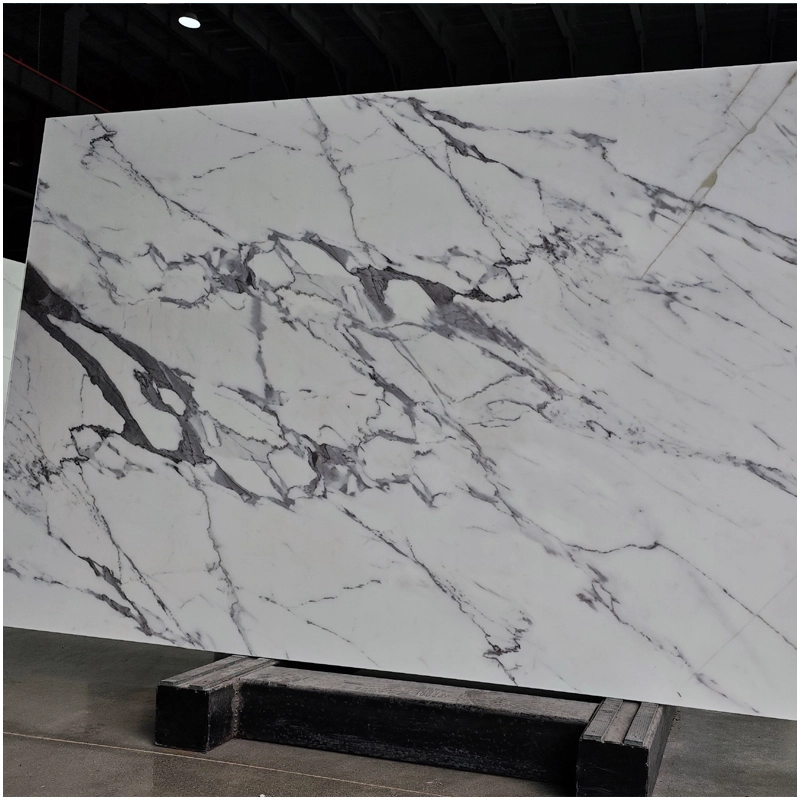
Why Black Marble Feels Risky—and Why It Works So Well
“Black marble? Won’t that make the room feel too dark?”
That is the hesitation many homeowners have right before they fall in love with it. They see a dramatic slab in a showroom or on a project board, admire the depth, the veining, the sheer authority of it—and then the practical voice kicks in. What if it shrinks the space? What if it feels too formal? What if it looks stunning in photos but becomes difficult to live with?
Those are fair questions. ブラックマーブル is not a background material. It is a decision. It changes how a room reads, how light behaves, and how every adjacent finish is perceived. Used poorly, it can feel heavy or theatrical in the wrong way. Used intelligently, it becomes one of the most effective tools for creating contrast, focus, and a sense of high-end permanence in modern interiors.
That is why this guide matters. The goal is not to convince you to put black marble everywhere like an overexcited show home. The goal is to show you where it works, why it works, and how to use it with enough restraint and confidence that the result feels bold, not forced. For readers who want brand context before the design talk, FOR U STONEについて explains that FOR U STONE is an experienced quarry owner, manufacturer, and exporter in China, with a long operating history, a broad natural-stone portfolio, and a project-oriented production capability that supports both residential and commercial work.
Why Black Marble Creates Instant Visual Authority
Black marble works because it does something few materials do well: it anchors a room immediately.
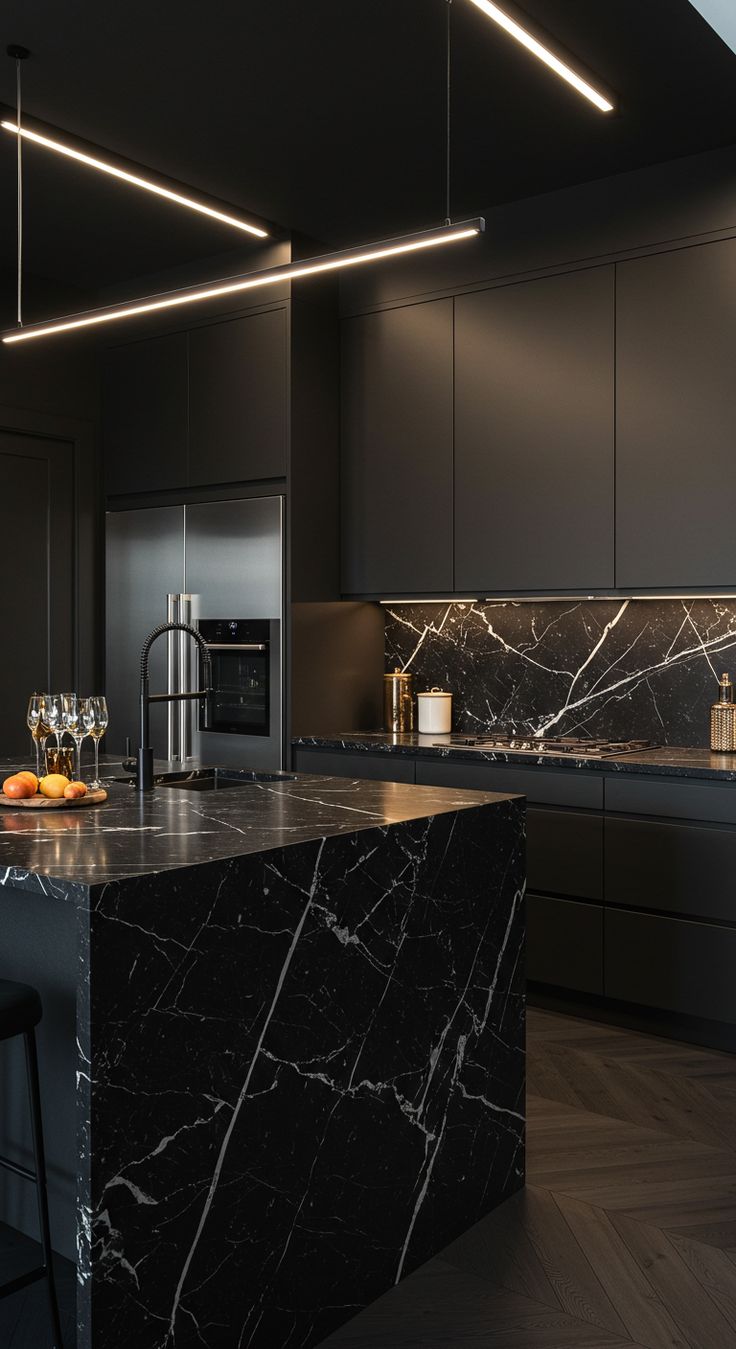
In design terms, dark stone creates weight. It tells the eye where to stop, where to focus, and what matters most. That is why designers use black marble for islands, fireplace walls, powder-room vanities, bar fronts, statement bathrooms, and sculptural feature walls. The contrast between a deep black background and expressive white, gold, or warm gray veining introduces structure and drama at the same time. Forustone’s own recent black-marble content repeatedly frames black marble as a material for contemporary spaces, high-end applied art, and luxury contrast-driven design, which fits exactly how it is being used today in premium interiors.
This is not just a showroom fantasy. Broader natural-stone research also supports the design logic. Architectural analysis of contemporary natural stone use highlights that stone selection is often driven by form, function, color, pattern, and texture working together, not just by durability alone. In other words, black marble is powerful because it performs materially and emotionally at the same time.
If you want to start from the widest product context, ビー玉 is the right overview page. It shows how black marble fits into a much broader marble portfolio, which matters because bold design choices usually work best when they are made with comparison in mind, not in isolation. Forustone also states on its marble overview that black marble is one of the core marble directions in its collection, alongside white, gray, and wooden marble options used across floors, walls, stairs, countertops, and other interior applications.
The Real Power of Black Marble Lies in Composition
The biggest mistake is not choosing black marble. The biggest mistake is treating it like a color instead of a composition tool.
Black marble is not paint. It is not a simple “dark finish.” It behaves differently depending on slab pattern, polish level, adjacent cabinetry, room size, ceiling height, lighting temperature, and what sits next to it. A black marble wall with fine white veining in a double-height foyer is a different creature from a black marble bathroom vanity in a low-light powder room. One feels architectural. The other can feel jewel-box intimate—if proportioned well.
That is where category pages become useful instead of decorative. The broader 大理石 collection helps you compare black marble not just against other black stones but against marble types overall. This matters because sometimes the boldest move is not choosing the darkest slab, but choosing the right level of movement, density, and contrast within the black-marble family. Forustone’s product structure also makes it clear that black marble is not a single look. It sits within a large marble system with many visual personalities and project directions.
Black Marble Works Best When You Control the Contrast
If you want black marble to feel expensive rather than oppressive, contrast is the game.
The easiest way to get this wrong is to pair black marble with too many competing dark finishes. A dark stone, dark wall paint, dark cabinetry, and weak lighting can flatten the room and turn elegance into visual congestion. The easiest way to get it right is to let black marble carry the drama while surrounding materials do supporting work.
That usually means one or more of the following:
-
warm wood tones to soften the severity
-
off-white or ivory walls to keep the room breathable
-
brass, bronze, or matte black metal used selectively
-
fewer patterns, but better ones
-
layered lighting that reveals the stone’s veining rather than burying it
そこで 大理石の色 becomes helpful as a planning tool rather than just a catalog page. Forustone states it offers a wide range of marble colors—over 300 options—so black marble should not be selected as a standalone gesture. It should be selected as part of a full color relationship inside the room.
Design psychology supports this too, even if many brands explain it badly. Forustone’s comparison between gray marble and black marble frames black marble as the side of modern luxury that conveys boldness, contrast, and authority, while gray brings calm and softness. That is a useful way to think about specification: black marble is not “better”; it is simply stronger in rooms that need a decisive focal point.
Where Black Marble Makes the Strongest Statement at Home
Not every space needs a black marble moment, but some spaces practically beg for one.
Kitchen islands and countertops
A black marble island is one of the cleanest ways to create a visual center in an open-plan kitchen. The stone reads as furniture, architecture, and sculpture at once. If the surrounding cabinetry is light oak, walnut, white lacquer, or matte taupe, the contrast becomes even more effective. Forustone’s 黒い大理石のカウンタートップ:アドバイスとデザインのアイデア page specifically notes how black marble countertops sharpen contrast with lighter cabinetry and create a highly modern effect that other stones struggle to match.
Bathrooms and powder rooms
Bathrooms are where black marble can go from “bold” to “cinematic.” Vanities, shower walls, niches, or even a single feature wall can create a hotel-grade impression without needing a huge footprint. Because these are more controlled spaces, they can tolerate stronger drama than large multi-function family rooms.
Fireplaces and feature walls
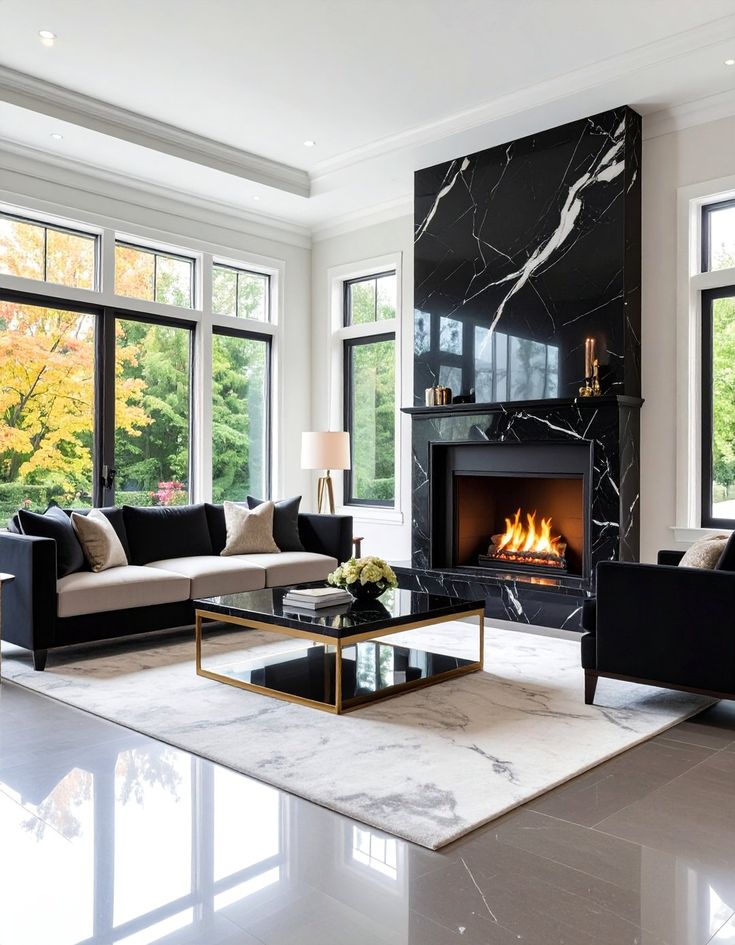
For homeowners who want one unforgettable visual move, black marble around a fireplace or full-height behind a media wall is often enough. The trick is to keep the surrounding materials calmer so the marble reads as the event, not just one loud thing among many.
Entryways and stair landings
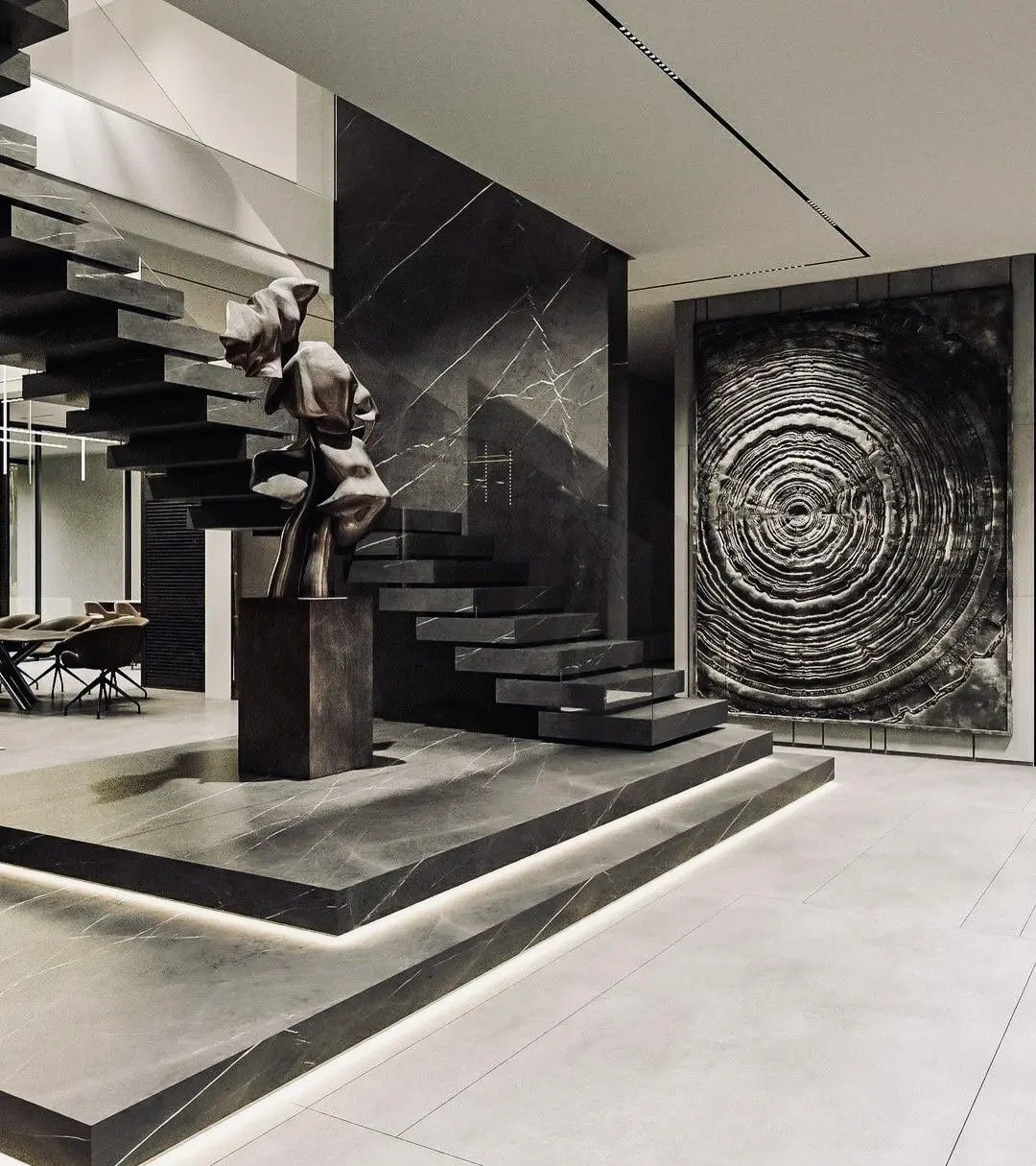
A modest application in an entry foyer or stair wall can immediately establish tone. You do not need a giant room. You need a controlled surface, proper lighting, and a stone that deserves the spotlight.
The point is not to use black marble everywhere. The point is to use it where it can actually command attention. That design logic is reflected clearly in ブラックマーブル・シリーズ, where Forustone groups a range of black-marble options including Nero Marquina, Portoro, Black Ice, and black-and-white variants that suit different levels of drama and veining intensity.
|
|
|
A Practical Room-by-Room Guide to Using Black Marble Boldly
| 部屋 | Best Use of Black Marble | なぜうまくいくのか | Watch Out For |
|---|---|---|---|
| キッチン | Island, backsplash, countertop, waterfall edge | Creates a strong central focus and sharp contrast | Too much gloss with poor lighting can feel heavy |
| バスルーム | Vanity top, shower wall, feature slab wall | High drama in a compact footprint | Needs balanced light and thoughtful finish selection |
| リビングルーム | Fireplace, media wall, coffee table top | Adds permanence and architectural depth | Avoid layering too many competing dark materials |
| Entryway | Accent wall, console top, flooring insert | Delivers immediate luxury and visual identity | Keep adjoining finishes quieter |
| Dining Area | Statement wall or buffet top | Elevates hospitality feel and formal tone | Needs warmth from wood, fabric, or light |
The broader argument for using natural stone in these zones is not only aesthetic. Natural stone organizations and sustainability-focused stone producers consistently argue that stone offers longevity, low VOC emissions, and durable service life in interior use, which is one reason it remains relevant in high-end design despite waves of trend materials. Polycor, for example, describes natural stone as durable, low carbon, VOC free, reusable, and recyclable, while Use Natural Stone emphasizes longevity and long-term performance as major reasons professionals continue to specify it.
A Forustone-Style Case Scenario: When Black Marble Becomes the Hero
Imagine a modern villa living room with pale oak flooring, warm greige walls, a low-profile cream sofa, bronze lighting accents, and a fireplace that currently disappears into the wall. The room is well proportioned, but forgettable. Nothing holds the eye. Nothing signals confidence.
Now replace that blank fireplace wall with a bookmatched black marble slab with crisp white veining. Suddenly the entire room organizes itself around a focal point. The pale wood feels warmer. The cream upholstery feels richer. The bronze lighting stops looking decorative and starts looking intentional. The room has not become darker; it has become more coherent.
This is exactly the kind of move Forustone’s recent black-marble resources are pushing toward. The Perfect Application of Black Marble Slabs in Contemporary Spaces そして High-End Applied Art of Black Marble Slabs both frame black marble as a material that shapes atmosphere as much as function. That is the right lens. Black marble is not just a cladding choice. It is an atmosphere-setting instrument.
Black Marble vs. Gray Marble: Which One Gives More Power?
This comparison matters because many homeowners are not really choosing between “black marble or no marble.” They are choosing between different kinds of luxury.
Gray marble is usually easier, softer, and more accommodating. It reflects more light, enlarges rooms visually, and plays well with quiet-luxury palettes. Black marble is bolder, more intentional, and more commanding. It creates focal points faster and with less surface area. That is why 灰色大理石と黒大理石の比較 is such a useful comparison page. Forustone’s own summary is blunt and accurate: gray brings calm sophistication, while black anchors rooms with contrast and authority.
So which one should you use?
Use black marble when the room needs definition, drama, or a premium signature. Use gray marble when the room needs calm, openness, or softness. The mistake is assuming boldness is automatically better. Boldness only works when the room actually benefits from it.
|
|
|


The Practical Pain Points—and How to Avoid Them
This is where the “beautiful headache” fear usually lives. Not in the marble itself, but in the way people specify it poorly.
Pain point 1: The room feels too dark
解決策 use black marble on one major surface, not every surface. Pair it with lighter walls, timber, or soft upholstery.
Pain point 2: The stone looks too formal
解決策 bring in texture. Bouclé chairs, oak cabinetry, linen drapery, or brushed metal can humanize the stone.
Pain point 3: It feels risky in family spaces
解決策 choose the location intelligently. A fireplace wall, vanity top, or backsplash may offer more visual reward and less stress than full flooring.
Pain point 4: The finish is wrong for the use
解決策 follow use logic. Forustone’s gray-vs-black comparison includes a simple but useful rule: polished finishes often work best on vertical show surfaces, while honed or leathered finishes can be better on horizontal tops and wet-adjacent areas because they hide wear more effectively.
This is also where professional standards matter. The Natural Stone Institute’s ASTM resource reminds specifiers that physical properties such as flexural strength and finish suitability are not decorative details; they are part of appropriate stone application. If you are using black marble in a demanding zone, specification quality matters just as much as visual taste.
How Black Marble Fits Into Residential Design, Not Just Luxury Fantasy
One of the best ways to make black marble feel believable is to stop imagining it only in penthouses and hotel lobbies.
It works in real homes when it is integrated into real domestic functions: kitchen islands, bathroom tops, fireplace surrounds, stair walls, or statement dining elements. That is why Marble Application in Residential Projects is such an important part of this topic. Black marble becomes easier to specify when you stop thinking of it as a “special occasion” material and start viewing it as one member of a larger residential marble strategy. Forustone’s residential-application page explicitly presents marble as a practical interior material for kitchens, bathrooms, feature walls, fireplaces, and pillars, which aligns well with how black marble should be used at home: selectively, strategically, and with confidence.
For homeowners or designers who are already narrowing down slabs, finish choices, or project applications, お問い合わせ FOR U STONE is the natural next step. The contact page positions FOR U STONE as a leading Chinese manufacturer and factory for natural marble and related products, which fits the needs of buyers who are moving from inspiration into specification and supply.
よくある質問
Is black marble a good choice for small rooms?
Yes, if it is used with discipline. In small rooms, black marble often works best as one focal surface—such as a vanity wall, backsplash, or fireplace surround—rather than an all-over treatment. Good lighting and contrast with lighter materials keep it from feeling cramped.
Does black marble make a home look more luxurious?
Usually yes. Black marble naturally introduces contrast, weight, and visual authority, which are all qualities associated with premium interiors. The key is not overusing it. One well-placed black marble application often feels more luxurious than an entire room full of stone.
Is black marble hard to maintain?
Like any natural marble, it needs sensible care and proper sealing, especially in active kitchens or wet areas. Maintenance is manageable, but specification and finish choice matter. Many designers prefer more forgiving finishes on work surfaces and polished finishes on vertical show surfaces.
Where should black marble be used first in a home?
The safest high-impact starting points are kitchen islands, bathroom vanities, fireplace surrounds, and statement walls. These applications allow black marble to do its visual work without overwhelming the whole house.
How do I keep black marble from feeling too heavy?
Balance it with warmth and light. Pale wood, soft neutrals, layered lighting, and restrained hardware choices all help black marble feel sophisticated instead of severe.
Why Black Marble Still Defines Bold Luxury at Home
The homeowner at the beginning was not really asking whether black marble looked beautiful. They were asking whether boldness could be elegant instead of risky.
That is the real answer black marble gives when it is used well. It shows that contrast does not have to mean chaos, and drama does not have to mean excess. In the right place, ブラックマーブル brings structure, confidence, and a sense of lasting value that lighter materials often cannot deliver on their own.
For homes that feel too safe, too pale, or too visually polite, black marble can be the move that changes everything. Not because it is loud, but because it knows exactly where to be quiet—and where to speak with authority.
参考文献
-
Natural Stone Institute. Dimension Stone Design Manual.
-
Natural Stone Institute. Which ASTM Standards Are Relevant to Natural Stone.
-
Polycor. How Stone Is Sustainable.
- FOR U STONE. ビー玉.
-
Polycor. The Impact of Natural Stone Building Materials on Sustainability and the Environment.
-
Polycor. Building Sustainably with Natural Stone: How Stone Secures LEED Credits.
-
Use Natural Stone. Natural Stone Versus Manmade Materials for Interiors.
-
Use Natural Stone. Using Natural Stone in Biophilic Design.
-
Sustainability. The Use of Natural Stone as an Authentic Building Material and Sustainable Design Resource.
-
Heritage. Heritage-Inspired Strategies in Interior Design: Balancing Identity, Materiality, and Contemporary Space.


