

A Conversation That Happens Right Before a Room Becomes Memorable
“We want the bathroom to feel more refined, but not too cold.”
“We love marble, but full slabs everywhere might feel too formal.”
“Can we add texture, pattern, and something more personal without making the space look busy?”
That is exactly where 大理石モザイク start to make sense. In modern homes, they are not just decorative extras. Used well, they become the bridge between luxury and livability. They can soften a hard bathroom, make a backsplash feel curated instead of generic, add visual rhythm to a shower wall, or turn a quiet powder room into the part of the house guests actually remember. As design preferences shift toward warmth, texture, and layered natural materials, mosaics fit the moment unusually well. The 2025 U.S. Houzz Bathroom Trends Study, based on 1,737 U.S. homeowners renovating or planning bathroom renovations, shows continued interest in natural materials and spa-like spaces, while NKBA’s 2025 Bath Trends Report highlights “calm, warm, and natural – but still bold” as a defining direction in bath design.
That is why homeowners are increasingly looking beyond plain field tile and asking where 大理石モザイク can add both personality and function. A supplier like フォー・ユーストーン becomes relevant here because the company is not just selling surface material; its public company information presents it as an experienced quarry owner, natural stone manufacturer, and exporter in China, while its broader site content highlights large-scale production capacity, marble inventory, customized processing, and ongoing project support for residential and commercial applications.
Why Marble Mosaics Work So Well in Today’s Homes
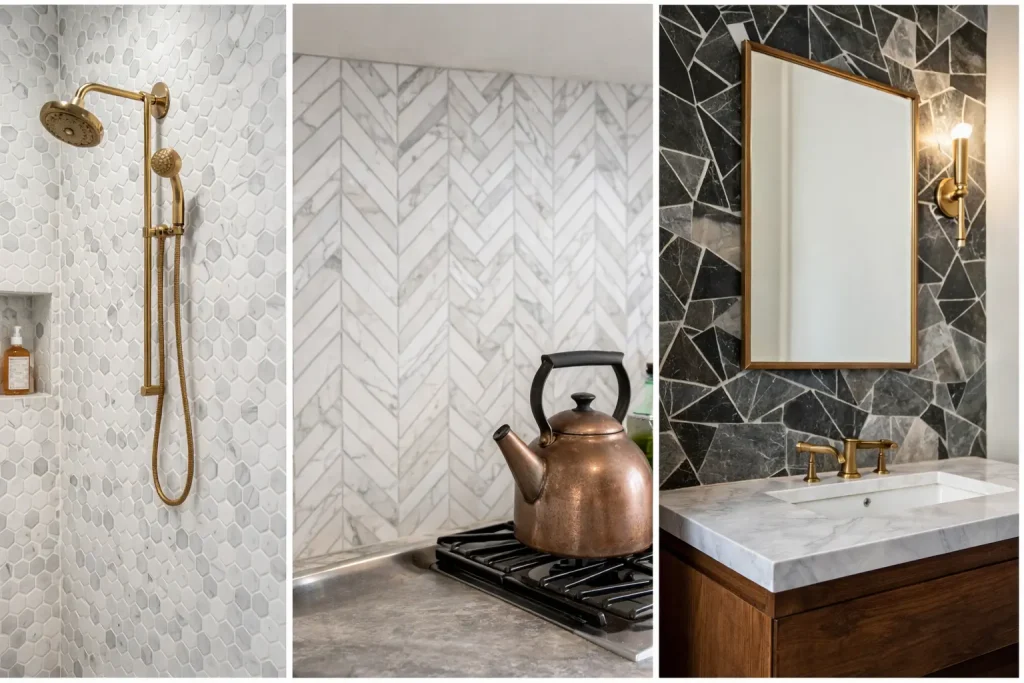
The appeal of marble mosaics is not hard to understand. Full marble slabs give you scale and drama; mosaics give you texture, movement, and detail. They allow a designer or homeowner to introduce natural stone in smaller modules, which makes them ideal for areas where pattern, surface grip, edge treatment, or visual layering matter.Is marble coverage continues to frame marble as a material that remains relevant across historical and contemporary interiors, while more recent design commentary also shows how smaller modular surfaces can add character without overwhelming minimalist spaces.
There is also a practical side. Small-format mosaics are often preferred in wet or irregular areas because they can adapt more easily to curves, slopes, and detailed layouts than large rigid pieces. The Natural Stone Institute’s wet-area guidance emphasizes that stone used in showers and other wet environments must be considered in relation to porosity, waterproofing, soundness, slope, and detailing. Meanwhile, Related slip guidance notes that decorative mosaics can benefit from smaller tile size and more grout joints, which may improve drainage and traction depending on the surface and application.
That dual advantage—beauty plus application flexibility—is exactly why 大理石製品 and curated stone collections remain such an important part of project planning. It is not only about finding a color. It is about choosing a stone language that can move from feature wall to vanity, from accent strip to shower floor, from decorative insert to full interior story. FOR U STONE’s marble category and broader site structure show that mosaics are treated as part of a larger marble ecosystem rather than a decorative afterthought.
Where Marble Mosaics Belong in a Home
The most common mistake with mosaics is using them everywhere at once. That usually ends badly. The better approach is to place them where texture, pattern, or refined contrast can do real design work.
In bathrooms
Bathrooms are still the strongest natural home for marble mosaics. This is partly aesthetic and partly technical. Mosaics can make shower floors feel safer and more visually interesting, create a softer transition between wall and floor, or bring a custom feel to niches, vanity walls, and tub surrounds.Is bathroom trend reporting and bath image libraries continue to show strong use of stone tile and mosaic surfaces in luxury-oriented bath spaces.
In kitchens
Kitchens benefit from mosaics differently. Here, the value is usually in the backsplash, the range wall, a bar niche, or a smaller focal area where texture can add depth without fighting the countertops. In 2025–2026 trend coverage, Notes that natural stone continues to appear strongly in new tile collections, particularly materials like marble, limestone, and travertine. That aligns well with backsplash applications where homeowners want something more tactile and custom than a flat standard tile field.
In powder rooms and entry details
Powder rooms are where you can be bolder. Because they are smaller and less visually repetitive, they tolerate richer pattern, stronger contrast, and more expressive mosaic layouts. They are ideal for geometric marble mosaics, waterjet forms, framed mirror walls, and decorative wainscoting details. The best powder rooms feel deliberate, and mosaics help create that “someone actually designed this” effect. Is powder-room inspiration pages show how often mosaic surfaces are used precisely for that reason.
This is where a broader stone source like ビー玉 becomes useful. Once homeowners see mosaics not as standalone products but as part of a complete stone palette, it becomes much easier to coordinate background stone, accent mosaic, trim, and larger architectural surfaces into one consistent interior story. FOR U STONE’s site content presents marble as suitable for flooring, wall cladding, stairs, vanity tops, tables, and more, which supports exactly that kind of layered design approach.

How to Choose the Right Marble Mosaic Style
Not all marble mosaics do the same job. Some are geometric and structured. Some are soft and decorative. Some are best for floors. Some are better for vertical accents. The trick is to match the mosaic logic to the room logic.
| Design Goal | Best Marble Mosaic Direction | Where It Works Best | What to Watch |
| Add texture without heavy contrast | Soft white or beige mosaics | Bathroom walls, kitchen backsplashes | Keep grout tone quiet |
| Make a small space feel custom | Waterjet or patterned mosaics | Powder rooms, vanity walls, framed panels | Avoid using it on every wall |
| Improve visual grip in wet zones | Smaller-format floor mosaics | Shower floors, wet-room transitions | Confirm slip suitability and slope |
| Introduce luxury through detail | Marble inlays, borders, medallions | Entry floors, niche surrounds, vanity zones | Balance with calmer surrounding surfaces |
| Create a feature with natural stone | High-contrast mosaics | Fireplace details, statement walls, bar areas | Let other materials stay restrained |
The product choice should follow three questions.
First, is the mosaic mainly decorative or also functional?
Second, will it sit next to larger marble surfaces or stand alone?
Third, is the room asking for calm texture or visible pattern?
These questions matter because in wet areas and high-use spaces, beauty alone is not enough. The Natural Stone Institute stresses that natural stone in kitchens and baths requires proper expectation-setting around performance, maintenance, and application suitability. Its consumer-care guidance also recommends neutral cleaners, mild soap solutions, and careful maintenance practices rather than harsh chemicals.
This is one reason 大理石タイル・モザイク are such a useful category rather than a random aesthetic add-on. FOR U STONE’s mosaic product content positions them as part of a manufacturing and supply solution, which is important for buyers who need repeatability, project coordination, and not just pretty sample photos.
The Biggest Design Mistakes to Avoid
Marble mosaics are forgiving in some ways, but they are not magic. A bad choice still looks bad—sometimes expensively bad.
Mistake 1: Using mosaic on every visible surface
This usually makes the room feel nervous. Mosaics should create a focal rhythm, not visual static. The best interiors give them space to breathe.
Mistake 2: Ignoring grout as part of the design
Grout is not a background technician; it is part of the final visual result.Is grout guidance makes clear that grout joints accommodate tile variation and plane changes, which is practical, but visually it also means grout width and color influence the entire mosaic effect. Too much contrast can make an elegant mosaic feel harsh.
Mistake 3: Treating wet-area mosaic like ordinary wall décor
In showers or other wet zones, slope, drainage, soundness, substrate prep, sealant placement, and waterproofing details all matter. Natural Stone Institute wet-area resources stress these requirements clearly, and movement-accommodation guidance in tile practice also matters where surfaces meet at corners or perimeters.
Mistake 4: Choosing pattern before choosing stone tone
A beautiful shape cannot rescue the wrong marble color. Stone tone should be chosen based on the room’s light, cabinetry, metals, and adjacent surfaces first. Pattern comes after.
That is why educational content like The main uses of marble mosaics is useful. FOR U STONE’s mosaic guidance frames marble mosaic as suitable for floors, walls, and multiple decorative surfaces, but that does not mean every pattern belongs in every location. The smart move is to match use-case, scale, and stone character instead of assuming “if it fits, it works.”
How to Blend Marble Mosaics with the Rest of the House
Good mosaic design is about coordination, not isolation. A mosaic backsplash should speak to the countertop. A shower-floor mosaic should relate to the wall tile. A powder-room feature should still make sense when the door is open and the room is viewed from the hallway.
A practical rule is this:
- pair expressive mosaics with quieter field materials
- pair softer mosaics with richer cabinetry or metals
- repeat one color note from the mosaic elsewhere in the room
- avoid stacking too many patterns in the same sightline
This is where FOR U STONE’s content strategy actually helps. The brand has not treated marble mosaics as an isolated niche. Its public-facing material library and product coverage suggest a project-oriented mindset—stone families, application ideas, manufacturing capability, and practical guidance all sit in the same ecosystem. That makes it easier for buyers to move from inspiration to specification without losing coherence.
And when you get into layout, cutting, edging, and pattern execution, Techniques and tips of FOR U STONE’s marble mosaics becomes especially relevant. That article emphasizes precision cutting, layout planning, and installation awareness—exactly the unglamorous details that separate an elegant mosaic wall from one that looks slightly off forever.
A Simple Room-by-Room Strategy
If you want a clean decision process, use this:
バスルーム
Choose marble mosaics for shower floors, niches, vanity backs, or one feature wall. Let the rest of the bathroom stay calmer.
キッチン
Use mosaic behind the range, across a backsplash band, or inside a coffee/bar niche. Do not crowd it with too many competing countertop patterns.
Powder Room
This is the room to take the risk. Use stronger shapes, richer tones, or decorative mosaic framing because the smaller size helps the design feel intentional rather than overwhelming.
Entry or Stair Landing
Use mosaic as an inset, border, or decorative focal moment—not as a carpet substitute made of stone. It should elevate the architecture, not imitate another material.
Fireplace Wall or Decorative Panel
Use marble mosaic when you want subtle dimensionality rather than one large uninterrupted slab. This works especially well in spaces that need texture more than veining drama.

Five Questions Homeowners Commonly Ask About Marble Mosaics
Are marble mosaics good for shower floors?
Yes, often very good—provided the material, finish, slope, and installation method are right. Smaller-format mosaics can help accommodate floor slope and, in many cases, provide better traction because of the increased grout-joint frequency. But the surface finish, waterproofing details, and wet-area suitability still need to be checked carefully.
Do marble mosaics require more maintenance than regular tile?
They can require more attention than a simple ceramic field tile because natural stone has its own care requirements and mosaics introduce more grout joints. The good news is that Natural Stone Institute care guidance recommends straightforward routines: neutral cleaners, mild soap, proper rinsing, and avoiding harsh chemicals.
Where should I use marble mosaics in a kitchen?
The most successful areas are usually backsplashes, range walls, bar zones, or smaller statement sections. In kitchens, mosaics work best where they can add depth and texture without taking over every visible surface.
Are marble mosaics too traditional for modern interiors?
Not at all. They feel dated only when the pattern, color, or installation style is outdated. In modern interiors, simpler geometric mosaics, tone-on-tone marble mosaics, or refined waterjet patterns can feel highly contemporary, especially when paired with cleaner cabinetry and restrained finishes.
Should I buy marble mosaics from a general tile seller or a stone specialist?
For project-level results, a stone specialist is usually safer. Marble is not just a color; it is a natural material with variation, fabrication needs, and application-specific considerations. A supplier that understands marble selection, matching, finishing, and coordinated project supply can usually help you avoid far more problems than a seller focused only on style names.
The Real Secret: Marble Mosaics Work Best When They Solve Something
At the beginning, the homeowner wanted something refined but not cold, textured but not chaotic, luxurious but still livable.
That is the real role of 大理石モザイク in home design. They are not there just to decorate empty walls. They work best when they solve something: when a shower floor needs more grip and more beauty, when a backsplash needs texture without visual heaviness, when a powder room needs identity, or when a space needs detail that slabs alone cannot deliver.
In other words, mosaics are most powerful when they are doing design work, not just filling area.
That is also why supplier choice matters. A project goes more smoothly when the source understands stone beyond the catalog page—material variation, fabrication precision, use-case logic, maintenance expectations, and how mosaic fits into a larger interior palette. FOR U STONE has built a helpful public content trail around those decisions, and that makes it easier for buyers to move from vague inspiration to something buildable. When the time comes to turn ideas into selections, the sensible next step is to お問い合わせ FOR U STONE and start with the room, the lighting, and the use-case before falling in love with the first pretty pattern.
参考文献
- FOR U STONE official materials, including company information, marble collections, marble tile mosaics, and mosaic-use/technique articles.
- Houzz Research, 2025 U.S. Houzz Bathroom Trends Study(survey of 1,737 U.S. homeowners).
- NKBA, 2025 Bath Trends Report.
- Houzz, 4 Trends in New Tile Products for 2025.
- ArchDaily, From Monumental Ruins to Lavish Interiors: 18 Projects That Prove Marble Is a Timeless Material.
- ArchDaily, Enriching Minimalism Through Pixel-Type Ceramics and Oversized Marbles.
- Natural Stone Institute, Marble, Onyx, & Serpentineand related kitchen/bath guidance.
- Natural Stone Institute, Care and Cleaningfor natural stone.
- Natural Stone Institute, wet-area and specification resources, including Dimension Stone Design Manual references.
- TCNA / related slip-resistance and grout resources, including ANSI A326.3 and slip-and-fall guidance for mosaics.


