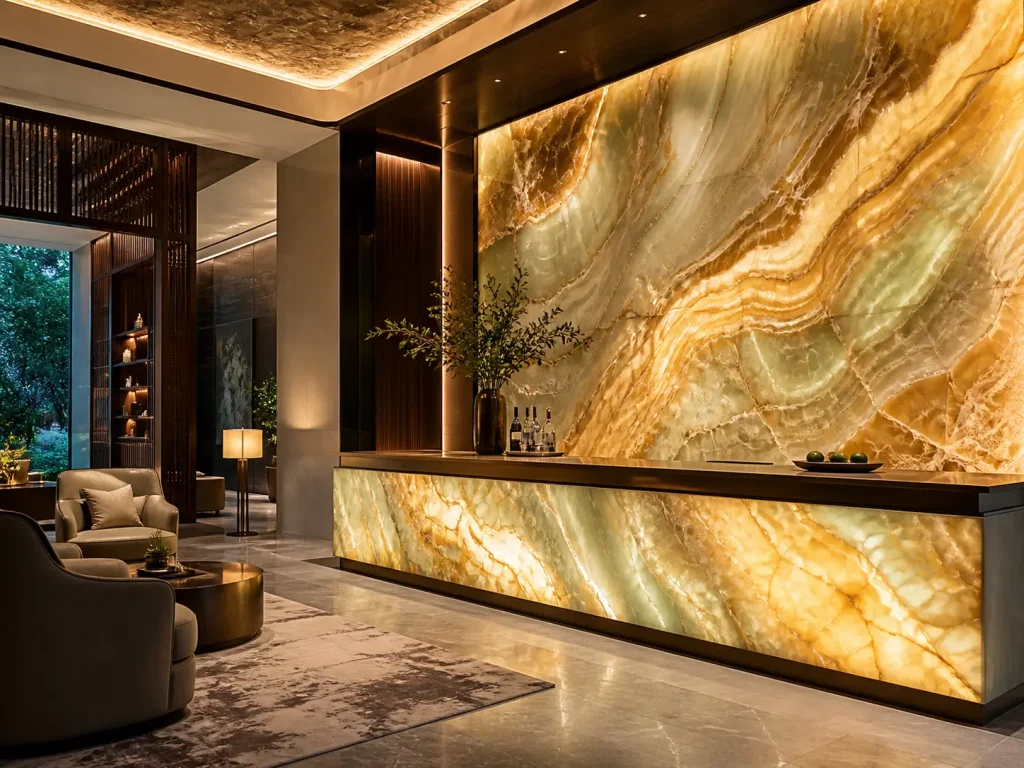
Onyx is one of the most visually dramatic natural stones used in luxury interiors. It is not chosen because it is the hardest stone, the cheapest stone, or the easiest stone to maintain. It is chosen because it can create something ordinary stone often cannot: light, depth, movement, and atmosphere. When backlit correctly, Onyx can turn a wall, bar counter, reception desk, vanity area, or hotel lobby into a glowing architectural feature.
However, Onyx is also a material that punishes careless specification. It is generally softer and more delicate than granite, quartzite, and many marble varieties. It can be sensitive to acids, scratches, impact, and improper cleaning. That means buyers should not treat Onyx like a general-purpose countertop or flooring material. Onyx works best when it is used strategically: as a focal surface, backlit feature, decorative wall, boutique counter, luxury bathroom element, or hospitality design statement.
For project buyers, designers, importers, and contractors, the first step is understanding the available product range. A professional Onyx slabs and tiles collection helps buyers compare colors, patterns, formats, translucency, and application possibilities before selecting actual slabs. This matters because Onyx is highly variable. Two slabs with the same trade name may look very different under natural light and completely different when backlit.
What Is Onyx Stone?
Onyx is a decorative natural stone known for its translucent structure, layered bands, and rich color variation. In the commercial stone industry, it is often called “Onyx marble” because it is frequently sold alongside marble and used in similar luxury interiors. Technically, however, Onyx is not simply marble with better lighting effects. It has a different formation process and a different performance profile.
Natural Onyx is commonly formed through mineral-rich water deposits. Over time, minerals create layered bands, cloudy movement, and semi-translucent zones. These layers are the reason Onyx can transmit light in ways that ordinary marble usually cannot. When LED lighting is placed behind suitable slabs, the stone reveals internal depth, color gradients, and vein movement that remain hidden under normal front lighting.
This is why Onyx is often used in hotel lobbies, luxury bars, spa rooms, villas, boutique retail stores, elevator backgrounds, bathroom vanities, and reception counters. It is not only a surface material; it is a mood-setting design element. The best Onyx projects usually begin with a clear question: “Where should the viewer’s eye go first?” Onyx answers that question loudly, but elegantly.
| Feature | Onyx Characteristic | Buyer Meaning |
|---|---|---|
| Translucency | Allows light to pass through selected zones | Excellent for backlit wall panels and bars |
| Layered bands | Natural mineral deposition creates movement | Every slab has unique visual character |
| Soft structure | More delicate than granite or quartzite | Better for decorative and low-impact areas |
| Color range | White, honey, green, blue, pink, brown, red, black | Flexible for luxury interior design |
| Maintenance need | Sensitive to acids, abrasion, and impact | Requires careful cleaning and professional installation |
Is Onyx the Same as Marble?
Onyx and marble are often grouped together in showrooms, but buyers should understand their differences. Marble is generally a metamorphic stone formed when limestone is changed by heat and pressure. Onyx is typically associated with mineral deposition and layered formation, which gives it stronger translucency and a more decorative appearance. In simple buying language: marble is usually more practical; Onyx is usually more dramatic.
This distinction is important because using Onyx in the wrong place can create expensive problems. A heavy-use kitchen countertop, restaurant preparation counter, or high-traffic floor may not be the best environment for Onyx. A backlit feature wall, boutique vanity, decorative bar face, reception counter, or luxury spa wall is much more suitable.
For B2B buyers, supplier experience matters because Onyx selection requires more than color matching. Buyers should check slab reinforcement, crack condition, backing system, light transmission, polishing quality, packing strength, and installation support. Reviewing a supplier’s background through an experienced natural stone manufacturer page can help buyers understand production capability, export orientation, and project service before placing a high-value order.
| Factor | Onyx | Marble |
|---|---|---|
| Visual effect | Translucent, layered, dramatic | Elegant, classic, often opaque |
| Best design role | Feature material and lighting surface | Broad architectural material |
| Durability | Lower to medium | Medium, depending on variety |
| Maintenance | Higher care required | Medium care required |
| Best applications | Backlit walls, bars, vanities, feature panels | Floors, walls, countertops, stairs, bathrooms |
Main Types and Colors of Onyx
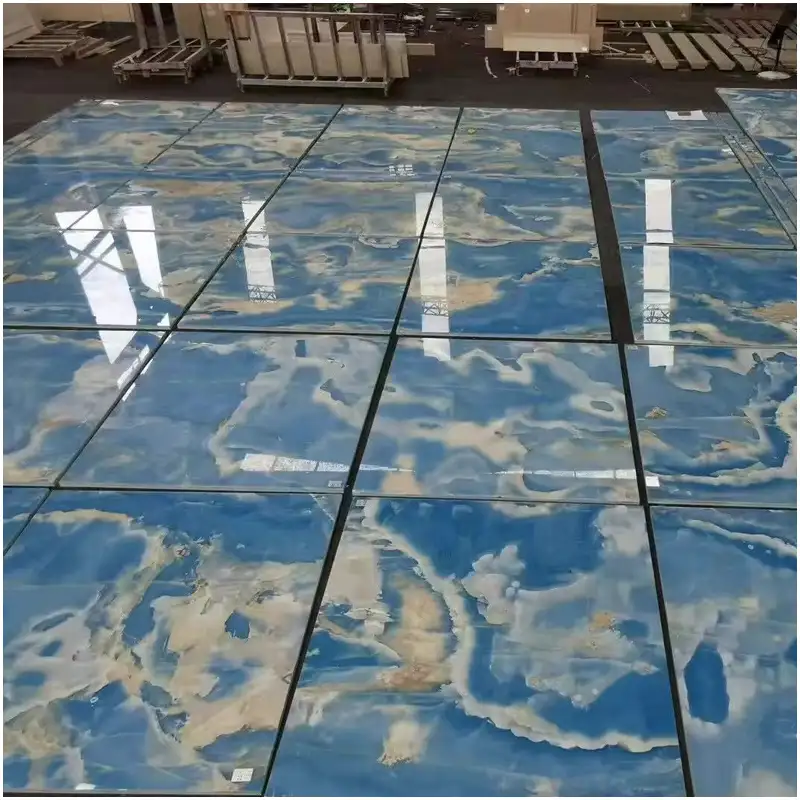
Onyx is available in many colors, and each color creates a different interior mood. White Onyx feels clean, luminous, and soft. Honey Onyx creates warmth and hospitality. Green Onyx feels exotic and natural. Blue Onyx is artistic and rare. Black Onyx creates contrast and drama. Pink, red, brown, and yellow Onyx can support boutique, spa, bar, and statement-wall designs.
Color selection should not be based only on preference. Buyers should consider room size, lighting temperature, background materials, metal finishes, furniture style, and whether the Onyx will be backlit. A stone that looks soft and balanced under daylight may become much stronger under warm LEDs. A slab that looks dark from the front may reveal surprising bands when lit from behind. This is why mockup testing is not optional for serious projects.
For high-impact hospitality spaces, Blue Onyx tiles can be used to create a cool, artistic, and premium mood in feature walls, bar fronts, bathroom panels, or boutique interiors. Blue Onyx is especially attractive when the design needs something more distinctive than standard white or beige stone. However, because blue tones can shift under different lighting temperatures, buyers should always test samples with the actual LED system or interior lighting plan before final approval.
| Onyx Type | Visual Style | Best Applications | Buyer Note |
|---|---|---|---|
| White Onyx | Clean, luminous, soft | Backlit walls, bathrooms, vanities | Needs careful stain protection |
| Honey Onyx | Warm, golden, luxurious | Bars, lobbies, spa walls | Excellent warm lighting effect |
| Green Onyx | Exotic, natural, artistic | Feature walls, tables, boutique interiors | Requires controlled slab matching |
| Blue Onyx | Cool, rare, expressive | Luxury bars, walls, bathroom features | Lighting temperature strongly affects color |
| Black Onyx | Bold, modern, dramatic | Feature panels, counters, dark interiors | Best with controlled lighting design |
Popular Onyx Applications in Real Projects
The strongest application for Onyx is usually the backlit feature wall. In hotel lobbies, spa corridors, bars, and high-end residential interiors, LED lighting behind translucent Onyx creates a glowing depth that standard wall cladding cannot deliver. It works especially well when the surrounding materials are restrained: dark wood, brushed metal, matte stone, soft textiles, or warm neutral walls.
Onyx is also used for reception counters, bar tops, bathroom vanity tops, fireplace surrounds, furniture panels, elevator backgrounds, and boutique display surfaces. However, buyers must match the application to the material’s real performance. Onyx is beautiful, but it is not the right answer for every heavy-use surface. If the surface will face constant impact, acidic liquids, knives, hot cookware, or heavy traffic, another stone may be safer.
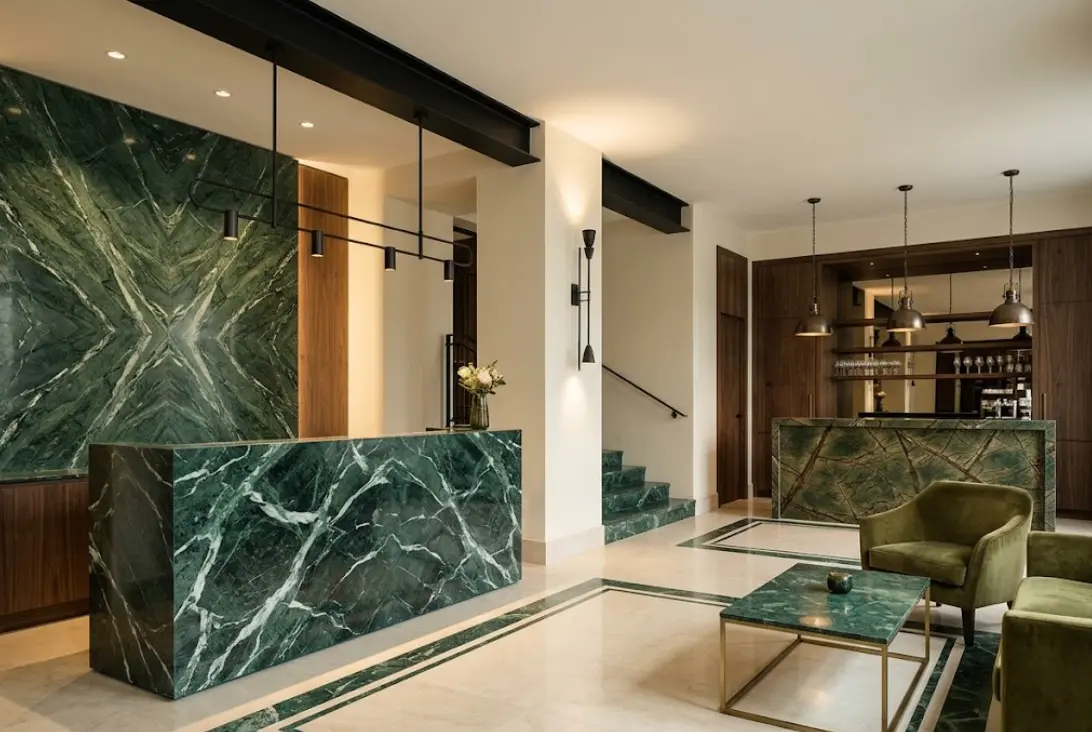
For natural, fresh, and highly decorative interiors, Green Onyx tile can create a strong biophilic luxury effect in bathrooms, spas, villas, and boutique commercial spaces. Green Onyx works particularly well with bronze metal, walnut wood, cream walls, and soft indirect lighting. The buyer should still confirm slab consistency, because green Onyx can vary dramatically from one block to another.
| Application | Suitability | Risk Level | Recommendation |
|---|---|---|---|
| Backlit wall panel | Excellent | Medium | Use reinforced slabs and LED mockup testing |
| Reception counter | Very good | Medium | Seal surface and protect edges |
| Bar top | Good | Medium to high | Avoid acidic drinks sitting on the surface |
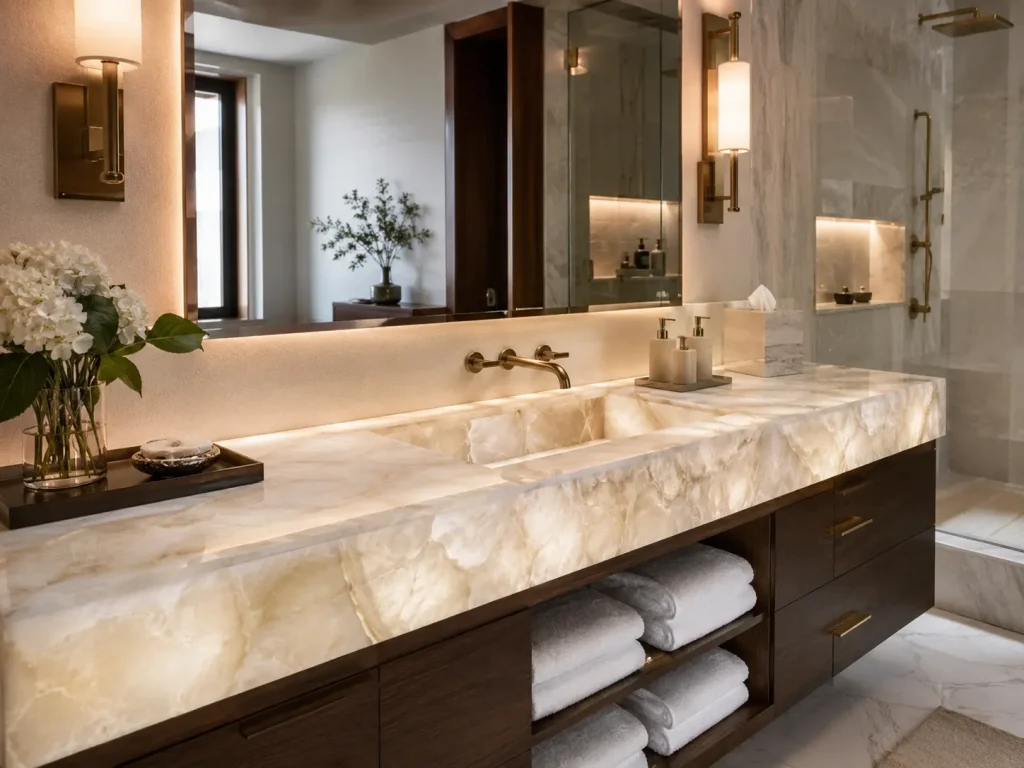
| Bathroom vanity | Good | Medium | Use gentle cleaners and wipe cosmetics quickly |
| Kitchen countertop | Limited | High | Use only for decorative or low-use areas |
| Flooring | Limited | High | Only for low-traffic decorative zones |

Why Onyx Is Popular in Luxury Interior Design
Onyx is popular because it does something psychologically powerful: it makes surfaces feel alive. Ordinary stone reflects light. Onyx can hold light, diffuse it, and reveal internal mineral layers. This creates a sense of depth that feels more architectural than decorative. In high-end spaces, that difference matters because clients and guests notice atmosphere before they notice specifications.
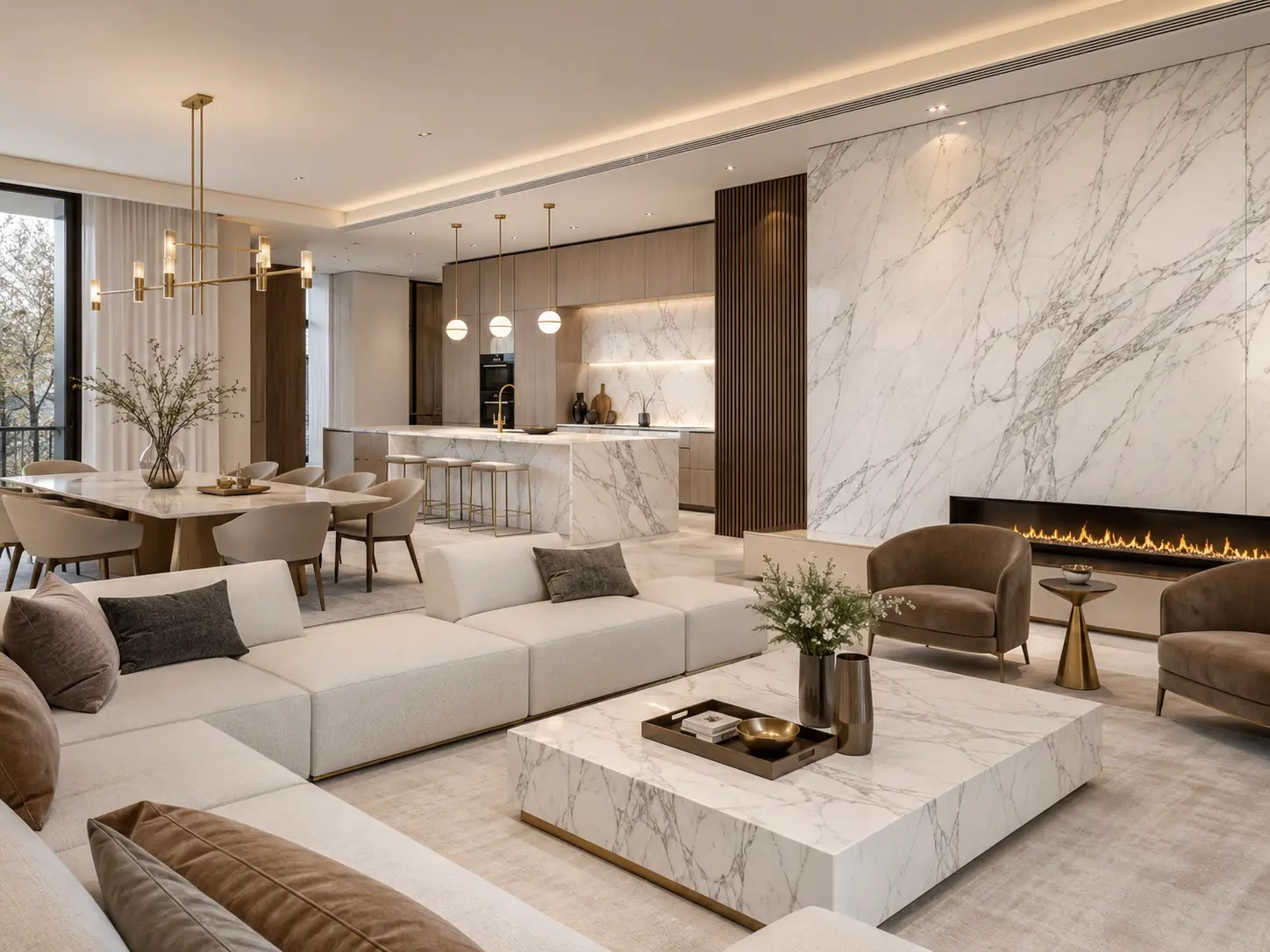
White Onyx is one of the most flexible choices for luxury interiors because it feels clean, bright, and elegant. It can be used in bathrooms, spa walls, reception backgrounds, vanity panels, and softly lit residential interiors. If the project requires a luminous neutral stone, White Onyx Marble is often a strong option because it can create a calm glowing effect without overwhelming the room.
At the same time, Onyx should not be overused. A full room covered in Onyx can feel too loud, too expensive, and honestly, a little like the stone is trying to win an argument with the furniture. The better approach is controlled drama: one feature wall, one glowing bar face, one vanity background, one reception counter, or one carefully framed panel. Luxury design is not about using the most expensive material everywhere; it is about knowing where the eye should stop.

Onyx Material Parameters Buyers Should Understand
Onyx buying requires technical review. The buyer should confirm thickness, translucency, reinforcement, resin treatment, surface finish, slab size, color matching, crack condition, backing material, packing method, and installation requirements. For backlit projects, a normal front-lit slab photo is not enough. The buyer needs an LED test or at least a light-transmission check using the actual slab.
Thickness affects both strength and light transmission. Thicker slabs may be stronger but transmit less light. Thinner panels may transmit light better but require reinforcement. Many Onyx slabs benefit from mesh backing, glass backing, laminated support, or composite systems depending on the final use. For large wall panels, this is not decoration; it is structural common sense.
| Parameter | Why It Matters | Buyer Checkpoint |
|---|---|---|
| Thickness | Affects strength and light transmission | Confirm slab thickness and final application |
| Translucency | Determines backlighting effect | Test actual slab with LED lighting |
| Water absorption | Affects staining and sealing needs | Ask supplier for data or care guidance |
| Flexural strength | Important for handling and installation | Use reinforcement when needed |
| Surface finish | Changes appearance and maintenance behavior | Polished is common; honed may reduce glare |
| Backing system | Improves stability and reduces breakage risk | Confirm mesh, glass, or composite backing |
| Color matching | Onyx varies strongly between slabs | Approve actual slabs before cutting |
| Packing | Onyx can be fragile during shipment | Request export packing photos |
Onyx vs Marble vs Granite vs Quartzite
Onyx is not a direct substitute for every natural stone. It should be compared by design purpose. Choose Onyx when the project needs translucency, drama, atmosphere, and a luxury focal point. Choose marble when the project needs broader architectural elegance. Choose granite when durability and practicality matter most. Choose quartzite when the buyer wants natural stone beauty with stronger performance for countertops and heavier use.
Black Onyx can be especially powerful in modern interiors because it creates contrast, depth, and drama. Used properly, Black Onyx Marble can work for feature walls, dark luxury bars, boutique counters, and modern reception spaces. However, dark Onyx needs careful lighting and cleaning planning because dust, fingerprints, water marks, and scratches may show more clearly than on lighter stone.
| Stone | Best Feature | Durability | Maintenance | Best Use |
|---|---|---|---|---|
| Onyx | Translucency and visual drama | Low to medium | High | Backlit walls, bars, feature panels |
| Marble | Timeless elegance | Medium | Medium | Floors, walls, vanities, counters |
| Granite | Strength and practicality | High | Low to medium | Kitchens, floors, exterior areas |
| Quartzite | Natural luxury with higher strength | High | Medium | Countertops, walls, premium interiors |
| Travertine | Warm natural texture | Medium | Medium | Walls, bathrooms, classic interiors |

Is Onyx Good for Countertops?
Onyx can be used for countertops, but buyers must be careful about where and how. It is suitable for bathroom vanities, powder room counters, reception counters, decorative bars, furniture tops, and low-use luxury surfaces. It is usually not the best choice for heavy family kitchens, restaurant preparation counters, commercial food-service worktops, or high-abuse surfaces.
The reason is simple: Onyx is more delicate than many other countertop materials. It can scratch, stain, etch, chip, or crack if treated roughly. For a showpiece bar in a private villa, Onyx can be perfect. For a busy kitchen where children, knives, lemon juice, wine, hot pans, and chaos all meet at 7 p.m., granite, quartzite, or engineered quartz may be safer.
| If You Need | Choose Onyx? | Better Option If Not |
|---|---|---|
| Backlit luxury bar | Yes | Onyx is one of the best choices |
| Heavy cooking kitchen | Usually no | Granite, quartzite, or quartz |
| Hotel reception feature counter | Yes | Marble if backlighting is not needed |
| Bathroom vanity | Yes, with care | Marble or quartz for lower maintenance |
| Restaurant worktop | Not ideal | Granite or engineered quartz |
| Feature wall | Yes | Marble or quartzite if no backlight is needed |
How to Backlight Onyx Correctly
Backlighting is where Onyx truly becomes special. But good backlighting is not just putting LED strips behind a stone panel and hoping the universe behaves. The slab must be tested, the LED system must be planned, the backing must be compatible, and the installation should allow future maintenance access. Poor backlighting creates hot spots, dark patches, visible dots, color shift, and disappointing results.
LED panels usually provide more even lighting than simple strips, especially for large panels. Diffusers can help reduce visible dots. Warm white light may enhance honey, beige, and brown Onyx. Neutral or cool white light may suit white, blue, or green Onyx. The final choice should be tested with the actual stone, not guessed from a screen.
For architects planning luminous feature walls or hospitality interiors, the architects guide to backlighting Blue Onyx Marble is especially relevant because blue Onyx requires careful control of color temperature, panel layout, stone thickness, and lighting uniformity. Backlit Onyx is breathtaking when done well, and very expensive-looking in the wrong way when done badly.
| Backlighting Factor | Recommended Check | Risk If Ignored |
|---|---|---|
| Slab translucency | Test actual slab with LED | Uneven dark spots |
| LED color temperature | Compare warm, neutral, and cool lighting | Wrong mood or color shift |
| Diffusion | Use even light distribution | Visible LED dots or stripes |
| Backing material | Confirm transparency compatibility | Shadows, stains, or dark lines |
| Maintenance access | Design removable or serviceable system | Expensive wall removal later |
| Electrical safety | Follow local electrical code | Safety and approval problems |
Onyx Buying Tips for B2B Projects
B2B Onyx buying should be based on actual project requirements. A hotel lobby wall, villa bar, spa feature panel, and boutique vanity may all use Onyx, but they do not need the same thickness, backing, lighting system, packing method, or installation detail. Before ordering, buyers should prepare drawings, sizes, color preferences, lighting plans, quantity, finish requirements, and application zones.
Always request actual slab photos and videos. If the project is backlit, ask for backlit photos or testing. Confirm whether the slab has mesh or glass backing. Ask about cracks, resin treatment, repair lines, slab size, cutting plan, packing method, and loading photos. Onyx is too expressive and too delicate for blind purchasing. If marble can be a diva, Onyx is the opera singer with a lighting contract.
| Buyer Question | Why It Matters |
|---|---|
| Can you provide actual slab photos under front light and backlight? | Onyx appearance changes dramatically under lighting |
| Is the slab reinforced with mesh, glass, or composite backing? | Reinforcement reduces breakage risk |
| Can you support bookmatching or panel layout? | Large feature walls need visual continuity |
| What thickness is available? | Thickness affects strength and lighting effect |
| Can you provide packing photos before shipment? | Export packing is critical for fragile stone |
| Can you match slabs for hotel or villa projects? | Project consistency protects final design quality |
Common Mistakes When Buying Onyx
The first mistake is treating Onyx like granite. Granite can tolerate heavy use better; Onyx cannot. The second mistake is choosing only by front-lit photos. A slab may look beautiful in daylight but disappointing under backlight. The third mistake is ignoring reinforcement. Large Onyx panels can be fragile during cutting, shipping, and installation.
The fourth mistake is using Onyx in heavy-traffic areas without accepting the maintenance cost. The fifth mistake is failing to plan electrical access for backlighting. If LED panels fail and the wall cannot be opened, repair becomes painful. The sixth mistake is using acidic cleaners. Onyx can be damaged by acidic substances, abrasive pads, and harsh chemicals, so maintenance instructions must be given to the owner, hotel staff, or cleaning team.
If This Is Your Project, Choose This Onyx Strategy
| If Your Project Needs | Choose | Avoid |
|---|---|---|
| Luxury backlit wall | White, honey, blue, or green Onyx with strong translucency | Dense slabs with poor light transmission |
| Warm hotel lobby | Honey or golden Onyx | Cold stones with weak lighting effect |
| Boutique bathroom vanity | White, pink, or green Onyx | Unsealed surface exposed to harsh cosmetics |
| Bar feature counter | Honey, brown, blue, or black Onyx | Heavy food-prep use |
| High-traffic flooring | Avoid Onyx | Choose marble, granite, or quartzite instead |
| Large bookmatched feature wall | Matching slabs with layout approval | Random unmatched slabs |
| Easy maintenance kitchen | Avoid Onyx | Choose quartz, granite, or quartzite |
Onyx Care and Maintenance Guide
Onyx should be cleaned with pH-neutral stone cleaner, soft cloths, and non-abrasive tools. Avoid vinegar, lemon-based cleaners, acidic bathroom cleaners, bleach, harsh degreasers, and rough pads. Wipe spills quickly, especially wine, coffee, cosmetics, oils, and acidic liquids. Use coasters, trays, and protective pads on vanity tops and bar counters.
Sealing should be handled according to supplier and installer guidance. Some Onyx surfaces require periodic resealing, especially in vanity, bar, and hospitality applications. Backlit systems should also be inspected because lighting failure can affect the entire design effect. Commercial projects should include written maintenance instructions, not just a beautiful handover photo.
| Care Task | Suggested Frequency | Purpose |
|---|---|---|
| Dust or wipe surface | Daily or as needed | Prevents residue buildup |
| pH-neutral cleaning | Weekly or after use | Protects polish and surface clarity |
| Spill removal | Immediately | Reduces staining and etching risk |
| Sealing check | Every 6–12 months | Controls absorption risk |
| LED system inspection | Annually | Prevents backlight failure |
| Professional inspection | Annually for hotels and commercial spaces | Maintains luxury appearance |
Frequently Asked Questions
1. What is Onyx stone?
Onyx stone is a decorative natural stone known for its translucent structure, layered bands, and dramatic color movement. It is often used in luxury interiors for backlit walls, reception counters, bar fronts, bathroom vanities, spa features, fireplace surrounds, and statement panels. Unlike ordinary wall cladding materials, Onyx can interact with light, allowing designers to create glowing surfaces with depth and atmosphere. It is best used as a feature material rather than a heavy-duty general-purpose stone.
2. Is Onyx the same as marble?
No, Onyx is not the same as marble, although it is often called Onyx marble in the commercial stone market. Marble is generally a metamorphic stone, while Onyx is known for mineral layering and semi-translucent properties. Onyx is usually more decorative, more translucent, and more delicate than most marble varieties. For buyers, the key difference is application: marble is suitable for broader architectural use, while Onyx is better for feature walls, backlit panels, bars, vanities, and low-impact luxury areas.
3. Is Onyx good for kitchen countertops?
Onyx is not usually the best choice for heavy-use kitchen countertops because it is more sensitive to acids, scratches, impact, and staining than granite, quartzite, or engineered quartz. It can work for decorative kitchen islands, luxury bar counters, powder room vanities, or low-use feature surfaces if properly sealed and maintained. For busy family kitchens or commercial food-preparation areas, buyers should usually choose a more durable material. Onyx is better when the project needs visual drama, not maximum abuse resistance.
4. Can Onyx be backlit?
Yes, Onyx can be backlit, and this is one of its strongest design advantages. Because many Onyx slabs are translucent, LED lighting behind the stone can reveal internal bands, veins, clouds, and color layers. However, backlighting must be tested before installation. Buyers should check actual slab translucency, LED color temperature, diffusion, backing material, panel layout, wiring access, and maintenance access. Without testing, the finished wall may show dark spots, visible LED dots, uneven brightness, or unwanted color shifts.
5. How do I choose a good Onyx supplier?
To choose a good Onyx supplier, ask for actual slab photos, videos, backlit testing, thickness details, reinforcement information, mesh or glass backing options, packing photos, slab matching support, and project experience. A reliable supplier should understand that Onyx is fragile, highly variable, and lighting-sensitive. For large hotel, villa, spa, or commercial projects, buyers should also ask whether the supplier can support bookmatching, panel layout, cut-to-size production, export packing, and installation guidance.
References
- “Marble, Onyx, and Serpentine: Natural Stone Varieties” — Natural Stone Institute — Natural Stone Consumer Reference
- “Dimension Stone Design Manual” — Natural Stone Institute — Stone Design and Installation Reference
- “ASTM C97/C97M Standard Test Methods for Absorption and Bulk Specific Gravity of Dimension Stone” — ASTM International — Stone Testing Method
- “ASTM C880/C880M Standard Test Method for Flexural Strength of Dimension Stone” — ASTM International — Structural Testing Method
- “Natural Stone Care and Maintenance Guidelines” — Natural Stone Institute — Stone Cleaning and Maintenance Resource
- “Backlighting Translucent Stone Surfaces: Design and Installation Considerations” — Stone World Technical Editorial Team — Stone Design Resource
- “Interior Lighting Design for Feature Materials” — Illuminating Engineering Society — Lighting Design Resource
- “Hotel Interior Material Selection and Maintenance Planning” — International Interior Design Association — Design Practice Resource
Final Buyer Insight: When Onyx Is the Right Stone Choice
What should buyers understand first? Onyx is a luxury decorative stone, not a heavy-duty universal surface. Its strongest value is translucency, layered color, backlit depth, and emotional design impact. It is best used where people will notice it: feature walls, reception counters, bars, bathroom vanities, spa interiors, hotel lobbies, and villa statement panels.
How should Onyx be specified? Choose the color and slab based on the project atmosphere, but confirm thickness, translucency, reinforcement, backing, sealing, packing, and installation method before ordering. For backlit applications, test the actual slab with the intended lighting system. Do not rely only on front-lit photos.
Why do Onyx projects fail? Most problems come from wrong application, poor lighting design, weak reinforcement, bad packing, acidic cleaning, no maintenance access, or unrealistic expectations. Onyx is not difficult when treated correctly; it is difficult when treated like granite.
Option logic: If the project needs a glowing focal wall, choose Onyx. If it needs a heavy-use kitchen worktop, choose quartzite, granite, or engineered quartz. If it needs a luxury vanity or bar, Onyx can be excellent with sealing and care. If it needs low maintenance and high impact resistance, Onyx is probably not the best answer.
Recommendation: Before purchasing, prepare drawings, slab sizes, color preferences, lighting method, application area, finish requirement, quantity, and shipping destination. Buyers can submit project details through the FOR U STONE contact page to request slab matching, backlighting advice, and project-oriented Onyx selection support.
If your project needs a luxury focal point rather than an ordinary surface, send the intended application, room photos, lighting concept, and required size. The right Onyx slab should be selected with the lighting plan, not after it.