
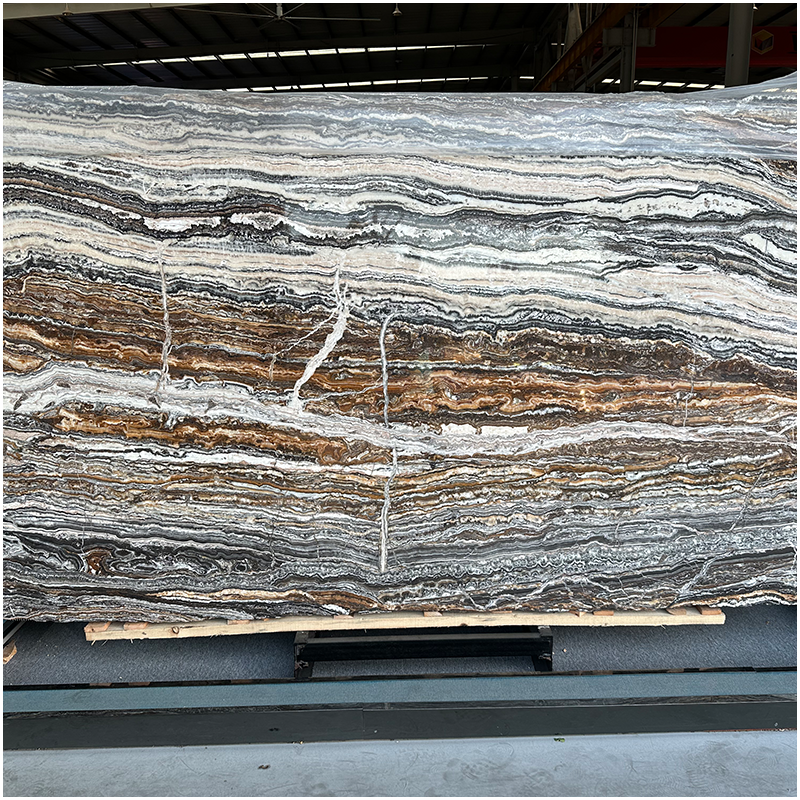


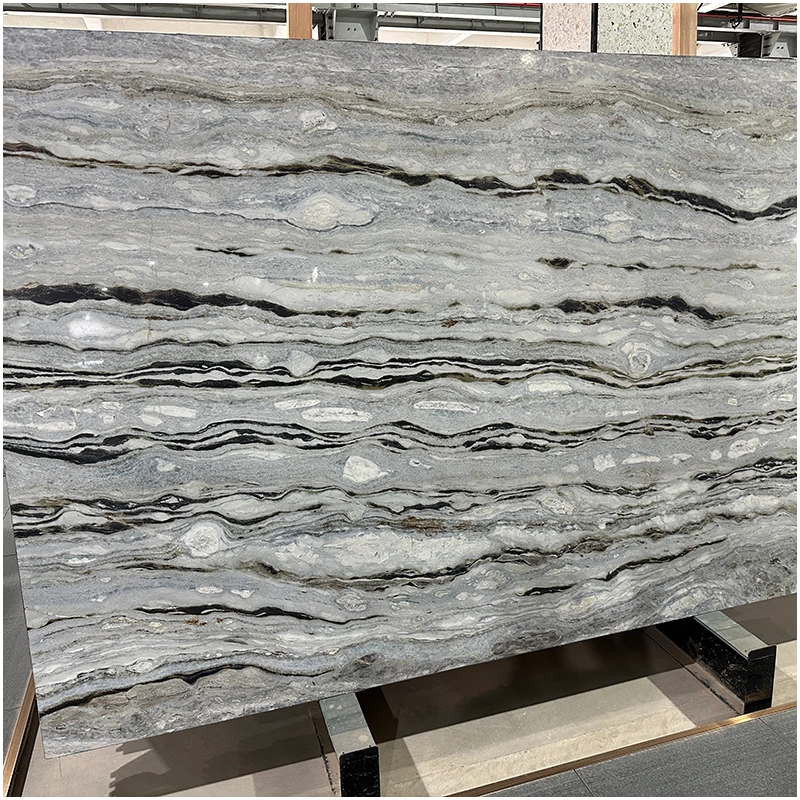

White marble has remained the undisputed emblem of luxury and architectural purity for millennia. From the pantheons of ancient Greece to the minimalist penthouses of modern-day Manhattan, the luminous quality of calcite-rich stone offers an aesthetic depth that synthetic alternatives simply cannot replicate. In 2026, as the demand for sustainable, natural materials surges, understanding the technical nuances of white stone is essential for architects, developers, and homeowners alike.
Sourcing high-quality material requires more than an eye for beauty; it demands an understanding of mineralogy, grading scales, and supply chain logistics. Whether you are looking for a Đá cẩm thạch trắng Carrara Trung Quốc to balance cost and elegance or seeking the rarest Italian blocks, this guide serves as your technical roadmap.
Why White Marble is the Top Choice for Luxury Interiors
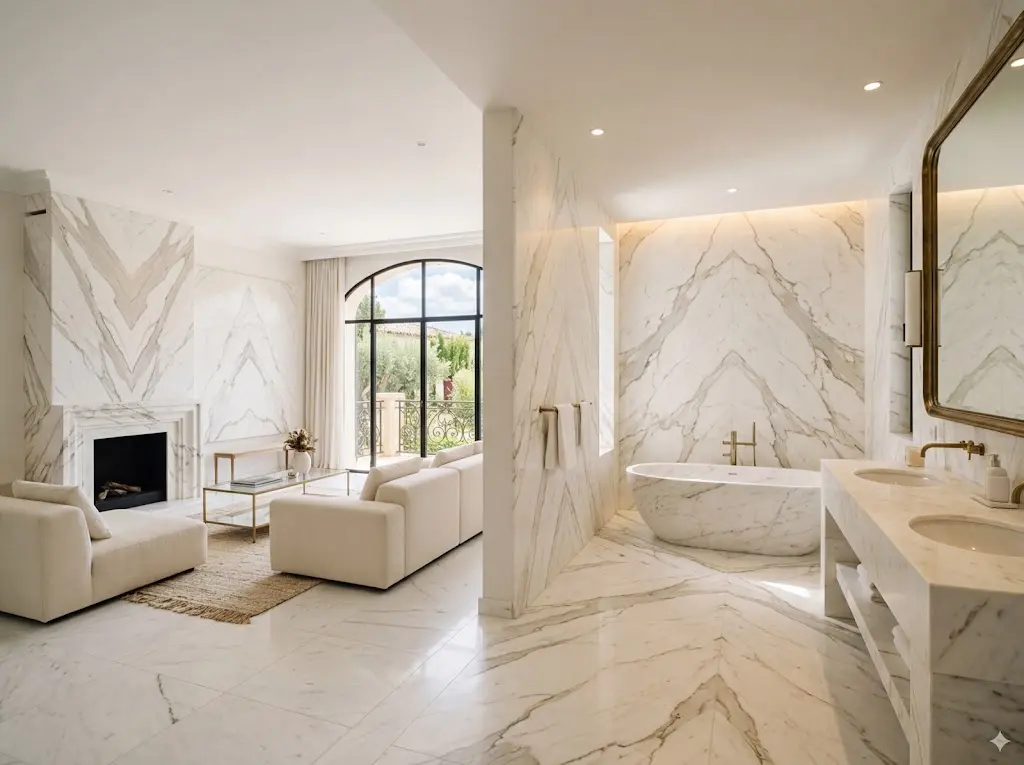
The preference for white surfaces in high-end design is rooted in both psychology and physics. White marble possesses a unique property known as “subsurface scattering.” Unlike opaque materials, light penetrates the surface of the marble before being reflected back out, giving the stone a “soul” or an inner glow. This characteristic is particularly vital in large-scale residential projects where natural light integration is a priority.
From a functional standpoint, white marble is a “cool” stone. Its high thermal mass allows it to stay below room temperature, making it an ideal surface for flooring in warmer climates. Furthermore, the neutral palette provides a versatile foundation. Designers often debate between different aesthetics, such as green marble slabs vs white marble, but white consistently wins for its ability to make smaller spaces appear expansive and its higher resale value in the real estate market.
Comparing Popular Types: Calacatta, Carrara, Volakas, and Statuario
Not all white marbles are created equal. The distinction lies in the quarry location, the mineral impurities that create “veining,” and the background “whiteness” index.
Carrara Marble: The Timeless Foundation
Originating from the Apuan Alps in Italy, Carrara is the most widely recognized marble. It typically features a soft, muddy-grey background with fine, feathery veins. It is the workhorse of the luxury world, offering a sophisticated look at a more accessible price point compared to its cousins.
Calacatta Marble: The Pinnacle of Rarity
Often confused with Carrara, Calacatta is much rarer and more expensive. It is characterized by a crisp, “sugar-white” background and bold, dramatic veining that can range from gold to dark grey. Because of its bold patterns, it is the preferred choice for book-matched feature walls and waterfall islands.
Statuario Marble: The Designer’s Masterpiece
Statuario contains the perfect balance of the two. It has the bright white base of Calacatta but with more structured, fluid grey veining. It is often reserved for indoor applications like statues and high-visibility countertops due to its high price per square foot.
Volakas Marble: The “Carrara of the East”
Hailing from Northern Greece, Volakas marble is increasingly popular in 2026 due to its unique diagonal veining. It offers a “cloud-like” aesthetic that is softer than Italian varieties. Designers frequently specify Volakas white marble flooring for hotel lobbies to achieve a high-end look with a distinct Mediterranean character.
Grading Standards: Commercial vs. Premium
In the stone industry, “White Marble” is a broad term that covers a wide spectrum of quality. A Nhà sản xuất đá cẩm thạch trắng will typically categorize slabs into different grades based on visual and structural integrity. Understanding these grades is crucial for bulk white marble wholesale procurement.
| Tính năng | Premium Grade (AAA) | Standard Grade (A/B) | Commercial Grade |
| Background Color | Pure white/uniform | Slightly off-white/cream | Greyish or yellowish tint |
| Veining Consistency | Balanced, no clusters | Occasional heavy spots | Irregular, “wild” patterns |
| Structural Integrity | Zero fissures/cracks | Minor dry veins (filled) | Visible fissures or “glass lines” |
| Crystal Size | Fine-grained | Hạt trung bình | Coarse/Large crystals |
For residential projects, Premium Grade is essential to ensure color harmony across multiple slabs. Commercial grade is often used in large-scale public projects where the natural “imperfections” of the stone add to the rustic character of the building.
Technical Specifications and Material Parameters
To ensure the longevity of a project, the physical properties of the stone must be matched to its application. White marble, being a metamorphic rock composed primarily of recrystallized carbonate minerals, has specific performance metrics. Architects should look for Gạch men đá cẩm thạch trắng có vân đen that meets or exceeds ASTM (American Society for Testing and Materials) standards.
| Parameter | Average Value | Đơn vị | ASTM Standard |
| Tỉ trọng | 2.71 – 2.73 | $g/cm^3$ | C97 |
| Sự hấp thụ nước | 0.10 – 0.15 | % | C97 |
| Cường độ nén | 90 – 120 | MPa | C170 |
| Độ bền uốn | 10 – 15 | MPa | C880 |
| Độ cứng Mohs | 3 – 4 | H | Không có |
Higher density and lower water absorption rates indicate a “tighter” crystalline structure, which makes the marble more resistant to staining and moisture-related damage in bathrooms and kitchens.
Surface Finishes: Polished, Honed, and Leathered
The finish of a marble slab dictates its interaction with light and its slip resistance.
-
Đã hoàn thiện: This is the most common finish. It uses a series of abrasive pads to buff the stone to a high shine. While it enhances the colors and veining, it can be slippery when wet and is susceptible to “etching” from acidic substances.
-
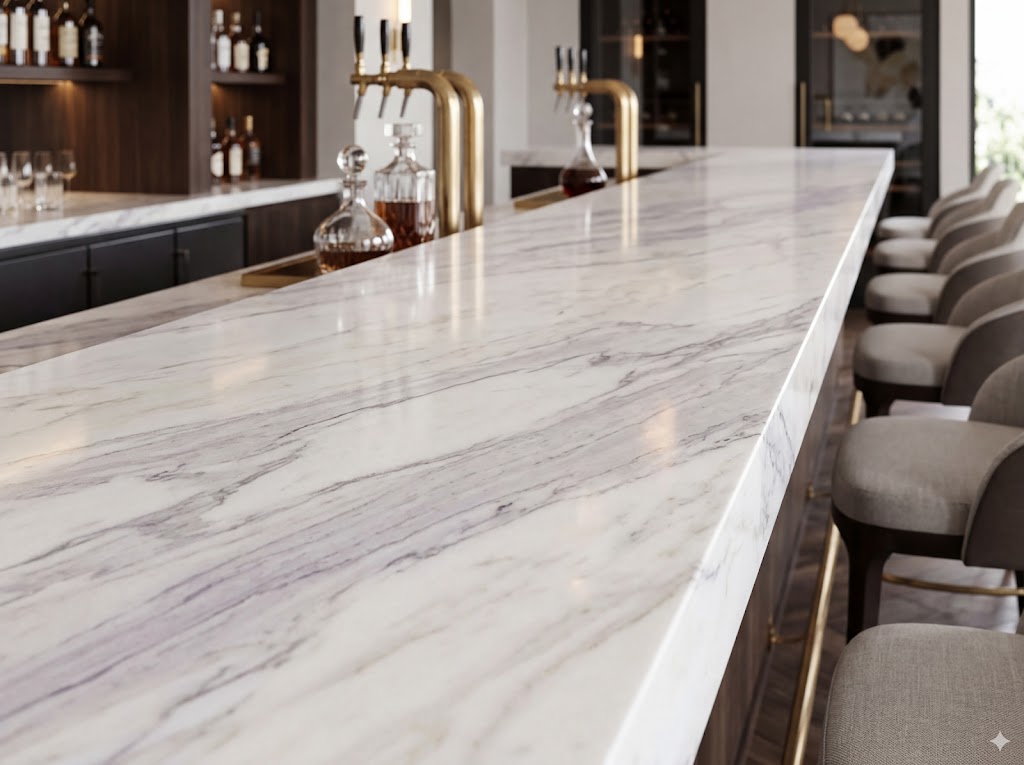
Được mài dũa: A honed finish is smooth but matte. It is achieved by stopping the buffing process earlier. This is the preferred finish for Greece Volakas white marble for bar design because it hides scratches and “etch marks” much better than a polished surface.
-
Da thuộc: A newer trend in 2026, the leathered finish involves brushing the stone with diamond-tipped brushes. This creates a textured, tactile surface that is incredibly slip-resistant and hides fingerprints—perfect for high-traffic commercial flooring.
Essential Care and Maintenance for White Surfaces
The biggest misconception about white marble is that it is “too high maintenance.” While it does require care, modern chemical sealers have made marble far more resilient.
-
Niêm phong: All white marble should be treated with a high-quality impregnating sealer upon installation. These sealers penetrate the pores of the stone, creating a hydrophobic barrier that repels water and oils.
-
pH Neutral Cleaning: Traditional household cleaners often contain vinegar or citric acid, which will “etch” (chemically burn) the marble. Always use a pH-neutral stone soap.
-
The “Poultice” Method: For deep-set stains, a poultice—a paste made of a cleaning agent and an absorbent material—can be used to literally “pull” the stain out of the stone’s pores.
Global Sourcing: Navigating the Supply Chain
When managing large-scale projects, sourcing directly from a Nhà máy sản xuất đá cẩm thạch trắng provides significant advantages in terms of quality control and cost-efficiency. Direct sourcing allows for “Dry Lay” inspections, where the manufacturer lays out all the slabs for a project in their warehouse so the architect can approve the veining flow before the stone is shipped.
When evaluating a white marble slab manufacturer, ensure they provide detailed photos of the specific blocks being cut. The international stone market is volatile, and prices can fluctuate based on quarry production levels in Italy, Greece, and Turkey. For those ready to begin a procurement process or seeking technical consultation, it is advisable to liên hệ với chúng tôi to discuss specific load-bearing requirements and shipping timelines.
Sustainability and Industry Trends
In 2026, the stone industry is leaning heavily toward “Circular Stone Economy” practices. This includes recycling water used in the cutting process and repurposing marble “off-cuts” into terrazzo or mosaic tiles. Natural stone has a significantly lower carbon footprint than engineered quartz, which requires high amounts of energy and resin to produce.
Furthermore, Generative AI is now being used at the factory level to predict veining patterns inside a block before it is even cut, reducing waste and ensuring that designers get the exact aesthetic they require for their high-end builds.
|
|
|


Câu hỏi thường gặp
1. What is the average cost of white marble slabs in 2026?
The price of premium white marble varies significantly based on rarity, background whiteness, and veining clarity. In the 2026 market, Italian Carrara typically ranges from $40 to $85 per square foot, while ultra-exclusive varieties like Calacatta Borghini or Statuario can exceed $250 per square foot. When sourcing from a bulk white marble wholesale partner, large-scale commercial projects can often secure volume discounts of 15-30% compared to local retail pricing.
2. How do I prevent white marble from turning yellow over time?
Yellowing in white marble is usually caused by two factors: the oxidation of internal iron minerals or the buildup of improper wax-based cleaners. To prevent this, it is essential to use a high-quality, breathable, non-yellowing solvent-based impregnating sealer. Additionally, ensure that the stone is installed using white thin-set mortar rather than grey, as the dark pigments in standard mortar can bleed through the translucent calcite structure of the marble.
3. Can white marble be used for high-traffic outdoor applications?
Yes, white marble is suitable for outdoor use, provided the correct finish and sealing protocols are followed. For exterior cladding or walkways, a honed, sandblasted, or leathered finish is superior to a polished one, as it provides essential slip resistance (DCOF > 0.42). Because marble is a natural carbonate, it will naturally “patina” or weather over time when exposed to UV rays and acidic rain, which many architects value for its historical aesthetic.
4. Which is better for a luxury kitchen: White Marble or Engineered Quartz?
While engineered quartz offers higher stain resistance, premium white marble remains the preferred choice for luxury interiors due to its superior heat resistance and unique geological soul. Marble can withstand hot pans without scorching, whereas quartz resins may melt. For homeowners concerned about maintenance, choosing a honed finish for Gạch men đá cẩm thạch trắng có vân đen allows for easier spot-repair and hides the “etching” marks caused by acidic liquids like lemon juice or wine.
5. How can I verify the material quality of a white marble factory?
To ensure you are receiving “Premium Grade” material, always request a technical data sheet confirming compliance with ASTM C503 standards. A reputable white marble slab manufacturer should provide clear documentation on density, water absorption (ideally < 0.15%), and compressive strength. Furthermore, requesting a “Dry Lay” service—where all slabs for your project are laid out on the factory floor for visual inspection—is the most reliable way to guarantee veining consistency before international shipping.
Tài liệu tham khảo
-
Natural Stone Institute (NSI) - Dimension Stone Design Manual, v.2025: Technical Standards for Marble Installation.
-
ASTM International - ASTM C503: Standard Specification for Marble Dimension Stone (Exterior and Interior).
-
Mendeley Data & Elsevier - Petrography and Physical Properties of Calcitic Marbles from the Mediterranean Basin, Dr. G. Antonelli.
-
American Institute of Architects (AIA) - Specifying Natural Stone: Avoiding Common Failures in Luxury Residential Projects.
-
International Journal of Rock Mechanics - Metamorphic Evolution and Compressive Strength Metrics of White Carbonate Rocks.
-
SGS Global Materials Testing - Durability Analysis: Comparative Porosity of Italian Carrara vs. Greek Volakas Marble.
-
Journal of Metamorphic Geology - Crystalline Grain Size and Its Impact on the Translucency of Statuario Marble.
-
U.S. Green Building Council (USGBC) - LEED v4.1: Lifecycle Assessment and Environmental Impact of Natural Dimension Stone.
White Marble Insight Hub: How to Evaluate, Specify, and Source the Right Material
Why does white marble continue to define high-end architectural spaces?
White marble remains the benchmark for luxury interiors because it combines natural translucency, geological depth, and long-term design credibility in a way that synthetic surfaces cannot fully reproduce. Its calcite-rich composition allows light to interact with the stone below the surface, creating visual softness and a sense of depth that works especially well in kitchens, bathrooms, hotel lobbies, feature walls, and premium flooring systems. For architects and developers, white marble is not just a decorative finish but a material that communicates permanence, refinement, and resale value.
How should buyers compare one white marble option to another?
The right comparison should go far beyond appearance alone. Buyers should assess background whiteness, vein structure, crystal grain size, water absorption, density, and finish suitability for the intended application. For example, Calacatta is often chosen for dramatic statement surfaces, Carrara is valued for balanced cost and classic elegance, Statuario is preferred for highly curated luxury interiors, and Volakas is selected for softer Mediterranean-style projects. When evaluating China Carrara White Marble or other export-oriented materials, consistency across slabs, packaging reliability, and factory quality control are equally important as visual beauty.
What makes premium white marble different from commercial-grade material?
Premium-grade white marble typically shows a cleaner white background, more balanced veining, fewer structural interruptions, and tighter crystal composition. Commercial-grade slabs may still be usable for large-scale projects, but they often contain more visible fissures, stronger color variation, or irregular vein concentration. In practical terms, premium material is more suitable for book-matched walls, waterfall islands, luxury vanity tops, and projects requiring visual continuity, while commercial-grade white marble may fit public spaces, larger flooring areas, or projects where natural variation is acceptable as part of the design language.
Which surface finish is the best option for different applications?
There is no single best finish for every project; the choice depends on traffic level, maintenance expectations, light reflection, and safety requirements. Polished white marble enhances brightness and veining contrast, making it ideal for feature walls, reception counters, and luxury bathrooms. Honed marble offers a softer and more contemporary look while reducing the visibility of etching, which makes it a strong option for countertops and interior flooring. Leathered surfaces are increasingly used in 2026 for commercial and hospitality spaces because they provide more texture, stronger slip resistance, and a more tactile natural-stone character.
What should architects, contractors, and homeowners consider before final selection?
Before approving any white marble slabs, decision-makers should confirm the intended use, slab layout, subfloor or wall loading conditions, finish type, sealing plan, and maintenance expectations. It is also important to request actual slab photos rather than relying only on sample chips, because white marble is highly variable by block and batch. For larger projects, dry lay approval is one of the most effective ways to control vein direction, color harmony, and visual rhythm. In kitchens and bathrooms, buyers should also verify porosity data, edge profile feasibility, and whether the selected marble is suitable for repeated moisture exposure.
How is the global white marble market evolving in 2026?
In 2026, the white marble market is increasingly shaped by three forces: sustainability, digital stone selection, and supply chain transparency. Buyers now pay more attention to quarry traceability, water recycling practices, lower-waste cutting methods, and factory-level quality documentation. At the same time, digital slab libraries, AI-assisted veining prediction, and remote dry lay review are changing how international clients source marble from Italy, Greece, Turkey, and China. This means that material selection is becoming more data-driven, while aesthetic expectations are becoming even more precise.
Why does white marble remain relevant even when engineered alternatives are everywhere?
Engineered materials may offer convenience, but white marble continues to outperform them in emotional value, geological authenticity, thermal behavior, and luxury positioning. Designers still specify white marble because it ages with character, interacts beautifully with natural light, and offers a level of individuality that mass-produced surfaces cannot match. In premium real estate and hospitality design, this distinction matters. White marble is not chosen only because it looks expensive; it is chosen because it communicates material honesty, spatial calm, and long-term architectural confidence.
Final buyer insight
The smartest way to buy white marble is to treat it as both a design material and a technical specification. A successful project depends on matching the right marble type, grade, finish, and source to the real conditions of the space. When buyers understand how to compare Carrara, Calacatta, Statuario, Volakas, and China-origin white marble options through both visual and engineering criteria, they make better decisions, reduce project risk, and achieve a result that feels naturally luxurious rather than artificially polished.


