

Hızlı Özet
Hızlı Özet: Export stone packing should be planned before production is finished because crates, labels, edge protection, slab order, loading photos, and container records affect how safely the material reaches the project site. A clear packing plan helps connect natural stone slabs, cut-to-size pieces, drawings, inspection records, and shipment documents into one traceable delivery process.
How to Plan Stone Packing for Export Projects: Crates, Labels, Photos, and Container Loading

FOR U STONE works with natural stone products, stone materials, mermer, granit, kuvarsit, tezgahlar ve vanity üstleri, and application projects. For these materials, packing is not a one-size-fits-all task. A polished marble slab, a granite stair tread, a quartzite island panel, a vanity top with sink cutouts, and exterior paving pieces each need a different packing conversation.
This article focuses on practical export packing, especially for project orders where stone pieces are tied to drawings, room numbers, elevation marks, or installation phases. It does not replace shipping, insurance, or local import advice. It gives architects, contractors, stone import companies, and project teams a cleaner checklist for what should be confirmed before a container is closed.
Why packing should be discussed before final inspection
Packing begins before the crate is built. The real packing plan starts when the order is divided by material, size, finish, drawing number, installation area, and loading sequence. If these decisions are left until the end, factory staff may be forced to make quick choices based on crate space rather than project logic.
For example, a hotel bathroom order may include vanity tops, wall pieces, thresholds, shower jambs, and floor tiles. If every piece is packed only by size, the installer may need to open several crates to find one bathroom set. If the pieces are packed by room or floor, site work can become easier. The correct approach depends on the project, but the decision should be made before packing begins.
For slab orders, packing should also consider slab sequence and visual approval. If a bundle contains bookmatched marble, selected kuvarsit plakalar, or a batch of stone approved from photos, the order of slabs should match the approval record. For cut-to-size work, the packing list should connect each piece to the drawing or marking system. That traceability is more useful than a generic crate number.
Packing also affects final inspection. The inspection team should review finished pieces before they disappear into crates. If possible, photo records should show the face, thickness, finish, edge, cutouts, quantity, crate label, and loading condition. These records do not guarantee that nothing can happen in transport, but they make communication much clearer if a claim, shortage, or site question appears later.
Start with the stone type and product format
Different stone formats need different packing attention. A project should not use the same packing standard for every material just because the products are all stone. The first question is the product format: slabs, tiles, cut-to-size pieces, countertops, vanity tops, stairs, wall panels, paving, mosaics, or mixed project sets.
Marble often needs careful face protection, corner protection, and attention to polished surfaces. Some marble pieces may also need stronger separation to avoid rubbing during transport. Granite is usually more robust, but sharp corners, polished edges, sink cutouts, and long thin pieces still need protection. Quartzite can be strong but variable by slab, and some exotic quartzite pieces may have natural fissures or resin-filled areas that require careful handling. Travertine may need attention around filled areas, holes, and surface finish.
U STONE'lar için doğal mermer plakalar, egzoti̇k kuvarsi̇t, travertenve granit categories should be treated as different packing situations, not just different names on a packing list. The same applies to stone countertops ve bathroom stone, where cutouts and finished edges create risk points.
The product format also affects crate orientation. Slabs usually need A-frame or bundle-style support, while cut-to-size pieces may be packed vertically or horizontally depending on size, thickness, finish, and crate design. Thin long strips, stair risers, and backsplash pieces should be reviewed because they can be easier to crack if they are poorly supported.
Crate design should match weight, size, and destination handling
A stone crate is a support system. It should hold the material during factory handling, truck movement, port transfer, ocean transport, unloading, and site delivery. A crate that looks acceptable inside the factory may still be weak if it cannot tolerate the full handling route.
For export orders, the crate design should match the weight and size of the stone pieces. Heavy slabs need stable bottom support and suitable bracing. Cut-to-size pieces need separators, padding, and enough internal restraint so the stone does not shift. Long pieces need support along their length. Finished edges should not be placed where they can rub against crate boards, metal straps, or neighboring pieces.
Wood packaging also has an international trade dimension. ISPM 15 is the international standard used by many countries for regulating wood packaging material in international trade. When wooden crates, pallets, dunnage, or supports are used for export, the project should confirm whether compliant treatment and marking are needed for the destination. This is not a decorative stamp. It can affect customs clearance and inspection at the receiving port.
Crate strength should be documented before loading. A useful photo record shows the empty crate structure, internal protection, packed pieces, labels, closed crate, and container loading. If the crate uses fumigated or heat-treated wood packaging, the markings should be visible where practical. The shipping team should also keep the packing list consistent with the crate numbers.
Labels must help the receiving team find the right pieces
A label is only useful if the receiving team can understand it under site conditions. A crate may be opened in a warehouse, at a jobsite, in a hotel basement, or near a loading dock. The label should connect the crate to the order, material, room, area, drawing number, quantity, and handling instruction. If the label only says “stone” or “marble,” it does not solve much.
For project stone, labels should be planned with the installation sequence in mind. A lobby wall crate may need elevation numbers. A bathroom package may need room numbers. Stair pieces may need floor, flight, tread, and riser markings. Countertops and vanity tops may need apartment, unit, kitchen, bathroom, or drawing references. Outdoor paving may need area and size codes.
The marking system should appear in three places: on the piece where suitable, on the packing list, and on the crate label. The same code should not mean different things in different documents. If a piece is fragile, polished, bookmatched, directional, or requires a specific face orientation, that information should be shown clearly.
Labels also help with claims and shortages. If a project team reports that a piece is missing, crate and piece codes make the conversation faster. Without labels, the team may need to sort through photos, drawings, and crate contents manually. Clear labels do not remove all risk, but they reduce confusion.
Edge, corner, and face protection should be specific
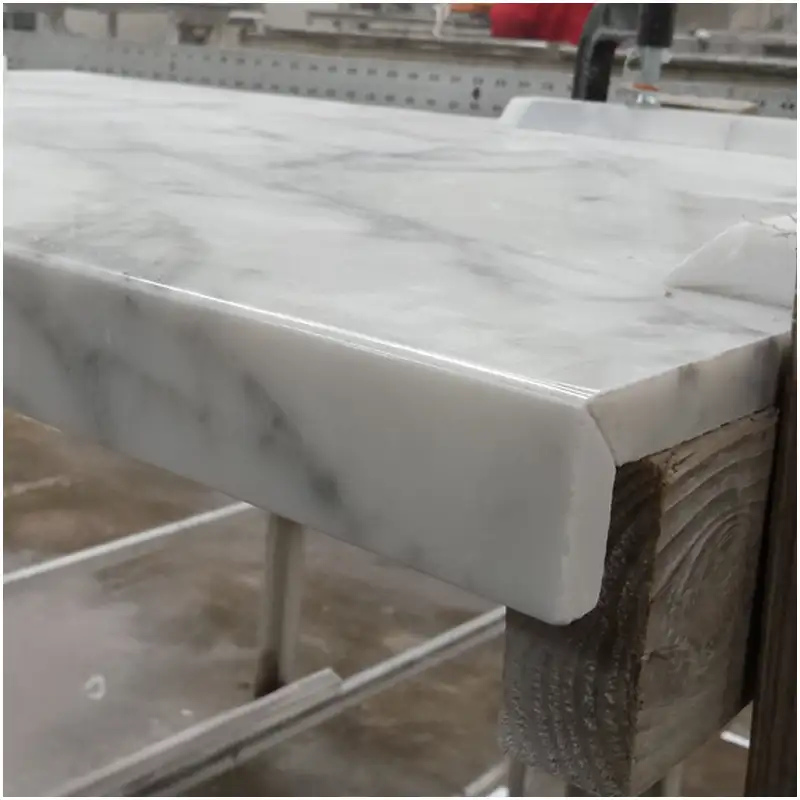
Stone damage often appears at the edges, corners, sink openings, and finished faces. These are the areas that need specific protection. A general layer of plastic or foam may not be enough for a polished marble vanity top, a mitered countertop edge, or a long stair tread.
For polished or honed surfaces, face-to-face contact should be avoided unless the packing method uses suitable protective layers. For sharp corners, corner guards or other protection may be needed. For finished edges, the crate should prevent rubbing, pressure points, and direct contact with hard packing materials. For sink cutouts, faucet holes, and narrow stone bridges, the packing plan should consider how the piece is supported around weak areas.
Backlit stone, onyx, translucent quartzite, and thin decorative panels require extra caution. FOR U STONE’s backlit stone wall materials, for example, may need careful face protection and handling because the final appearance depends on both stone integrity and surface clarity. A small chip or scratch can be more visible when light passes through the material.
Protection should not create new problems. Some tapes, films, adhesives, or spacers may leave marks on certain finishes if used incorrectly or left too long. The safest approach is to use packing materials appropriate for the stone type and finish, then document the packed condition before closure.
Photo records should follow the packing process
Photo records are not just marketing images. For export stone projects, they are part of the handover record. A good photo set can show what was finished, how it was packed, how it was labeled, and how it entered the container. This record helps if the receiving team has questions after arrival.
A practical packing photo set should include material photos before packing, piece labels, crate labels, protection details, closed crate photos, loading sequence, container number, seal number, and final loaded condition. For cut-to-size projects, it is useful to photograph pieces by drawing group before they are packed. For slabs, show the selected slabs and bundle condition. For countertops and vanity tops, show cutouts, edges, and finished faces.
Photos should be clear enough to identify the crate and piece codes. A beautiful close-up of marble veining is not enough if nobody can tell which crate the slab belongs to. The most useful records combine visual quality and traceability. File naming can also help. A folder labeled by project, PO number, material, crate number, and date is easier to use than dozens of unnamed phone photos.
FOR U STONE project communication should use these photos as a record, not as decoration. The goal is to help the project team confirm that the packed goods match the order before the container leaves.
Container loading needs its own checklist
Container loading is the last point where the factory can visually confirm how the packed stone leaves the origin. Once the container is sealed, later corrections become difficult. Loading should not be treated as simple forklift work. It is a documentation and risk-control step.
The loading team should check container condition before loading. The floor, walls, roof, doors, odor, water marks, and previous cargo residues should be reviewed. A damaged or wet container can create problems for stone, crates, labels, and packing materials. Photos of the empty container can help document the condition before loading begins.
The loading sequence should match weight distribution and unloading needs. Heavy crates should be positioned safely. Mixed crates should not be loaded in a way that makes the receiving team open the wrong materials first. If a project needs certain crates early for installation, that sequence should be discussed before loading. A container is not only a volume puzzle. It is part of the project’s delivery plan.
After loading, the record should show crate positions where possible, container number, seal number, and closed-door photos. The packing list, invoice, and shipping documents should match the crate count and labels. Any discrepancy should be corrected before the container leaves.
Comparison table: packing focus by product type
| Ürün Tipi | Main Packing Risk | What To Confirm |
|---|---|---|
| Natural stone slabs | Slab movement, face rubbing, wrong sequence, edge chips | Bundle support, slab order, face protection, selected slab photos, and crate or A-frame stability. |
| Cut-to-size wall and floor pieces | Mixed pieces, chipped corners, unclear room or drawing marks | Piece code, drawing number, room area, separators, corner protection, and packing list match. |
| Tezgahlar ve makyaj tezgahları | Sink cutout cracks, finished edge damage, faucet hole confusion | Cutout photos, edge protection, sink model reference, top orientation, and cabinet or room label. |
| Stairs and risers | Long thin pieces, wrong sequence, edge damage | Floor and flight code, tread or riser mark, length support, edge protection, and installation order. |
| Outdoor paving and pool coping | Heavy crates, surface rubbing, wrong size grouping | Thickness group, finish, size code, crate weight, forklift access, and unloading plan. |
What to check before approving shipment
Shipment approval should not depend only on the statement that packing is finished. The project team should receive enough information to understand what was packed and how. The level of detail can vary by order size, but the basic approval package should be consistent.
- Final packing list with material name, size, thickness, finish, quantity, crate number, and piece code where needed.
- Inspection photos showing surface, edge, cutouts, and finish before packing.
- Photos showing crate labels, piece labels, and internal protection where practical.
- Closed crate photos and total crate count.
- Wood packaging treatment or marking information when applicable for the destination.
- Container condition photos before loading.
- Loading photos showing crate placement and handling condition.
- Container number, seal number, and closed-door photos.
- Document check against invoice, packing list, and shipping instruction.
- Clear contact path for questions before the vessel departs.
This checklist is especially useful for mixed project shipments. If a container includes mermer wall panels, granit stair treads, quartzite countertop pieces, and bathroom stone packages, the receiving team needs a clear map of what is inside.
How packing supports installation and inquiries
Good packing does more than reduce transport risk. It also makes the receiving and installation process easier. When crates are labeled by room, area, or drawing code, the site team can sort materials faster. When photos show piece condition before shipment, the project team has a reference point. When the packing list matches the crate labels, fewer people need to guess where a piece belongs.
This matters for commercial projects because installation timing is often tight. A hotel lobby, villa wall, apartment bathroom, or retail floor may have several trades working at once. If stone crates are opened in the wrong order, pieces can be moved multiple times, increasing the chance of damage. If crate labels match the installation plan, the material can move from container to storage to work area with less confusion.
Packing also affects future inquiries. A project team that receives clear packing records is more likely to trust the production process. FOR U STONE should use packing photos, crate lists, inspection records, and loading documentation as part of the quotation and project communication path. A serious stone order is not finished when the stone is cut. It is finished when the material can be identified, unloaded, and installed with fewer preventable questions.
Related stone project guides
Sıkça sorulan sorular
1. What should be included in an export stone packing list?
An export stone packing list should include material name, finish, thickness, size, quantity, crate number, piece code, drawing or room reference where needed, and total crate count. For cut-to-size projects, the packing list should connect each piece to the approved drawings so the receiving team can identify where the material belongs after the container arrives.
2. Why are photos important before stone shipment?
Photos help document the condition of stone before packing, the labels used on pieces and crates, the protection inside the crate, and the way crates were loaded into the container. These records are useful when the receiving team checks quantity, surface condition, crate sequence, and possible transport issues. Photos should be clear enough to identify crate numbers and piece codes.
3. What is ISPM 15 and why does it matter for stone crates?
ISPM 15 is an international standard for wood packaging material used in international trade. When export stone crates, pallets, or dunnage use regulated wood packaging, the project should confirm whether compliant treatment and marking are required for the destination. This can affect customs inspection and port clearance, so it should be checked before the crates are completed.
4. How should cut-to-size stone pieces be labeled for a project?
Cut-to-size stone pieces should be labeled with a code that matches the approved drawing, room, elevation, floor, or installation area. The same code should appear on the piece where suitable, the packing list, and the crate label. Clear labeling helps the site team sort wall panels, floor pieces, countertops, stairs, and bathroom stone without opening every crate repeatedly.
5. What should be checked during container loading for stone shipments?
Before loading, check the container floor, walls, roof, doors, dryness, cleanliness, and visible damage. During loading, confirm crate count, crate labels, weight distribution, loading sequence, and handling condition. After loading, record the container number, seal number, crate placement where practical, and closed-door photos. These records should match the packing list and shipping documents.
Final Conclusion
Stone packing should be planned as part of project delivery, not treated as a simple warehouse task after production. The crate design, label system, edge protection, photo record, packing list, container condition, and loading sequence all affect whether the material can be received and installed with fewer preventable problems.
For marble, granite, quartzite, travertine, countertops, bathroom stone, stairs, wall panels, and outdoor flooring, the safest approach is to connect packing with drawings, inspection, and shipment documents. FOR U STONE can review material type, finish, quantity, drawings, packing method, and project destination so export stone orders move from production to delivery with clearer records.

Ask FOR U STONE for export packing planning
For a project order, send drawings, target material, finish, quantity, piece sizes, project location, and shipment requirements. FOR U STONE can help review stone selection, cut-to-size planning, inspection photos, packing records, and export delivery details before the order is shipped.
Referanslar
- ISPM 15 Regulation of Wood Packaging Material in International Trade, International Plant Protection Convention Secretariat, Food and Agriculture Organization of the United Nations, IPPC Standards.
- Wood Packaging Materials Frequently Asked Questions, Animal and Plant Health Inspection Service, United States Department of Agriculture, USDA APHIS.
- Dimension Stone Design Manual 2024, Natural Stone Institute Technical Committee, Natural Stone Institute, Natural Stone Institute.
- Standards and Specifications for Natural Stone Products, Natural Stone Institute Technical Committee, Natural Stone Institute, Natural Stone Institute.
- ASTM C1528/C1528M Standard Guide for Selection of Dimension Stone, ASTM Committee C18, ASTM International, ASTM International.
- ASTM C119 Standard Terminology Relating to Dimension Stone, ASTM Committee C18, ASTM International, ASTM International.
- Container Loading And Cargo Securing Guidance, International Maritime Organization, International Maritime Organization, IMO Publications.
- Transport Information Service Guidance for Natural Stone, German Insurance Association Cargo Loss Prevention Team, GDV, Transport Information Service.