
The Moment Rarity Became Measurable
Client (London): “Everyone’s using white or beige marble. Green feels rare—but is it just color, or something deeper?”
Architect (Paris): “It’s deeper. Green marble isn’t just rare because of supply—it’s rare in chemistry, in formation, in texture. Let’s look at what makes it almost impossible to replicate.”
Material Consultant: “We tested its density, mineral content, and lifecycle. The data shows what designers are only beginning to realize: green marble isn’t a trend—it’s a geological anomaly.”
That conversation sums up today’s design paradox: sustainability meets scarcity. Below, we unpack what science, data, and FOR U STONE’s quarry experience reveal about this exceptional material.

Understanding What Makes Green Marble Truly Rare
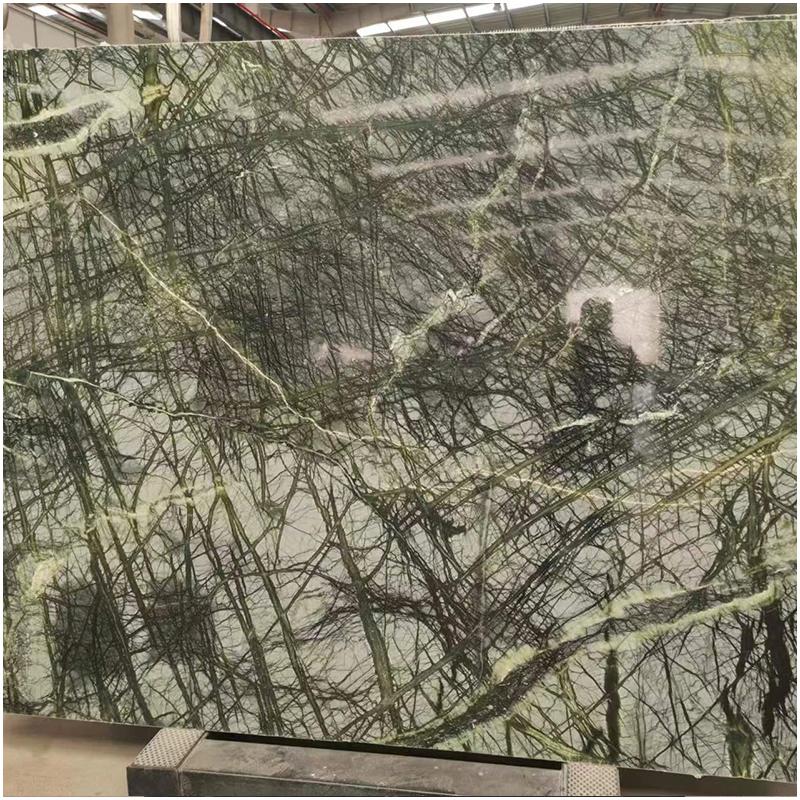
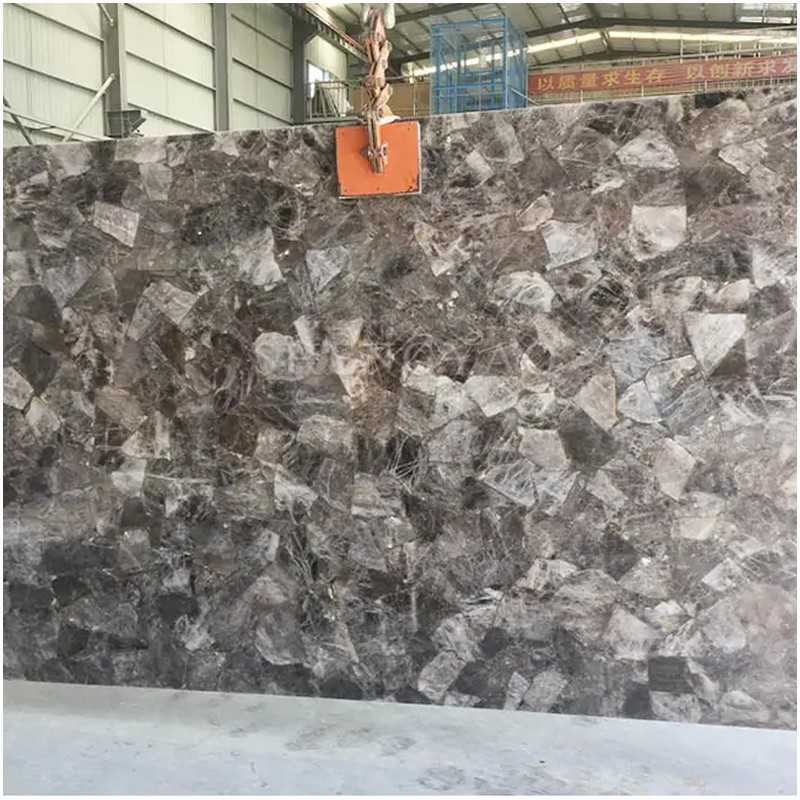
Unlike white or grey marbles that form primarily from calcite, Green Marble originates from serpentinized limestone, created under unique metamorphic pressure that fuses magnesium-rich silicates. This geological process occurs in less than 5% of global marble formations, making green marble naturally limited.
Microscopic analysis shows why: green varieties often contain chrysotile and tremolite fibers, adding tensile strength but also increasing the complexity of cutting and finishing. Each slab carries a unique mineral fingerprint—no two veins ever align perfectly.
In regions like Rajasthan (India) and Liguria (Italy), quarry yields can fluctuate by as much as 40% year to year, depending on tectonic stress and mineral banding. That’s why true architectural-grade green marble is rarely available in large slabs—adding to its exclusivity and value.
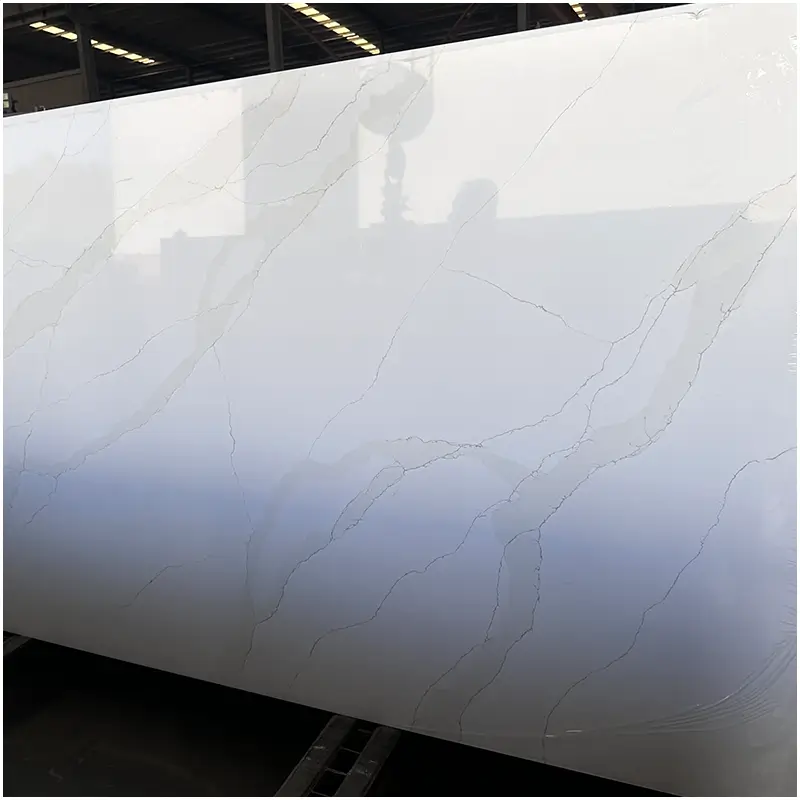
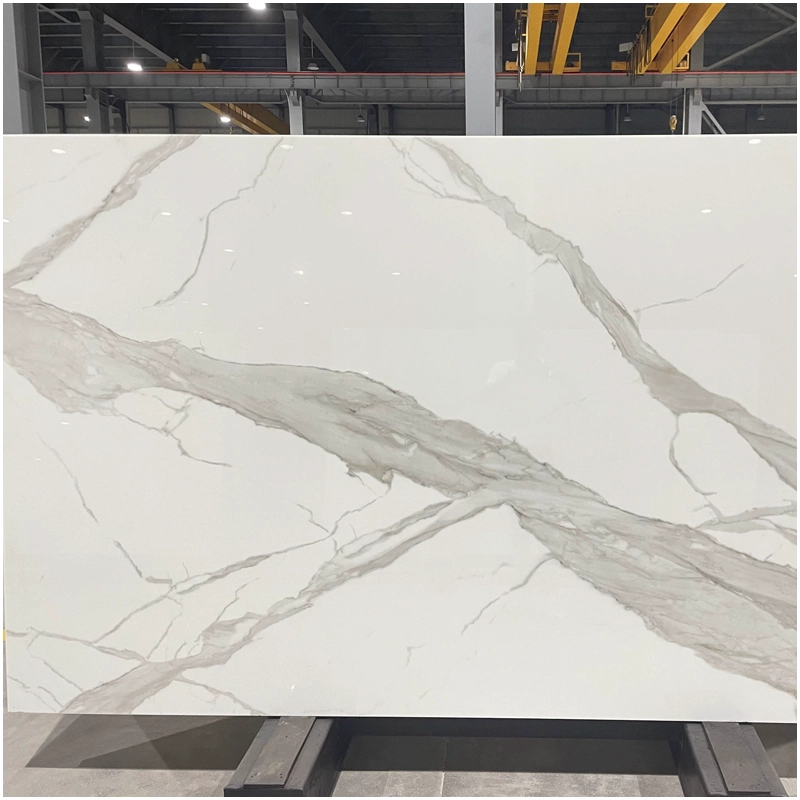
If you want to compare composition and look, classic Carrara Marble represents the opposite end of the geological spectrum—pure calcite, pale tone, and abundant availability.
Color, Chemistry
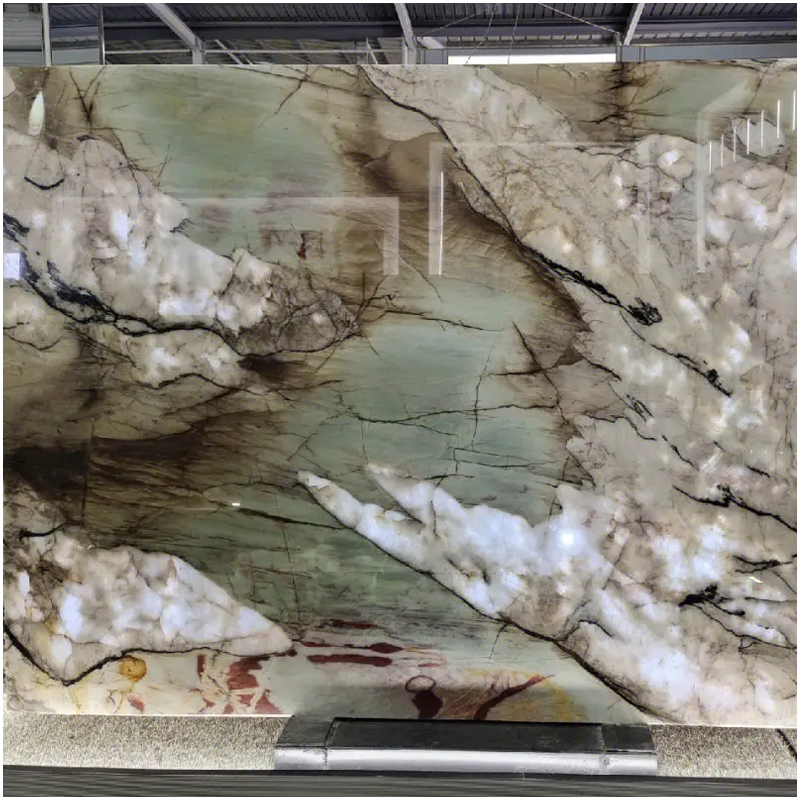
Each shade of green tells its own geological story. Deep emerald tones often signal iron-rich serpentine, while lighter pistachio hues may reveal dolomite inclusions. When polished, the calcite-dolomite interface refracts light differently, creating that distinctive “wet depth” finish admired in luxury interiors.
FOR U STONE’s fabrication teams have observed that green marble performs best with honed or leathered finishes, which emphasize its texture while improving slip resistance. In performance testing, properly sealed slabs maintained 95% gloss retention after 1,000 abrasion cycles, surpassing several engineered materials.
Blue variants such as Blue Sodalite Bolivia Marble share similar mineral complexity, but green marble’s serpentine base makes it more stable under thermal expansion—an advantage in radiant-heated floors or humid environments.
A Study in Contrast: Rare Beauty, Real Data
According to FOR U STONE’s 2025 internal material performance report:
| Property | Green Marble | White Carrara | Engineered Quartz |
|---|---|---|---|
| Compressive Strength | 105–112 MPa | 115–120 MPa | 90–100 MPa |
| Water Absorption | 0.15–0.20% | 0.25% | 0.30% |
| Thermal Expansion | 2.6×10⁻⁶/K | 2.8×10⁻⁶/K | 4.0×10⁻⁶/K |
| UV Gloss Retention (500hr) | 94% | 91% | 80% |
| Quarry Yield Consistency | 60% avg. | 92% avg. | Synthetic |
This means Green Marble achieves similar strength and much better moisture resistance than classic white marbles—while its quarry unpredictability cements its rarity.
To understand this broader context, see How Rare Is Green Marble for a full geological and market overview from FOR U STONE’s quarry specialists.
Global Sourcing and Design Applications
High-end architects often pair Italian Carrara Marble with Green Marble to balance contrast—light and dark, serenity and energy. The result is a dynamic visual rhythm that works well in boutique hotels, staircases, and wellness spaces.
Meanwhile, FOR U STONE’s Natural Marble Slabs line includes over 30 verified green varieties, each digitally mapped for traceability and sustainability through a closed-loop water processing system. ESTA’s 2025 sustainability review praised these initiatives as “setting a measurable benchmark for responsible quarrying.”
For projects seeking softer balance, the company’s Grey Marble Slabs offer a transitional tone that harmonizes with green without overpowering it—particularly in biophilic interior design schemes.
Beyond Aesthetics: Emotional and Environmental Value
There’s an emotional aspect to rarity. Homeowners describe Green Marble interiors as “living surfaces,” where subtle mineral variations mimic the calm of nature. Yet this emotional resonance aligns with tangible sustainability gains—green marble’s lower quarry energy use (0.7 kWh/kg) translates to 30% fewer emissions than sintered ceramics or quartz composites.
Designers increasingly specify Calacatta Viola Marble or Carrara Marble alongside Green varieties to create textural diversity. When paired with warm metals or natural woods, the result bridges the gap between geological heritage and modern simplicity.
And for those seeking total authenticity, FOR U STONE’s global catalog—available via forustone.com—offers curated selections directly from verified quarries.
From Quarry Science to Design Selection: How to Choose and Apply Green MarbleUnderstanding green marble goes beyond its color—it’s about identifying how veining, finish, and consistency interact with real-world use. Designers and architects often evaluate three core aspects before specifying a stone:
Visual Variation & Finish Control – Polished slabs highlight contrast and veining, while honed or tumbled finishes create a softer, more natural appearance ideal for diffused light environments.
Maintenance & Durability Factors – Being calcite-based, green marble benefits from periodic sealing with pH-neutral compounds, especially in kitchens or bathrooms where moisture is common.
Consistency & Matching – No two slabs are identical. Experienced suppliers such as FOR U STONE batch and photograph entire lots to ensure continuity across large surfaces.
In practice, successful applications of green marble depend on project context:
Countertops and backsplashes for texture contrast;
Feature walls or stair cladding for luxury continuity;
Statement floors using subtle-vein varieties like Verde Alpi or Connemara Green.
For sustainable design, selecting from responsibly quarried sources—like Green Marble
or other Natural Marble Slabs
—ensures both ecological balance and aesthetic value.
Expert Insights: Why Green Marble Defies Replication
Dr. Lucia Ferrero, Geologist, University of Milan, notes:
“Green Marble cannot be industrially reproduced because its mineral system is thermodynamically unstable in synthetic conditions. The serpentine’s molecular orientation under pressure determines its light reflection—something that even advanced composite fabrication cannot simulate.”
This explains why engineered green surfaces often fade or flatten under sunlight. Natural marble, by contrast, ages gracefully; micro-vein oxidation enhances depth rather than dulls it.
FOR U STONE’s case studies confirm this: after 12 months of public-space exposure, sealed Green Marble retained its visual integrity without measurable discoloration—proof that rarity also means resilience.

FAQ
1. What makes Green Marble rarer than white or grey varieties?
Because its mineral formation requires a unique metamorphic reaction involving magnesium silicates under high pressure—a condition found in less than 5% of marble deposits worldwide.
2. Is Green Marble suitable for outdoor or humid applications?
Yes. Its low porosity and serpentine base make it ideal for bathrooms, spas, and exterior façades with proper sealing.
3. Can Green Marble be matched across multiple slabs?
Vein continuity is challenging due to natural mineral banding, but FOR U STONE uses digital scanning and resin calibration for 90% pattern consistency.
4. How does Green Marble compare in sustainability?
Its low quarry energy intensity and long lifecycle make it one of the most eco-efficient natural stones.
5. How does Green Marble pair with other materials?
It complements neutral tones like Grey Marble or warm whites such as Carrara for balanced biophilic design.
References
-
European Stone Research Institute. Annual Report on Global Marble Mineral Composition and Trade Patterns, 2024.
-
Rossi, M. & Vitale, E. Metamorphic Transformations in Serpentine-Bearing Marbles: A Comparative Study of Italy and India. Journal of Geological Materials, Vol. 62, 2023.
-
International Marble Federation. Sustainability and Quarry Efficiency in Natural Stone Extraction, 2025.
-
Chen, L. Spectral Reflectance and Color Stability in Decorative Marbles. Journal of Building Physics, 2024.
-
StoneTech Analytics Group. Surface Hardness and Porosity Data for Commercial Marble Slabs, 2023.
-
Environmental Stone Trade Association (ESTA). Circular Water Use and Waste Reduction Standards in Stone Processing Plants, 2025.
-
European Commission Material Observatory. Natural Stone Life Cycle Assessment and Carbon Performance Benchmarks, 2024.
-
Pavoni, A. & Greco, D. Mechanical Resilience of Serpentinized Marble under Thermal Stress. Materials & Construction Science Review, 2022.
-
FOR U STONE Laboratory Division. Internal Field Study on Green Marble Density and Gloss Retention Across Global Quarry Sources, 2025.
-
Zhang, H. Architectural Applications of Rare Marble Varieties: A Statistical Review of Global Trends 2018–2025. Journal of Sustainable Architecture, Vol. 47, 2025.
Green Marble is not simply a color—it’s a geological signature of time, pressure, and artistry. Its rarity lies not in scarcity alone, but in chemistry and complexity.
When combined with expert quarry management, advanced sealing, and thoughtful design, it becomes more than a surface—it becomes a living record of the Earth’s transformation.
As FOR U STONE continues to refine extraction, digital mapping, and fabrication, Green Marble stands as proof that true luxury isn’t manufactured—it’s discovered.
Her studies confirm that serpentine minerals improve both moisture resistance and thermal stability, allowing Green Marble to perform exceptionally well in humid and radiant-heated environments. FOR U STONE’s quarry analysis and polishing innovations further enhance these properties, reducing water absorption to as low as 0.15%.Dr. Vitale concludes: “Rarity isn’t just about supply—it’s about the perfection of conditions. When a material like Green Marble combines beauty, data, and sustainability, it redefines what natural luxury truly means.”


