สรุปอย่างรวดเร็ว
What Is Marble Mosaic?
Marble mosaic is made from natural marble through cutting, shaping, polishing, sorting, arranging, and mounting. Unlike printed surface materials, marble mosaic preserves the natural color, mineral movement, and texture of the stone itself. In a well-made marble mosaic, the beauty does not come from artificial dye or a flat printed pattern. It comes from the natural variation of the marble.
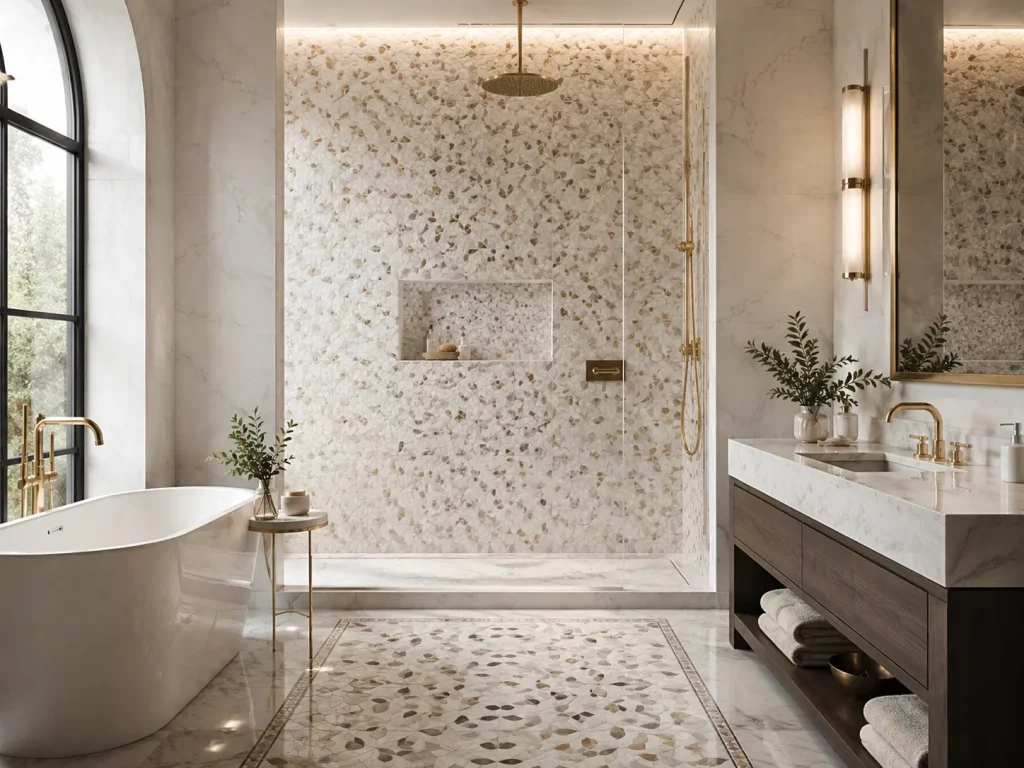
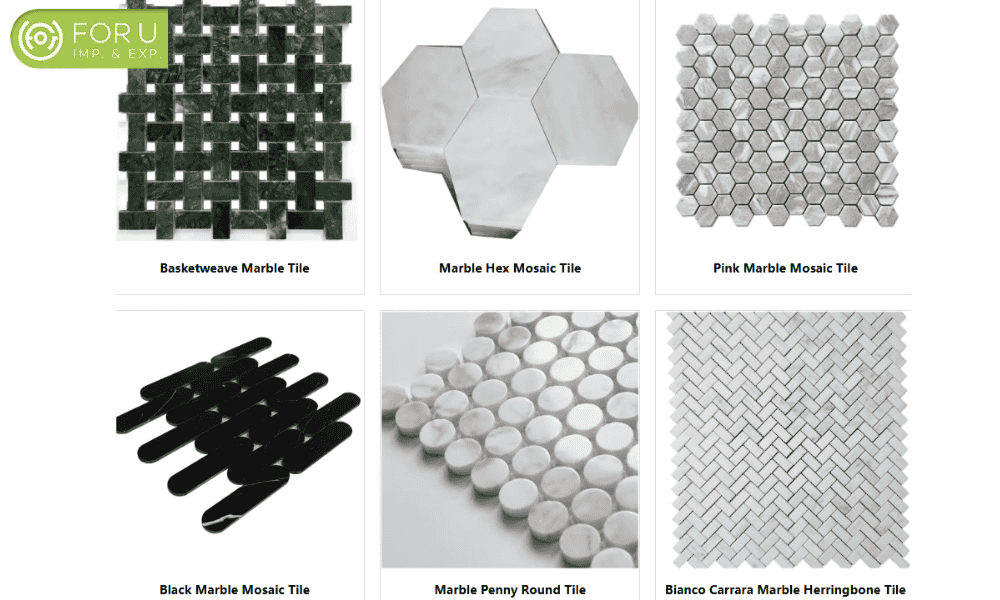
This is why marble mosaic has a different feeling from ordinary wall tiles. It creates a quieter, more natural, and more artistic space. The small pieces of stone can form simple grids, complex flowers, geometric borders, curved patterns, gradient effects, medallions, or fully customized art panels. In the right space, marble mosaic can make people feel the texture of natural stone, the rhythm of handmade detail, and the elegance of classical decoration.
Because each mosaic unit is small, marble mosaic can express design ideas more flexibly than large-format slabs. A single slab usually shows one large stone surface, while mosaic can use many small pieces to create movement, contrast, color layers, and artistic transitions. This is why marble mosaic is widely used in hotel lobbies, bathrooms, swimming pools, bars, restaurants, villa floors, wall panels, entertainment venues, stations, spas, and art parquet projects.
Marble Mosaic Material Parameters Buyers Should Know
Before choosing กระเบื้องโมเสกหินอ่อน tiles, buyers should understand the basic material parameters. These parameters affect cutting difficulty, installation cost, loss rate, joint filling, final visual effect, and long-term performance. A mosaic may look small, but the technical logic behind it is not small at all. Tiny stone, big headache if selected badly.
| Material Parameter | Typical Marble Mosaic Feature | Buyer Impact |
|---|---|---|
| วัตถุดิบ | Natural marble, including white, beige, yellow, red, green, grey, and black marble types | Determines color tone, veining, hardness, cutting difficulty, and final decoration style. |
| Unit Size | Small pieces are commonly used for mosaic patterns, borders, gradients, and art parquet | Smaller pieces allow more complex patterns but require more processing and joint filling. |
| การเคลือบผิว | Polished, honed, tumbled, brushed, sandblasted, or antique finish | Controls gloss, slip feel, cleaning difficulty, and visual atmosphere. |
| ความหนา | Project thickness varies by wall, floor, or decorative panel use | Affects installation method, floor height, strength, and compatibility with surrounding materials. |
| Color Variation | Natural stone pieces may show different tones even from the same stone type | Buyers should approve samples and understand natural variation before bulk production. |
| Joint Filling | Small-particle mosaics require more grout lines than large tiles | Grout color, width, and cleaning method strongly affect the final result. |
Why Marble Mosaic Is Used for Walls and Floors
Marble mosaic is mainly used for wall and floor decoration because it combines material value with artistic flexibility. A single mosaic unit has a small area, but different colors, shapes, and arrangements can be combined almost infinitely. This allows designers to express modeling ideas, space rhythm, cultural style, and visual personality more freely than with simple large tiles.
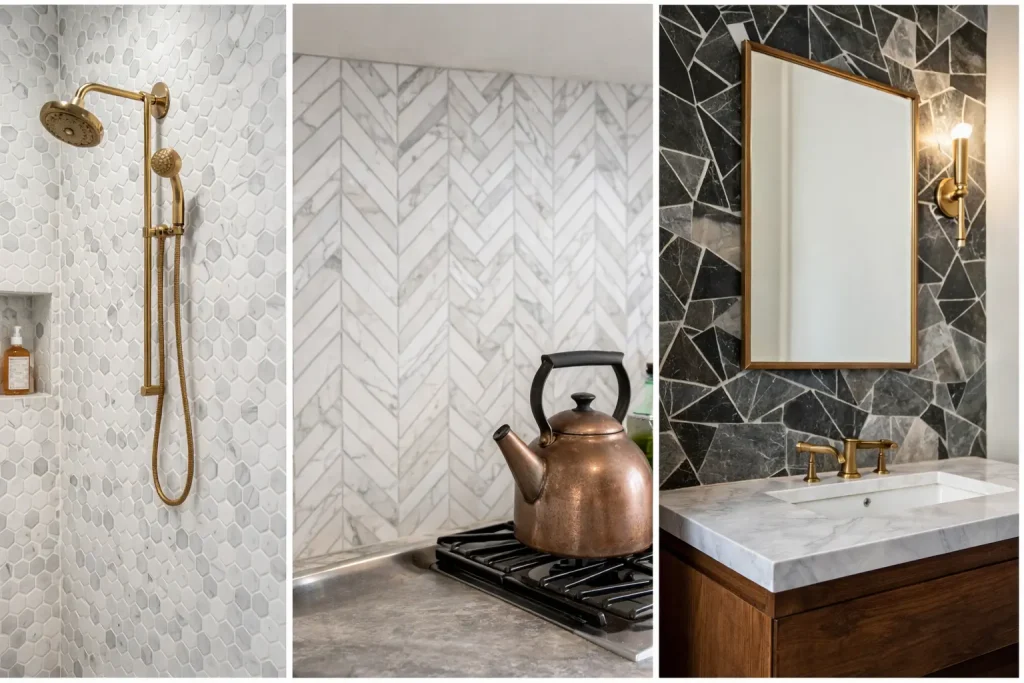
On walls, marble mosaic can be used for bathroom backsplashes, shower walls, spa feature walls, kitchen backsplashes, hotel corridors, bar counters, elevator surrounds, and decorative background panels. On floors, it can be used for villa entrances, hotel lobby borders, bathroom floors, swimming pool edges, art parquet, and custom medallions. When used properly, marble mosaic can create a final effect that exceeds ordinary smooth-surface tiles.
For commercial projects, marble mosaic is valuable because it can make a space feel customized without requiring an entire wall or floor to be made from expensive large slabs. A border, feature panel, small art area, or decorative partition can upgrade the whole interior. This is one of the reasons marble mosaic remains popular in hotels, bars, stations, swimming pools, entertainment venues, and high-end homes.
| ประเภทโมเสค | Main Advantage | Best Use Scenario | Buyer Risk to Check |
|---|---|---|---|
| หินอ่อนโมเสก | Natural stone texture, premium appearance, strong artistic value | Hotels, villas, bathrooms, feature walls, art parquet, luxury interiors | Color variation, cutting loss, grout care, and stone maintenance. |
| Ceramic Mosaic | Stable color, easy cleaning, broad availability | Bathrooms, kitchens, public walls, economical projects | May lack natural stone depth and premium material value. |
| กระเบื้องโมเสกแก้ว | Bright reflection, water-friendly appearance, modern color effects | Pools, bathrooms, spa walls, decorative accents | Slipperiness, breakage risk, and visible adhesive or backing issues. |
| Metal Mosaic | Modern industrial texture and strong visual contrast | Commercial interiors, bars, feature panels, retail design | Scratching, fingerprints, corrosion risk, and style limitations. |
Cost and Value: Why Marble Mosaic Can Be a Smart Decoration Choice
One common advantage of marble mosaic is that it can deliver strong decorative value without requiring a full space to be covered by expensive large stone slabs. In many projects, buyers use marble mosaic in selected areas such as borders, wall highlights, shower niches, entrance medallions, or feature strips. This creates a high-end visual effect while keeping material use more controlled.
The original idea that marble mosaic has a relatively cheap cost should be understood correctly. The raw stone pieces may be more cost-effective than large premium slabs in some cases, especially when using smaller pieces or mixed materials. However, complex patterns, sharp corners, multiple stone colors, hand assembly, and detailed sanding can increase labor cost. So the real value of marble mosaic is not simply “cheap.” It is the ability to create higher visual impact from smaller material areas.
If a buyer has the same budget, marble mosaic can often create stronger decorative detail than a plain wall tile. If a buyer wants the same luxury atmosphere, marble mosaic can sometimes reduce the need for full-slab installation. This makes it useful for designers, contractors, hotels, and homeowners who want a balance between beauty, customization, and project control.
| Buyer Goal | Choose Marble Mosaic If… | Choose Large Marble Slab If… | Commercial Logic |
|---|---|---|---|
| Same Budget, Higher Decoration Detail | You want borders, patterns, gradients, or artistic surfaces. | You want a continuous large natural stone surface. | Mosaic creates stronger design detail from smaller stone areas. |
| Same Visual Grade, Lower Full-Surface Cost Pressure | You only need feature zones, shower walls, or decorative panels. | The whole wall or floor must show continuous stone veining. | Partial mosaic use can reduce full-slab dependency. |
| Higher Customization | You need logos, floral patterns, geometric layouts, or art parquet. | You need natural slab movement as the main design language. | Mosaic is more flexible for complex design expression. |
| Lower Pattern Risk | You approve a repeatable pattern and color range before production. | You accept natural slab variation and layout planning. | Clear samples and drawings reduce disputes during installation. |
Stone Color, Hardness, and Cutting Difficulty
Different marble colors and stone types behave differently during mosaic production. Beige and white marble types often have lower hardness and are easier to cut. Blue and green marble types may contain more mineral complexity or metal-related elements, and some can be harder, rarer, and more expensive. This is why buyers should not assume all กระเบื้องโมเสกหินอ่อน tiles have the same processing difficulty.
Some materials are beautiful but not dense enough for easy cutting. White marble, rosin yellow, hibiscus red, domestic green flower marble, and other decorative stones may have higher loss rates when cut into small pieces, depending on block quality and structure. Fragile materials may break during cutting, sanding, transport, or installation. For complex mosaic patterns, this loss rate must be considered during quotation.
A professional marble mosaic supplier should explain material suitability before production. If a buyer chooses only by color without considering cutting performance, the final cost and production time may increase. Beautiful stone is lovely, but if it breaks like a biscuit during cutting, the factory will not be smiling.
| Stone Color / Type | Typical Processing Feature | การใช้งานที่แนะนำ | Buyer Reminder |
|---|---|---|---|
| ซีรี่ส์หินอ่อนสีขาว | Elegant, relatively easier to cut in many varieties, visible natural variation | Bathrooms, walls, borders, hotel interiors, classic designs | Check stain resistance, veining consistency, and sealing needs. |
| ซีรี่ส์หินอ่อนสีเบจ | Warm tone, soft luxury, usually easier to match with interiors | Villas, hotel corridors, floors, spa walls, living spaces | Approve color range because beige stones can vary between batches. |
| Green / Blue Marble Series | More distinctive, sometimes harder or rarer depending on material | Feature panels, luxury bathrooms, statement walls, art parquet | Check cutting difficulty, loss rate, availability, and budget. |
| Red / Yellow Decorative Marble | Strong color personality, may be more fragile in some types | Artistic mosaics, borders, cultural patterns, custom panels | Request sample cutting and confirm breakage rate before bulk order. |
Structural Characteristics of Small Particle Marble Mosaic
Small particle marble mosaic has its own structural advantages. Because the individual pieces are small, they can be arranged tightly and used to create complex surface effects. The pattern can change greatly, and in some cases it can approach the smooth visual rhythm of larger mosaic surfaces while still offering more detailed stone movement.
Small particles are especially useful when the design requires curves, gradients, flower shapes, borders, waves, logos, or complex custom patterns. However, they also bring more production and installation requirements. Smaller units mean more joints, more sorting, more backing control, and more grout work. During decoration, joint filling and surface cleaning must be handled carefully.
There may also be color differences between small particles. This is normal for natural marble, but the supplier should sort materials according to the approved sample standard. Buyers should not expect natural marble mosaic to look like a printed ceramic sheet. The charm is natural variation, but the control is professional selection.
| Structural Feature | ข้อได้เปรียบ | Installation Consideration |
|---|---|---|
| Tight Small-Particle Structure | Can create detailed patterns, curves, gradients, and art effects | Requires accurate backing, proper adhesive, and careful alignment. |
| High Pattern Flexibility | Suitable for custom design, decorative borders, and complex shapes | More complex patterns increase production time and labor cost. |
| Natural Color Variation | Creates richer texture and more natural stone character | Requires sample approval and material sorting before production. |
| More Grout Lines | Can add visual rhythm and anti-slip texture in some areas | Needs more joint filling, cleaning, and grout color planning. |
| Flexible Reorganization | Can be adjusted for walls, floors, edges, and partitions | Installer skill affects the final flatness and pattern continuity. |
Complexity Evaluation: What Makes Marble Mosaic More Difficult?
The complexity of a กระเบื้องโมเสกหินอ่อน project depends on the number of materials, the number of unit sizes, the sharpness of corners, and the complexity of the pattern itself. More stone types create more sorting work. More sizes create more cutting and layout work. More sharp corners increase sanding difficulty. More complex patterns increase the need for accurate drawings and skilled assembly.
This is important for buyers because complexity affects price, production time, quality risk, and installation planning. A simple square mosaic sheet is very different from a custom hotel lobby medallion made from five stone colors, curved borders, and many sharp corners. If the supplier quotes both as if they are the same, something is wrong. The little stones know the truth.
| Complexity Factor | Low Complexity | High Complexity | Impact on Cost and Production |
|---|---|---|---|
| Number of Stone Types | 1–2 materials | 4 or more materials | More materials increase sorting, matching, and stock management. |
| Unit Block Size Variation | One repeated size | Multiple sizes and shapes | More sizes require more cutting accuracy and layout checking. |
| Corner and Edge Detail | Simple square or rectangle | Sharp corners, curves, petals, logos | Sharp or curved parts increase sanding and breakage risk. |
| Pattern Difficulty | Grid, border, simple wave | Gradient, art parquet, logo, medallion | Complex pattern requires drawings, templates, and skilled assembly. |
Real Project Scenarios for Marble Mosaic
In hotels, marble mosaic is often used for lobby borders, bathroom walls, spa floors, corridor details, and decorative panels. It helps create a high-end atmosphere without requiring every surface to be covered with large stone slabs. A small mosaic border can make a hotel corridor feel more designed. A marble mosaic shower wall can make a guest bathroom feel more premium.
In residential interiors, marble mosaic is suitable for kitchen backsplashes, bathroom floors, entrance areas, living room feature walls, staircase landings, and custom art panels. A homeowner may use โมเสกหินอ่อนสีขาว for a clean bathroom wall, beige marble mosaic for a warm spa-style floor, or green marble mosaic for a decorative niche.
In commercial spaces, marble mosaic can support brand identity. Bars, restaurants, clubs, swimming pools, retail stores, and entertainment venues often need memorable surfaces. Mosaic can create logos, patterns, partitions, edge trims, and decorative focus areas. When applied properly, the final effect can be much stronger than a plain smooth-surface tile.
Compliance and Quality Checks Before Ordering Marble Mosaic
For wall and floor decoration projects, buyers should not check appearance only. They should confirm material type, thickness, surface finish, mesh backing, adhesive compatibility, grout joint width, slip resistance for floors, sealing requirements, packaging, and installation instructions. For wet areas such as bathrooms, pools, spas, and shower floors, water exposure and cleaning chemical resistance should be considered.
For international buyers, standards and regulations may vary by market. Natural stone tiles and mosaic installations may need to follow local building codes, tile installation guidelines, adhesive standards, slip-resistance requirements, and indoor material safety requirements. If buyers are concerned about radioactivity, they should request testing reports based on the destination country’s requirements rather than relying on visual judgment. Natural stone use should always be supported by documentation when the project is public, commercial, or hospitality-based.
Professional procurement should include sample approval, pre-production drawings, material confirmation, color range approval, packing method, installation guidance, and after-sales claim standards. Marble mosaic is beautiful, but it is detailed work. The supplier’s process matters as much as the stone itself.
| การตรวจสอบคุณภาพ | ทำไมจึงสำคัญ | Buyer Action |
|---|---|---|
| Sample Approval | Natural marble has color and vein variation. | Approve physical samples before bulk production. |
| Mesh Backing Quality | Poor backing can affect installation alignment. | Check backing strength, flexibility, and adhesive compatibility. |
| Thickness and Flatness | Uneven pieces can affect wall and floor finish. | Confirm tolerance and inspect random pieces before shipment. |
| Grout Planning | Grout color changes the final visual effect. | Choose grout color with sample mock-up, not imagination. |
| การปกป้องในการบรรจุภัณฑ์ | Small mosaic pieces can chip during transport. | Request carton, foam, pallet, and moisture protection details. |
Industry Trend: Why Marble Mosaic Still Has Strong Design Demand
Marble mosaic remains popular because modern design is moving toward personalized surfaces, natural materials, and smaller decorative details that make spaces feel less generic. Large slabs are still important, but designers increasingly use mosaic to add rhythm, softness, and craftsmanship to interiors.
Another trend is the return of hotel-style bathrooms and spa-style residential interiors. Homeowners want bathrooms that feel calm and premium. Hotels want surfaces that are memorable but practical. Restaurants and bars want visual details that photograph well. Marble mosaic fits this trend because it brings natural stone texture into smaller, more controlled design zones.
The demand is also supported by custom manufacturing. Digital drawings, waterjet cutting, improved backing systems, better adhesives, and stronger packaging make complex marble mosaic projects easier to manage than before. For B2B buyers, this means marble mosaic is no longer only a decorative luxury. It can be a planned product category for hotels, villas, swimming pools, retail spaces, and commercial interiors.
Common Mistakes When Buying Marble Mosaic
The first mistake is choosing only by picture. A mosaic pattern may look perfect in a digital image, but the real stone may show color differences, vein movement, and small texture changes. Buyers should request samples, not just product photos.
The second mistake is ignoring installation conditions. A wall mosaic and a floor mosaic may need different thickness, backing, adhesive, grout, and finish. Wet areas such as bathrooms, pools, and spas require more attention to water exposure, slip feel, and cleaning.
The third mistake is underestimating pattern complexity. More colors, more shapes, more sharp corners, and more curved lines usually mean more labor and higher loss. Buyers should confirm drawings and complexity level before asking for a final quotation.
The fourth mistake is not planning grout. Grout is not a boring afterthought. It can change the whole look of marble mosaic. A matching grout creates a soft and seamless effect. A contrasting grout makes every unit more visible. Choose wrong, and the mosaic may suddenly look like it got dressed in the dark.
FAQ About Marble Mosaic
1. What is marble mosaic made of?
โมเสกหินอ่อนทำจากชิ้นหินอ่อนธรรมชาติที่ถูกตัด ขึ้นรูป ขัดเงา คัดแยก และจัดเรียงเป็นลวดลายตกแต่งสำหรับใช้กับผนังและพื้น วัสดุนี้มักจะคงสีและพื้นผิวธรรมชาติของหินไว้ โดยไม่พึ่งพาเอฟเฟกต์พื้นผิวที่พิมพ์ลงไป ขึ้นอยู่กับโครงการ โมเสกหินอ่อนสามารถติดตั้งบนแผ่นตาข่ายและจัดส่งในรูปแบบแผ่น ขอบ ตราประดับ แผงศิลปะ หรือลวดลายตามสั่งเพื่อให้ติดตั้งได้ง่ายยิ่งขึ้น
2. Where can marble mosaic tiles be used?
กระเบื้องโมเสคหินอ่อนสามารถนำไปใช้ได้กับผนังห้องน้ำ พื้นห้องอาบน้ำ ผนังกั้นครัว ล็อบบี้โรงแรม ทางเข้าวิลล่า ขอบสระว่ายน้ำ ผนังสปา เคาน์เตอร์บาร์ ภายในร้านอาหาร การตกแต่งสถานี สถานที่บันเทิง และโครงการปาร์เกต์ศิลปะตามสั่ง โดยเฉพาะอย่างยิ่งเมื่อผู้ออกแบบต้องการพื้นผิวหินธรรมชาติ รายละเอียดขนาดเล็ก ขอบเขต ไล่เฉดสี หรือลวดลายซับซ้อนที่ยากจะสร้างขึ้นด้วยแผ่นหินขนาดใหญ่
3. Is marble mosaic suitable for bathroom floors?
โมเสกหินอ่อนสามารถใช้เป็นพื้นห้องน้ำได้หากเลือกผิวหน้า ความหนา แผ่นรอง พื้นผิวติดกาว ยาแนว และวิธีการปิดผนึกที่เหมาะสม ชิ้นโมเสกขนาดเล็กจะทำให้เกิดเส้นยาแนวมากขึ้น ซึ่งอาจช่วยเพิ่มแรงยึดเกาะของพื้นเมื่อเทียบกับกระเบื้องขัดเงาขนาดใหญ่บางชนิด อย่างไรก็ตาม ผู้ซื้อยังจำเป็นต้องตรวจสอบคุณสมบัติเรื่องการลื่นไถล การสัมผัสกับน้ำ ข้อกำหนดด้านการบำรุงรักษา และมาตรฐานอาคารในท้องถิ่นสำหรับพื้นห้องอาบน้ำและพื้นที่เปียก โดยปกติแล้ว ผิวหน้าแบบขัดหยาบหรือผิวหน้าที่มีลักษณะเป็นเนื้อหยาบจะเหมาะกว่าพื้นผิวขัดเงามาก
4. What affects the price of marble mosaic?
ราคาของโมเสกหินอ่อนขึ้นอยู่กับชนิดหิน ความหายากของสี ขนาดหน่วย ความซับซ้อนของลวดลาย ความยากง่ายในการตัด จำนวนวัสดุที่ใช้ รายละเอียดขอบ งานขัดผิว แผ่นรองตาข่าย การบรรจุภัณฑ์ และปริมาณการสั่งซื้อ แผ่นโมเสกสี่เหลี่ยมแบบเรียบมักผลิตได้ง่ายกว่า ในขณะที่เมดัลเลียน สัญลักษณ์โลโก้ ไล่เฉดสี ลวดลายมุมแหลมคม และการออกแบบหลายสีที่ทำตามสั่งนั้นต้องใช้แรงงานมากกว่าและมีการสูญเสียวัสดุสูงกว่า ผู้ซื้อควรเปรียบเทียบทั้งต้นทุนวัสดุและความซับซ้อนในการผลิตก่อนยืนยันคำสั่งซื้อ
5. How should buyers choose a marble mosaic supplier?
ผู้ซื้อควรเลือกซัพพลายเออร์โมเสคหินอ่อนที่สามารถจัดหาตัวอย่างจริง ตัวเลือกวัสดุ การควบคุมช่วงสี แบบแปลนการตัด ยืนยันลวดลาย รายละเอียดแผ่นรองตาข่าย คำแนะนำในการติดตั้ง การตรวจสอบคุณภาพ และบรรจุภัณฑ์ที่ปลอดภัย สำหรับโรงแรม วิลล่า สระว่ายน้ำ การตกแต่งภายในเชิงพาณิชย์ และโครงการศิลปะตามสั่ง การทำงานร่วมกับซัพพลายเออร์หรือโรงงานที่เข้าใจทั้งพฤติกรรมของหินธรรมชาติและความซับซ้อนในการผลิตโมเสคจะปลอดภัยกว่า
อ้างอิง
1. Dimension Stone Design Manual — Natural Stone Institute — Natural Stone Institute — Natural Stone Institute Publications.
2. Learn About Natural Stone Care and Maintenance — Natural Stone Institute — Natural Stone Institute — Natural Stone Institute Consumer Care Resources.
3. TCNA Handbook for Ceramic, Glass, and Stone Tile Installation — Tile Council of North America — TCNA — TCNA Technical Publications.
4. ANSI A108/A118/A136.1 Installation Standards for Ceramic Tile — American National Standards Institute — ANSI — Tile Installation Standards.
5. ISO 13007 Ceramic Tiles, Grouts and Adhesives — International Organization for Standardization — ISO — ISO Standards Catalogue.
6. ASTM C503/C503M Standard Specification for Marble Dimension Stone — ASTM International — ASTM International — ASTM Stone Standards.
7. Slip Resistance and Floor Safety Technical Guidance — Health and Safety Executive — HSE — HSE Flooring and Slip Resistance Resources.
8. Natural Stone Sustainability Standard ANSI/NSI 373 — Natural Stone Institute — Natural Stone Institute — Natural Stone Sustainability Resources.
บทสรุป
Marble mosaic is a natural stone decorative material that combines beauty, flexibility, craftsmanship, and practical design value. It can preserve the natural colors of marble while allowing designers to create gradients, borders, patterns, art panels, and complex floor or wall effects. Its small unit size makes it especially useful for spaces that need detail, personality, and visual rhythm.
For buyers, the right marble mosaic choice depends on stone type, color variation, hardness, cutting difficulty, pattern complexity, backing quality, grout planning, installation conditions, and project use. If the project needs authentic natural stone texture and customized decorative expression, marble mosaic is a strong option. If the project needs very low maintenance, perfect color consistency, or industrial-scale repetition, ceramic or engineered alternatives should also be compared.
Marble Mosaic: Practical Takeaway for Buyers, Designers, and Contractors
How does marble mosaic improve wall and floor design?
Marble mosaic improves wall and floor design by turning small natural stone pieces into detailed decorative patterns. It can create borders, gradients, wave lines, art parquet, feature panels, and complex custom layouts that are difficult to achieve with ordinary large tiles. This makes it valuable for hotels, villas, bathrooms, swimming pools, spas, restaurants, and commercial interiors.
Why do buyers choose marble mosaic instead of ceramic or glass mosaic?
Buyers choose marble mosaic when they want authentic stone texture, natural color variation, and a more premium decorative effect. Ceramic mosaic is easier to standardize, and glass mosaic can create bright reflective effects, but marble mosaic offers stronger material depth and classical luxury. The best choice depends on design goal, maintenance expectation, installation area, and project budget.
What options should buyers compare before ordering?
Buyers should compare marble type, color range, unit size, surface finish, thickness, mesh backing, grout color, adhesive compatibility, and installation environment. White and beige marble mosaics are often easier to match with interiors, while green, blue, red, or yellow marble mosaics can create stronger feature effects but may require closer control of hardness, cutting loss, and material availability.
Key consideration: mosaic complexity changes the real cost
The cost of marble mosaic is not decided by stone material alone. Pattern complexity, number of colors, number of unit sizes, sharp corners, sanding work, mesh backing, and installation difficulty all affect the final price. A simple mosaic sheet and a custom medallion are completely different products. Buyers should confirm drawings and samples before comparing quotations.
Final recommendation
If the project needs natural stone texture, artistic detail, and flexible design expression, marble mosaic is a strong choice. If the project requires perfect color uniformity, very low maintenance, or highly standardized mass installation, buyers should also compare ceramic, glass, or engineered mosaic options. The safest decision is to match the mosaic type to the application, pattern complexity, installation area, and supplier capability