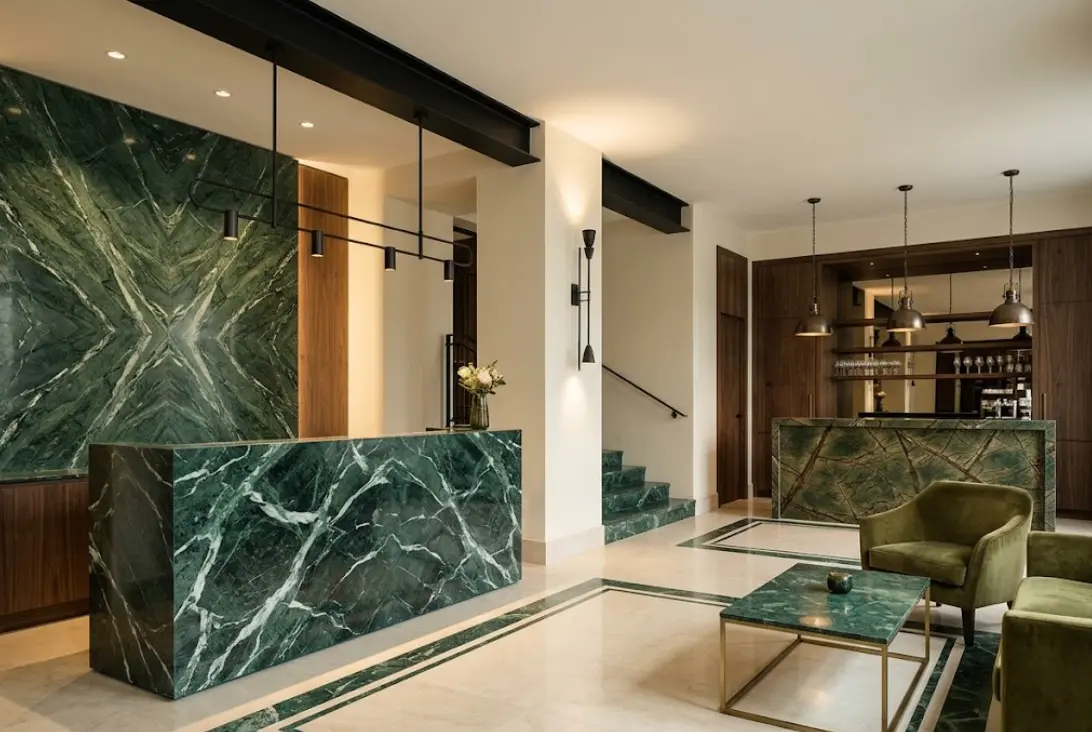
A luxury hotel selects Pietra Grey Marble for a reception wall. The sample looks perfect: dark grey background, clean white veins, and a mirror-like polished surface. Then the fabricated panels arrive. Under the lobby’s warm LED lighting, tiny swirl marks appear. The edges look dull. A few white veins show micro-cracks. The buyer expected “polished marble”; the fabricator knows dark marble is not that forgiving.
Mármore cinzento Pietra is one of the most elegant dark grey marbles used in modern interiors, but achieving a perfect polished finish without scratches requires more than running the slab through a polishing line and hoping for the best. Dark marble reveals sanding lines, uneven gloss, edge dullness, resin marks, and hairline defects more clearly than light stone. Buyers comparing premium materials from a professional marble slabs supplier should understand surface finish, vein stability, polishing method, application area, and inspection standards before ordering.
What Is Pietra Grey Marble?
Pietra Grey Marble Explained for Project Buyers
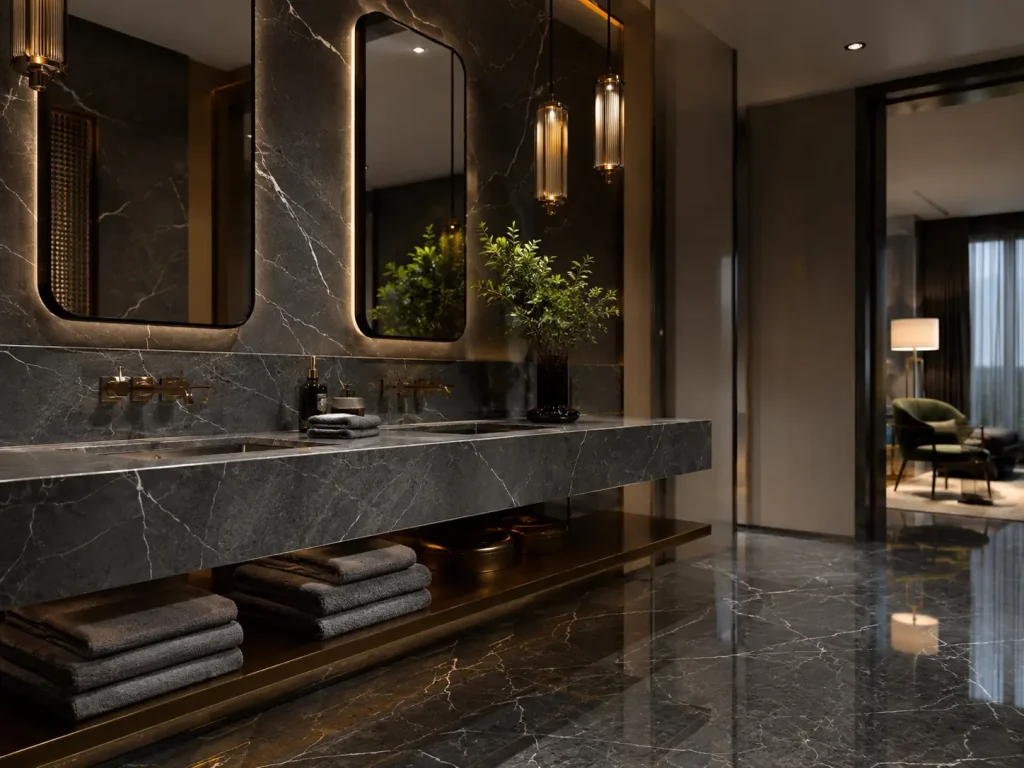
Mármore cinzento Pietra is a natural dark grey marble recognized for its charcoal-grey base and contrasting white calcite veins. It is widely used in hotel interiors, bathroom vanities, wall panels, flooring, staircases, reception counters, fireplace surrounds, elevator lobbies, and luxury commercial spaces. Its appeal comes from contrast: the dark background gives visual depth, while the white veins add movement and architectural sharpness.
Unlike engineered quartz or porcelain, Pietra Grey Marble is a natural stone. This means every slab has its own tone, vein density, texture, and structural characteristics. Some slabs may have fine and elegant veining; others may show wider veins or stronger natural movement. This variation is part of the beauty, but it also means buyers should approve full slab photos or physical slabs before fabrication, not only small samples.
Why Pietra Grey Marble Is Popular in Luxury Interiors
The popularity of Pietra Grey Marble comes from its ability to feel dramatic without becoming visually loud. It is darker and more architectural than many light grey marbles, but softer and more versatile than pure black marble. It pairs beautifully with brushed brass, black metal, walnut wood, cream walls, warm lighting, glass partitions, and minimalist furniture.
If the project needs a bold luxury look, polished Pietra Grey Marble is a strong choice for walls, vanities, counters, and decorative panels. If the project needs softer modern texture, honed Pietra Grey Marble may be more suitable. If the project involves commercial flooring, wet transition zones, or heavy foot traffic, sandblasted, brushed, or honed finishes may be safer and easier to maintain. For buyers evaluating direct product options, this honed gray marble Pietra Grey Marble page provides a useful material reference for finish selection and project planning.
The Challenge of Polishing Hard Dark Grey Marble
Why Dark Marble Shows Scratches More Easily
Dark polished marble reflects light in a way that makes defects more visible. Fine scratches, swirl marks, uneven sanding lines, dull patches, and polish haze may not be obvious on light beige marble, but they can appear clearly on Pietra Grey Marble under side lighting. Hotel wall washers, LED strips, daylight from curtain walls, and glossy interiors can reveal surface problems that were invisible inside a factory.
This is why polishing dark marble requires disciplined processing. The goal is not only to make the surface shiny. The goal is to remove each previous scratch pattern gradually until the final surface shows consistent reflection. If the factory skips abrasive steps, uses contaminated pads, applies uneven pressure, or fails to inspect under strong lighting, the final result may look acceptable during production but disappointing after installation.
Hardness, Veins, and Mineral Variation
Pietra Grey Marble is generally denser and harder than some softer decorative marbles, but it remains a marble. Its white calcite veins may respond differently from the dark grey matrix during grinding and polishing. If the machine pressure is too aggressive, the white veins may chip, open, or show micro-cracks. If the polishing process is too weak, the darker areas may retain fine scratches or uneven gloss.
Mineral variation is also important. Some zones polish faster than others. Some veins absorb resin differently. Some repaired areas may reflect light differently from the natural stone. This is why buyers should ask about slab resin treatment, backing, vein stability, polishing control, and inspection standards before placing a bulk order.
Common Polishing Defects on Pietra Grey Marble
| Polishing Defect | Likely Cause | Visible Result | Prevention Method |
|---|---|---|---|
| Swirl marks | Contaminated pads or poor machine movement | Circular marks under side lighting | Use clean abrasives and consistent polishing direction. |
| Fine scratches | Skipped grit levels or trapped grit | Thin lines visible on dark background | Follow complete abrasive sequence. |
| Uneven gloss | Inconsistent pressure or uneven slab structure | Patchy reflection | Control pressure, speed, and inspection lighting. |
| White vein chipping | Aggressive grinding or weak vein zones | Small chips along white veins | Inspect veins and use careful polishing pressure. |
| Burn marks | Excess heat from speed or poor water cooling | Dull or cloudy areas | Use proper water flow and controlled speed. |
Advanced Abrasive Techniques for a Mirror-Like Reflection
Why Abrasive Sequence Matters
A mirror-like polished finish depends on gradually removing scratches from the previous grit. Coarse grinding levels the surface. Medium grinding refines the scratch pattern. Fine honing prepares the surface for polish. Pre-polish and final polish create clarity and depth. If one stage is skipped, the final polish may look shiny but still reveal old scratches under light.
There is no single universal grit sequence that fits every Pietra Laje de mármore cinzento, because equipment, stone structure, resin condition, slab thickness, and finish target all matter. However, the logic is always the same: each step must remove the marks from the previous step before moving forward. Polishing is not a race. Rush the process and the scratches will send you a very shiny invoice later.
Pressure, Speed, and Water Control
Polishing pressure must be controlled carefully. Too much pressure can create heat, burn marks, uneven gloss, or vein chipping. Too little pressure may fail to remove previous scratches. Excessive speed can create swirl marks. Insufficient water can clog abrasives and overheat the stone. Consistent machine movement is essential because directional marks are easy to see on dark polished surfaces.
Edges require special attention. A slab face may look excellent while the edge looks dull, wavy, or scratched. Countertop edges, vanity edges, stair nosings, and reception desk returns should be polished separately with careful progression. Edge finish is where many cheap jobs confess their secrets.
Resin Treatment and Surface Stabilization
Some Pietra Grey Marble slabs may require resin treatment to fill micro-cracks, stabilize natural veins, and improve surface integrity. Resin quality affects polish clarity, color balance, and long-term appearance. Poor resin application can create shadow lines, visible repair marks, or uneven reflection. Vacuum resin treatment and mesh backing may improve slab stability, especially for slabs with natural fissures or stronger white veining.
Buyers should ask whether slabs are resin-treated, mesh-backed, or reinforced. This does not mean the slab is low quality; many natural marbles receive treatment to improve stability and fabrication performance. The key is transparency. A serious supplier should explain treatment, not hide it behind poetic stone descriptions.
Measuring Gloss and Surface Quality
Gloss can be measured with a gloss meter, commonly using 60-degree geometry for many surfaces. For premium polished marble, the exact acceptable gloss range depends on product type, supplier capability, and project requirements. More important than one peak gloss number is consistency across the slab. One shiny corner does not make the whole panel premium.
Visual inspection should include side lighting, daylight, and installation-like lighting. For hotel lobbies, bathrooms, and elevator walls, the inspection should simulate strong design lighting because these spaces often reveal fine polishing defects. Buyers may define acceptable tolerance for scratches, pinholes, resin marks, edge finish, gloss variation, and vein conditions.
| Inspection Item | Porque é que é importante | Recommended Check | Buyer Warning |
|---|---|---|---|
| Gloss uniformity | Controls mirror-like appearance | Check multiple points under strong light | One glossy area does not represent the whole slab. |
| Scratch visibility | Dark marble shows fine defects clearly | Use side lighting and daylight checks | Factory lighting may hide defects. |
| Edge polish | Visible in counters, stairs, and panels | Inspect edge reflection and smoothness | Edges often reveal weak fabrication. |
Dealing with White Calcite Veins: Ensuring Structural Integrity
Why White Veins Need Special Attention
The white veins are the soul of Pietra Grey Marble. They create the contrast that designers love. However, strong veins may also represent mineral transitions, natural lines, or areas where micro-fissures may occur. Some veins are stable and decorative. Others require careful inspection before cutting, polishing, handling, or installation.
Buyers should not fear white veins, but they should respect them. A dramatic vein across a feature wall can be stunning. The same vein crossing a narrow countertop strip near a sink cutout may increase fabrication risk. Context decides whether the vein is a design hero or a structural troublemaker.
Slab Inspection Before Cutting
Before fabrication, inspect both the front and back of the slab. Look for fissures, repaired veins, resin lines, mesh backing, weak zones, filled areas, and irregular thickness. Strong lighting can reveal hairlines that are not visible under normal light. Fabricators should mark major vein zones and plan cuts to avoid placing fragile veins at unsupported edges, narrow strips, or high-stress cutouts.
For bookmatched walls or large hotel panels, dry layout is especially important. It helps confirm vein continuity, visual balance, slab orientation, and cutting sequence. Buyers can also review broader Pietra Grey Marble design inspirations and care tips to connect slab selection with design planning and long-term maintenance expectations.
Reinforcement Methods for Veined Pietra Grey Marble
Reinforcement may include resin filling, mesh backing, fiberglass backing, stone adhesive reinforcement, careful cutting direction, support during transportation, edge reinforcement, and dry layout before installation. For countertops, sink cutouts and cooktop openings should not be placed carelessly across weak veins. For stairs, vein direction and structural support should be reviewed to reduce breakage risk.
When White Veins Improve Design and When They Increase Risk
| Aplicação | Vein Design Value | Structural Risk | Buyer Recommendation |
|---|---|---|---|
| Feature wall | Very high visual impact | Moderate if panels are well backed | Use dry layout and slab numbering. |
| Bathroom vanity | Elegant contrast | Higher near sink cutouts | Avoid weak veins around openings. |
| Pavimentos | Creates movement across large areas | Depends on traffic and slab quality | Choose finish by traffic level and inspect veining. |
| Bookmatched panels | Strong luxury effect | Requires careful matching and handling | Approve full slabs before cutting. |
Honed and Sandblasted for Commercial Flooring
When Polished Pietra Grey Marble Is Not the Best Choice
Polished Pietra Grey Marble looks luxurious, but it is not always the smartest choice for every area. In high-traffic commercial flooring, polished dark marble may show scratches more quickly. In wet areas, it may also become slippery depending on finish, cleaning, and local safety requirements. This does not mean polished marble is bad. It means the finish must match the application.
If the project is a luxury wall, vanity, fireplace, reception counter, or low-abrasion decorative panel, polished finish is excellent. If the project is a busy floor, hotel corridor, office lobby, or wet transition area, honed or sandblasted finishes may be more practical. For commercial buyers, finish zoning is often the smartest strategy: polished vertical surfaces, honed floors, and textured areas near transitions.
Honed Pietra Grey Marble for Softer Commercial Interiors
Honed Pietra Grey Marble has lower gloss and softer reflection. It gives a calm, modern, architectural feeling. It also hides fine scratches better than a high-polish surface, making it more practical for floors and interiors where glare reduction is important. Honed finish works well in hotels, office lobbies, bathrooms, corridors, retail spaces, and understated luxury interiors.
The trade-off is that honed marble may be more sensitive to staining if not sealed and maintained properly. Dark honed surfaces may also show oil marks or water marks differently from polished stone. Buyers should request finish samples before bulk production.
Sandblasted Pietra Grey Marble for Slip Resistance and Texture
Sandblasting creates a textured surface that can improve grip compared with polished marble. It may be suitable for commercial flooring, stair treads, entrance transitions, semi-outdoor zones, or areas where slip resistance matters more than mirror reflection. However, sandblasting changes the visual character of Pietra Grey Marble. The surface usually appears lighter, less glossy, and more textured.
Textured finishes can also hold dirt more easily than polished surfaces, so the cleaning plan matters. A sandblasted surface may be safer in some zones, but it should be paired with proper maintenance. Safety and cleaning are a couple; separating them usually causes problems.
Polished vs. Honed vs. Sandblasted Pietra Grey Marble
| Tipo de acabamento | Efeito visual | Visibilidade dos riscos | Resistência ao deslizamento | Best Application |
|---|---|---|---|---|
| Polido | Mirror-like, dramatic, luxury | High on dark surfaces | Lower in wet areas | Walls, vanities, counters, feature panels |
| Amaciado | Soft, matte, modern | Moderate to low | Better than polished in many cases | Floors, bathrooms, commercial interiors |
| Jato de areia | Textured, lighter, practical | Lower visibility | Higher than polished | Stairs, transition areas, commercial flooring |

Material Parameters Buyers Should Confirm Before Ordering
Thickness, Slab Size, and Application Matching
Common Pietra Grey Marble thickness options may include 18mm, 20mm, and 30mm depending on supplier, project, and application. Wall panels may use thinner slabs with proper backing. Countertops often need stronger thickness or laminated edges. Flooring requires suitable thickness, stable substrate, correct adhesive, and professional installation.
Large slabs create a more seamless visual effect, but they also need careful handling and export packing. Buyers sourcing for hotels, villas, and commercial interiors should request slab photos, thickness confirmation, finish samples, cut-to-size drawings, and packing details. For project-based procurement, this guide on sourcing premium grey marble can help wholesalers and contractors evaluate material selection, supplier control, and project risk.
Surface Finish Quality and Gloss Level
Polished finish should show consistent reflection without visible sanding marks. Honed finish should show uniform matte appearance. Sandblasted finish should show consistent texture. Buyers should not approve finish only by product name. “Polished,” “honed,” and “sandblasted” can vary between suppliers, machines, and production batches.
Water Absorption, Stain Resistance, and Sealing
Pietra Grey Marble is natural stone and may need sealing depending on application. Bathrooms, kitchens, bars, floors, and hospitality projects require stain protection. Acidic substances such as vinegar, lemon juice, wine, and some cleaning chemicals can etch marble surfaces. Buyers should understand that marble maintenance differs from quartz or porcelain. Sealant quality, cleaning method, and maintenance schedule matter.
| Specification Item | Common Check | Porque é que é importante | Buyer Recommendation |
|---|---|---|---|
| Espessura | 18mm, 20mm, 30mm | Affects strength and application suitability | Match thickness to wall, floor, counter, or stair use. |
| Acabamento | Polished, honed, sandblasted, brushed | Controls appearance, slip behavior, and maintenance | Choose finish by zone, not only appearance. |
| Vein stability | Inspect fissures, repairs, and backing | Reduces breakage during cutting and installation | Use reinforcement when needed. |
| Vedação | Stain protection plan | Important for wet and high-use areas | Confirm sealant and maintenance schedule. |
Pietra Grey Marble Applications by Finish
Polished Finish for Walls, Vanities, and Luxury Counters
Polished Pietra Grey Marble creates dramatic contrast and high-end reflection. It is ideal for feature walls, bathroom vanities, reception counters, fireplace surrounds, elevator lobby panels, and decorative surfaces where traffic abrasion is limited. The polished finish highlights the white veins and gives the stone stronger depth.
For luxury interiors, polished Pietra Grey Marble can become the main visual anchor. Designers can use it with brass lighting, dark wood, cream walls, or minimalist furniture. For more design context, this article on Pietra Grey Marble sculpting elegance gives additional inspiration for using this material in refined interiors.
Honed Finish for Flooring and Modern Interiors
Honed Pietra Grey Marble offers softer elegance. It reduces glare and can hide fine scratches better than polished marble. This makes it useful for flooring, corridors, bathrooms, commercial interiors, and modern residential spaces. It still requires sealing and proper maintenance, but it can be more forgiving than polished finish in daily use.
Sandblasted Finish for Commercial and Transitional Spaces
Sandblasted Pietra Grey Marble creates a more textured surface that can improve grip. It may be suitable for stair treads, commercial flooring, entrance transition zones, semi-outdoor areas, and spaces where safety matters. It changes the look of the stone, making the surface lighter and less reflective, so buyers should approve physical samples before bulk production.
Pietra Grey Marble vs. Other Dark Stone Options
Pietra Grey Marble vs. Nero Marquina Marble
Nero Marquina is typically black with white veining, creating stronger contrast and a more dramatic effect. Pietra Grey Marble is softer, more architectural, and often easier to integrate into modern interiors. If the design needs intense black luxury, Nero Marquina may be suitable. If the design needs dark elegance with softer grey depth, Pietra Grey Marble may be the better choice.
Pietra Grey Marble vs. Grey Granite
Grey granite is generally harder and more scratch resistant than marble. It may be better for heavy-duty floors, exterior areas, or projects prioritizing durability over vein elegance. Pietra Grey Marble offers more refined veining and a softer luxury character, making it stronger for interior walls, vanities, counters, and hotel-style spaces.
Pietra Grey Marble vs. Dark Quartz
Dark quartz offers stronger color consistency and lower maintenance. Pietra Grey Marble offers natural depth, authenticity, and unique veining. Quartz may be more practical for kitchens and high-use counters. Marble may win when natural stone character is the design priority. For broader positioning in architecture and interiors, this article on Pietra Gray Marble architecture and design explains why this stone remains a timeless choice.
| Material | Visual Character | Scratch Risk | Manutenção | Buyer Recommendation |
|---|---|---|---|---|
| Mármore cinzento Pietra | Dark grey with white veins | Moderate; scratches visible on polished finish | Requires stone-safe care | Choose for luxury interiors and controlled applications. |
| Nero Marquina | Black with strong white veins | High visibility on polished black surface | Requires careful cleaning | Choose for stronger contrast and drama. |
| Granito cinzento | Granular natural pattern | Lower than marble in many uses | Generally easier | Choose for heavy-duty flooring or exterior use. |
| Dark quartz | More uniform engineered look | Lower daily maintenance concern | Easier than marble | Choose for practical high-use counters. |
Maintenance: Keeping Polished Pietra Grey Marble Scratch-Free
Daily Cleaning Rules
Use pH-neutral stone cleaner, soft cloths, and microfiber mops. Remove dust and grit regularly because tiny particles can behave like sandpaper under shoes or cleaning pads. Avoid vinegar, lemon, acidic cleaners, harsh chemicals, abrasive pads, and rough brushes. Clean spills quickly, especially wine, coffee, cosmetics, oil, and acidic substances.
Scratch Prevention in Commercial Projects
Commercial projects should use entrance mats, furniture pads, soft cleaning pads, and protective coverings during construction. Heavy objects should not be dragged across polished marble. Cleaning machines should use suitable pads and pressure settings. Maintenance staff should understand that marble care is different from porcelain or quartz care.
When to Re-Polish or Re-Hone
Minor dullness may be improved by professional maintenance. Deep scratches require resurfacing. Uneven gloss may require repolishing across a full area rather than spot polishing only, because spot repairs can create visible gloss differences. Commercial floors may need periodic maintenance depending on traffic level.
Industry Trends: Dark Marble in Modern Commercial Design
Dark Grey Marble as a Luxury Neutral
Designers increasingly use dark grey marble as a modern alternative to black and white stone. It creates contrast without feeling too harsh. Pietra Grey Marble works well in hotel lobbies, luxury bathrooms, retail interiors, office receptions, and residential feature spaces.
Mixed Finishes by Zone
Projects are increasingly combining polished walls with honed floors. This creates visual continuity while improving practicality. A polished feature wall can deliver drama, while a honed floor can reduce glare and scratch visibility. Finish zoning is one of the smartest ways to balance luxury and performance.
Bookmatched and Large-Format Panels
Pietra Grey Marble can be used for bookmatched walls and large-format panels. Vein continuity matters, so slab selection and dry layout are critical. For high-end projects, the difference between random slab placement and carefully planned bookmatching is not small. One looks intentional. The other looks like the installer played marble Tetris without coffee.
|
|
|


Regulations, Safety, and Quality Standards
Slip Resistance for Flooring
Commercial flooring should meet local slip-resistance requirements. Polished marble may not be suitable for wet public floors. Honed, sandblasted, brushed, or textured finishes may be safer depending on the project. Buyers should request slip test data where needed and coordinate with architects, installers, and local code requirements.
Indoor Air and Sealant Considerations
Sealants, adhesives, and installation products may need low-VOC documents depending on project type and region. Green building projects may require material declarations, installation product documentation, or maintenance guidelines. Buyers should confirm requirements early, not after the stone has already shipped.
Inspection and Acceptance Standards
Buyers should check surface finish, gloss, scratches, cracks, chips, resin lines, thickness, dimensional tolerance, edge polish, slab tone, and packing. For luxury projects, full slab approval and dry layout are recommended. For commercial projects, mockups may reduce design and installation risk.
Common Mistakes When Buying Pietra Grey Marble
Mistake 1: Approving Only a Small Sample
Small samples may not show full veining, tone range, resin treatment, or structural characteristics. Buyers should approve full slab photos, videos, and acceptable variation ranges before production.
Mistake 2: Choosing Polished Finish for Every Area
Polished finish looks luxurious, but it may become slippery or show scratches quickly in high-traffic flooring. Use polished finish for walls and counters, and consider honed or sandblasted finish for floors where needed.
Mistake 3: Ignoring White Vein Stability
White veins may be decorative, but some can also represent weaker zones. Buyers should inspect veins and request reinforcement or careful cutting plans when needed.
Mistake 4: Using Wrong Cleaning Products
Acidic cleaners, abrasive pads, and harsh chemicals can cause etching, dull spots, and surface damage. Use pH-neutral stone care products and train maintenance teams properly.
Mistake 5: Choosing Supplier by Price Only
Low price can hide poor polishing, weak resin treatment, cracks, color inconsistency, poor packing, and project delays. Buyers should choose a supplier with slab inspection, finish control, reinforcement options, and export packing experience.
How to Choose a Reliable Pietra Grey Marble Supplier
What a Professional Supplier Should Provide
A professional Pietra Grey Marble supplier should provide full slab photos, physical samples, finish samples, polishing quality control, resin and backing information, vein inspection, thickness options, cut-to-size support, dry layout support, packing photos, inspection reports, maintenance guidance, export documentation, project lead time, and after-sales communication.
Supplier capability matters because Pietra Grey Marble is both beautiful and technically demanding. Buyers can review FOR U STONE marble supplier capability when evaluating project experience, slab selection, fabrication control, and export support.
Manufacturer vs. Supplier vs. Wholesale Buyer Logic
If you need polished wall panels, choose a supplier with strong polishing control. If you need flooring, choose a factory with finish zoning and anti-slip options. If you need container-level supply, compare Pietra Grey Marble wholesale options but verify slab range and packing. If you need hotel or commercial projects, prioritize inspection and dry layout. If you need countertops, confirm edge polish, resin treatment, sink cutout support, and packing protection.
For project discussion, buyers can contacto FOR U STONE with application area, finish preference, slab size, thickness, traffic level, edge details, and project drawings. A clear brief helps the supplier recommend suitable Pietra Grey Marble slabs and processing options instead of guessing. And guessing, as usual, is not a project management method.
Recommended Buyer Checklist Before Ordering
| Checklist Item | Porque é que é importante | Buyer Action |
|---|---|---|
| Application area | Determines finish and thickness | Confirm wall, floor, counter, stair, or vanity use. |
| Finish requirement | Controls appearance and safety | Choose polished, honed, or sandblasted by zone. |
| White vein density | Affects design and structural planning | Inspect slab photos and mark weak zones. |
| Packing method | Protects polished surfaces and slab edges | Request export packing photos and protection details. |
FAQ: Pietra Grey Marble Polishing and Finishes
1. O mármore Pietra Grey riscam com facilidade?
O mármore Pietra Grey é um mármore natural e pode riscar-se se exposto a grãos abrasivos, objetos arrastados, esponjas de limpeza ásperas ou ferramentas de manutenção inadequadas. Seu fundo cinza-escuro pode tornar os riscos finos mais visíveis do que em pedras mais claras, especialmente em superfícies polidas sob iluminação lateral intensa. Para áreas de alto uso, os compradores devem utilizar tapetes de entrada, ferramentas de limpeza suaves e selecionar acabamentos adequados.
2. Qual é o melhor acabamento para o Mármore Pietra Grey?
O melhor acabamento para o mármore Pietra Grey depende da aplicação. O acabamento polido é ideal para paredes de luxo, pias, balcões de recepção, embelezamentos de lareiras e painéis decorativos. O acabamento afiado costuma ser mais indicado para pisos e interiores discretos, pois reduz o brilho e esconde melhor arranhões leves. O acabamento jateado pode ser adequado para pisos comerciais, escadas ou áreas que necessitam de maior aderência.
3. Como você polir o mármore Pietra Grey sem arranhões?
Para polir o mármore Pietra Grey sem arranhões visíveis, os fabricantes devem utilizar uma sequência controlada de abrasivos, resfriamento adequado com água, pressão adequada, almofadas limpas, polimento cuidadoso das bordas, tratamento com resina onde necessário e inspeção final sob iluminação intensa. Pular níveis de grão, usar abrasivos contaminados, superaquecer a pedra ou aplicar pressão desigual podem deixar arranhões, marcas de redemoinho ou áreas opacas.
4. O mármore Pietra Grey polido é adequado para pisos comerciais?
O mármore Pietra Grey polido pode ser utilizado em interiores comerciais selecionados, mas pode apresentar arranhões com maior evidência e tornar-se escorregadio em áreas molhadas. Para pisos de alto tráfego, corredores de hotéis, transições de entrada ou zonas públicas úmidas, acabamentos lapidados ou jateados podem ser mais práticos. Os compradores devem confirmar as necessidades de resistência ao escorregamento, o nível de tráfego, a capacidade de manutenção e os requisitos locais de segurança antes de escolher um piso polido.
5. Como você mantém o mármore Pietra Grey polido?
Mantenha o mármore Pietra Grey polido com produtos de limpeza para pedras neutros em pH, panos macios, mop de microfibra, tapetes de entrada, protetores para móveis e limpeza rápida de derramamentos. Evite produtos de limpeza ácidos, vinagre, suco de limão, esponjas abrasivas, escovas rígidas e arrastar objetos pesados sobre a superfície. Projetos comerciais devem treinar equipes de limpeza, pois uma manutenção incorreta pode causar gravuras, manchas opacas e riscos visíveis.
Referências
1. Dimension Stone Design Manual — Natural Stone Institute — Commercial Stone Design Guidance.
2. Stone in Architecture: Properties, Durability — Siegfried Siegesmund and Rolf Snethlage — Springer.
3. Marble and Stone Restoration Guide — Fred M. Hueston — Stone Forensics Technical Publications.
4. Standard Test Methods for Absorption and Bulk Specific Gravity of Dimension Stone — ASTM International — ASTM C97.
5. Standard Test Method for Abrasion Resistance of Stone Subjected to Foot Traffic — ASTM International — ASTM C241/C1353 Reference Standards.
6. Standard Test Method for Flexural Strength of Dimension Stone — ASTM International — ASTM C880.
7. Test Method for Measuring Dynamic Coefficient of Friction of Hard Surface Flooring Materials — ANSI A326.3 — Tile Council of North America.
8. Cleaning and Maintenance Guide for Natural Stone Surfaces — Natural Stone Institute — Stone Care Reference.
How Buyers Should Specify Pietra Grey Marble Finish
How should buyers understand Pietra Grey Marble?
Mármore cinzento Pietra is a dark grey natural marble with white calcite veins, valued for luxury interiors, feature walls, vanities, counters, flooring, stairs, and commercial decorative surfaces. Its beauty comes from contrast, but its dark background also makes polishing marks and scratches more visible.
Why does polishing Pietra Grey Marble require special control?
Dark marble reflects light in a way that reveals fine scratches, swirl marks, dull patches, and uneven gloss. A high-quality polished finish requires a disciplined abrasive sequence, clean pads, proper water cooling, pressure control, resin treatment where needed, edge polishing, and inspection under realistic lighting.
What finish should different projects choose?
If the project is a luxury wall, vanity, reception counter, or decorative panel, polished Pietra Grey Marble delivers the strongest reflective impact. If the project is flooring with moderate traffic, honed finish may be more practical. If the project involves commercial flooring, stair treads, or wet transition zones, sandblasted or textured finishes may offer better grip and lower scratch visibility.
What should buyers consider before ordering?
Buyers should confirm application area, traffic level, wet or dry zone, slab size, thickness, polish requirement, honed or sandblasted samples, white vein density, resin treatment, mesh backing, crack inspection, cut-to-size drawings, bookmatch requirement, edge details, sealing needs, slip-resistance requirements, cleaning method, packing method, lead time, and supplier project experience.
What is the practical recommendation?
Do not choose a finish only because it looks beautiful in a sample. Choose polished finish where reflection and luxury matter most, honed finish where daily use and scratch control matter, and sandblasted finish where grip and commercial practicality matter. The best Pietra Grey Marble project combines slab selection, finish control, reinforcement, installation planning, and maintenance discipline.