


The global architectural landscape continues to embrace the timeless elegance and structural reliability of natural stone, with pristine white varieties leading the charge in luxury commercial and residential developments. From sweeping hotel lobbies to exclusive corporate headquarters, the demand for high-end, flawlessly fabricated stone is unyielding. For procurement officers, contractors, and regional distributors, navigating the global supply chain to secure reliable wholesale white marble slabs is a complex endeavor that goes far beyond simple aesthetics. It requires a rigorous evaluation of a quarry’s yield, a factory’s technological capabilities, and the logistical frameworks necessary to move thousands of tons of fragile cargo across oceans. This comprehensive guide details the critical phases of sourcing, fabricating, and quality-controlling premium natural stone for large-scale projects.

The Science and Economics of Premium White Marble
Before issuing a purchase order for thousands of square feet of material, project stakeholders must understand the fundamental geology that dictates how the stone will perform in its intended environment.
Physical Parameters: Calcite vs. Dolomite Compositions
Not all white stones are created equal. Their mineral makeup heavily influences their compressive strength, water absorption rates, and resistance to environmental stress. Calcite-based marbles tend to be softer and more reactive to acids, while dolomite-based stones offer slightly higher durability. Understanding these scientific parameters is vital when determining where to buy bulk white marble for specific applications, such as high-traffic flooring versus decorative vertical cladding.
Below is a comparative data table outlining the typical physical properties of industry-standard white marbles:
| Varietà di pietra | Apparent Density (g/cm³) | Assorbimento dell'acqua (%) | Resistenza alla compressione (MPa) | Flexural Strength (MPa) | Primary Mineral |
| Italian Carrara | 2.72 | 0.11 – 0.15 | 130 – 140 | 15 – 18 | Calcite |
| Greek Volakas | 2.80 | 0.14 – 0.18 | 120 – 135 | 14 – 16 | Dolomite |
| Crystal White | 2.85 | 0.08 – 0.12 | 145 – 155 | 18 – 20 | Calcite/Quartz |
| Oro Calacatta | 2.71 | 0.12 – 0.16 | 125 – 138 | 15 – 17 | Calcite |
Global Market Trends and Architect Preferences
Modern architectural blueprints increasingly specify materials that offer both luminous visual appeal and structural longevity. The market is seeing a massive surge in demand for materials that provide a crisp, clean background punctuated by distinct, natural veining. For North American and European developers seeking highly competitive pricing without sacrificing geological integrity, partnering with a technologically advanced premium white marble manufacturer in Asia has become a dominant procurement strategy. These facilities leverage economies of scale to process massive block allocations into highly refined, project-ready architectural elements.
Advanced Stone Processing Technology at For U Stone
The transition from a raw, multi-ton geological block extracted from the earth to a refined, millimeter-perfect architectural surface relies entirely on the processing technology utilized by the fabrication facility.
Precision Engineering with 5-Axis CNC Machinery
In large-scale commercial flooring or highly detailed interior cladding, dimensional tolerances are unforgiving. Modern factories utilize sophisticated 5-axis Computer Numerical Control (CNC) bridge saws to process slabs. These machines interpret CAD (Computer-Aided Design) files to execute cuts with tolerances as tight as +/- 0.5 millimeters. This extreme precision is absolutely critical when fabricating striking, high-contrast materials like piastrella in marmo bianco con venature nere, where even a fractional deviation in the cut can disrupt the visual flow of the installation across a sprawling hotel atrium.
Water-Jet Cutting for Intricate Architectural Patterns
When architects specify complex medallions, sweeping curved vanity tops, or intricate mosaic inlays, traditional diamond-blade cutting is insufficient. Advanced fabrication centers deploy high-pressure water-jet technology, which forces a mixture of water and abrasive garnet through a microscopic nozzle at pressures exceeding 60,000 PSI. This allows for cold-cutting without introducing thermal stress or micro-fractures into the delicate stone. For contractors looking to understand the capabilities of specific materials for intricate work, exploring resources detailing what is Volakas white marble provides insight into how this specific dolomite structure responds to advanced water-jet profiling for bespoke commercial designs.
Custom Fabrication: From Cut-to-Size to Book-matched Slabs
Value-added fabrication at the factory level significantly reduces labor costs, material waste, and installation time on the actual job site.
Achieving Perfect Symmetry: The Art of Book-Matching
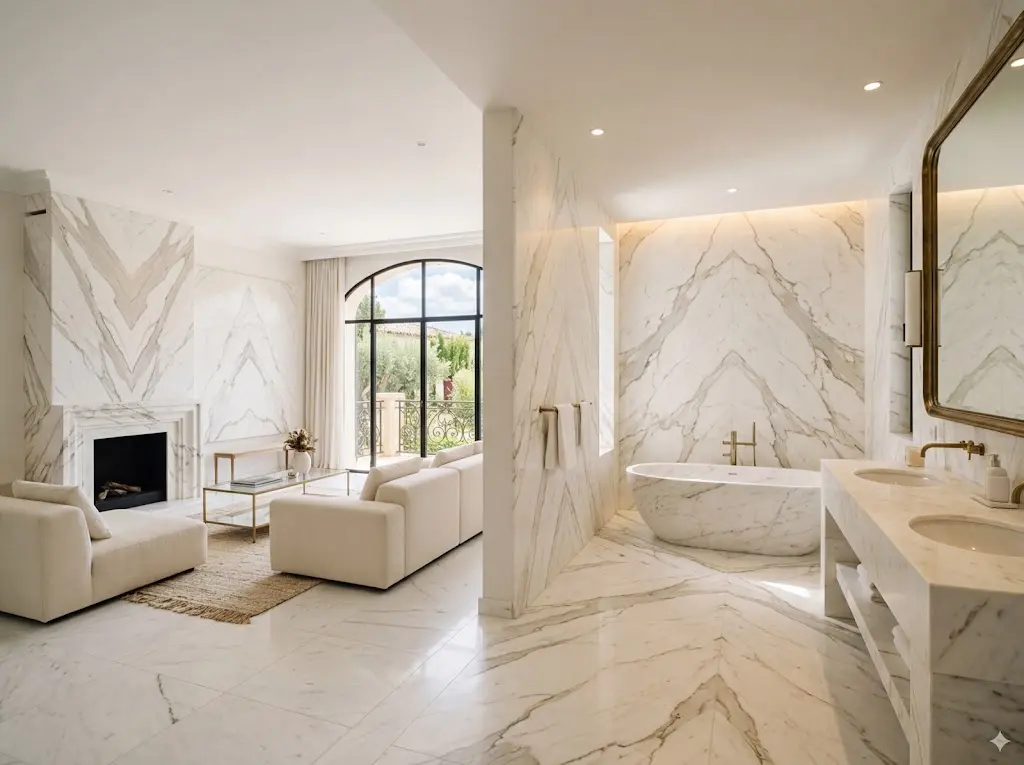
Book-matching is a highly specialized processing technique where sequential slabs are cut from the same geological block and polished on opposite faces. When placed side-by-side, the natural veining mirrors itself, creating stunning, symmetrical geometric patterns. This requires meticulous block selection and flawless slicing execution. For luxury hospitality projects requiring striking focal points, ordering custom cut-to-size white marble pre-configured for book-matched installations allows installation crews to immediately mount the panels without field modifications, protecting the delicate edges of the stone.
Cut-to-Size Operations for Large Developments
Shipping raw slabs directly to a job site for field cutting is an antiquated and costly logistical model. It results in exorbitant waste and high on-site labor overhead. Modern wholesalers instead mandate full factory-level fabrication. By transmitting architectural shop drawings directly to the processing facility, massive quantities of commercial white marble floor tiles can be cut, finished, edged, and labeled according to the specific room layout. This “plug-and-play” delivery method drastically accelerates the construction schedule of multi-story residential towers and luxury commercial plazas.

Quality Control: Dry-lay Inspection for Large Scale Projects
The inherent beauty of natural stone lies in its organic inconsistency; however, this same inconsistency poses the greatest risk for large architectural spaces. Stringent factory-level quality control is non-negotiable.
Eliminating Vein Mismatch on the Factory Floor
A premium fabrication facility will never ship a cut-to-size order blind. To ensure visual harmony, factories conduct extensive “dry-lay” inspections. The entire floor plan of a lobby or bathroom is laid out in a massive staging area inside the factory. Purchasing agents dealing with a reliable white marble factory direct can expect high-resolution photographs and videos of the dry-lay. Inspectors meticulously evaluate the color transitions, ensuring that the background tones match and the veining flows logically from one tile to the next. Once approved, each piece is alphanumerically coded on the back to correspond with the architect’s installation blueprint.
Quantitative Defect Management and Thickness Tolerance
Beyond aesthetic sorting, rigorous quantitative checks are performed. Inspectors utilize digital calipers to ensure absolute thickness uniformity, preventing “lippage” (uneven edges) during floor installation. Furthermore, the stone is scrutinized under high-lumen lighting for natural micro-fissures or subsurface iron deposits. Understanding the chemical vulnerabilities of the stone, such as why does white marble yellow (often due to the oxidation of trace iron pyrite within the stone when exposed to moisture), allows factory technicians to apply specialized penetrating sealers and epoxy resins prior to shipping, neutralizing future maintenance liabilities.
International Shipping: Secure Packaging and Logistics
The final, and often most hazardous, phase of the supply chain is the physical transportation of thousands of pounds of fragile, rigid material across global shipping lanes.
ISPM-15 Compliant Wooden Crating
International customs regulations are incredibly strict regarding agricultural pests. All wood used for packing stone must be heat-treated and fumigated in compliance with ISPM-15 standards. Failure to use properly stamped wooden A-frames or enclosed crates will result in the cargo being quarantined or rejected at the destination port.
Container Loading Protocols and Weight Optimization
Stone is incredibly dense. A standard 20-foot shipping container will reach its maximum legal weight capacity long before it runs out of physical space. Expert logistics teams must calculate the exact center of gravity and distribute the weight evenly over the container’s axles. The crates are then heavily braced with timber and steel cables to prevent shifting during oceanic transit. When sourcing for major developments, partnering with the best white marble suppliers for contractors ensures that not only is the stone fabricated flawlessly, but the logistical chain is managed with precision, ensuring materials arrive on-site, on time, and fully intact.
FAQ
1. Why does white marble turn yellow over time, and how can it be prevented?
L'ingiallimento del marmo bianco è causato principalmente dall'ossidazione di tracce di ferro (pirite) presenti naturalmente nella pietra quando questa viene esposta all'umidità. Può inoltre derivare dal degrado di sigillanti o cere organici di bassa qualità esposti alla luce UV, oppure dall'utilizzo di prodotti chimici per la pulizia inappropriati e acidi. La prevenzione inizia a livello di fabbrica con l'applicazione di resine epossidiche penetranti di alta qualità e stabili ai raggi UV, e durante la posa mediante l'utilizzo di adesivi bianchi puri che non macchiano e garantendo un'idroisolamento adeguato del supporto nelle aree umide.
2. What is the difference between Carrara, Calacatta, and Volakas marble?
Il Carrara è un marmo calcitico italiano noto per le sue venature grigie morbide e piumate su uno sfondo bianco-grigiastro, che lo rendono estremamente versatile e conveniente. Il Calacatta, anch'esso proveniente dall'Italia, è più raro e presenta venature grigie o dorate audaci, drammatiche e spesse su uno sfondo bianco cristallino e netto. Il Volakas è un marmo a base di dolomia proveniente dalla Grecia, caratterizzato da distinte venature grigie o bordeaux diagonali su una base bianca purissima; offre eccellente lavorabilità e un aspetto lussuoso spesso preferito in progetti commerciali di grandi dimensioni.
3. Why is a dry-lay inspection crucial for large commercial flooring projects?
Le pietre naturali presentano variazioni di colore intrinseche e motivi venati imprevedibili. Un'ispezione in secco effettuata in fabbrica consiste nel posare le piastrelle pre-tagliate esattamente come saranno installate sul cantiere definitivo. Ciò consente agli ispettori del controllo qualità di armonizzare i toni di fondo, abbinare i motivi venati continui tra più pezzi e eliminare anomalie visivamente disturbanti. Il layout approvato viene poi numerato, garantendo così che l'appaltatore sul posto possa posare il pavimento senza difficoltà e senza dover selezionare i materiali a occhio.
4. How are large marble slabs safely transported internationally?
A causa del loro peso estremo e della loro fragilità, le lastre di grandi dimensioni vengono imballate su pallet in legno a forma di A, pesantemente rinforzati. Tali pallet devono essere realizzati in legno trattato termicamente per rispettare gli standard internazionali di fumigazione ISPM-15. All'interno del container marittimo (tipicamente un container da 20 piedi per carichi pesanti), gli struttura a forma di A vengono fissate mediante fili d'acciaio, catene e robuste traversine in legno, al fine di impedire qualsiasi movimento laterale o spostamento durante il turbolento viaggio oceanico e garantire che il carico arrivi senza fratture.
5. Is it more cost-effective to buy raw slabs or factory cut-to-size pieces?
Per sviluppi su larga scala, acquistare pezzi tagliati su misura direttamente in fabbrica è notevolmente più conveniente. Sebbene le lastre grezze possano sembrare inizialmente più economiche al metro quadrato, il loro importazione comporta trasferire direttamente sul cantiere locale i costi relativi alla manodopera specializzata per la lavorazione, alle macchine da taglio costose e all'inevitabile spreco di materiale, che si aggira tra il 15% e il 25%. Un ordine diretto in fabbrica per pezzi tagliati su misura garantisce che paghi soltanto per la superficie utile e finita, riducendo drasticamente i tempi di installazione in loco e minimizzando i costi di spedizione legati ai materiali di scarto.
References:
-
“Dimension Stone Design Manual, Version 8.0.” Natural Stone Institute (NSI).
-
“Standard Specification for Marble Dimension Stone (Exterior).” ASTM International, ASTM C503/C503M.
-
“Geology and Properties of Commercial Marble.” European Federation of Natural Stone Industries (EUROROC).
-
“Moisture Dynamics and Iron Oxidation in Calcitic Stones.” Journal of Architectural Conservation.
-
“Global Stone Industry Report: Sourcing and Fabrication Trends.” Marmomac Observatory.
-
“ISPM 15: Regulation of Wood Packaging Material in International Trade.” International Plant Protection Convention (IPPC).
-
“Tolerances in Stone Fabrication and Installation.” Marble Institute of America.
-
“Advanced CNC Machining Parameters for Natural Stone Processing.” International Journal of Advanced Manufacturing Technology.
White marble remains one of the most specified natural stones in luxury architecture because it combines visual brightness, prestige, and long-term design relevance. Yet for contractors, developers, and procurement managers, the real decision is not simply which white marble looks best. The real question is how to source, fabricate, inspect, and deliver the right stone in a way that protects budgets, schedules, and final installation quality.
Why project-scale sourcing demands more than just a beautiful slab
In small residential projects, visual appeal may dominate the buying decision. In large hotel, office, retail, or residential tower developments, however, white marble becomes a systems-level procurement issue. Buyers must evaluate quarry consistency, mineral composition, fabrication precision, thickness tolerance, packaging reliability, and whether the supplier can produce a fully coordinated cut-to-size program rather than simply exporting random slabs. This is why experienced buyers look for a white marble factory direct partner with both stone resources and advanced CNC processing capability.
How fabrication technology changes the true value of white marble
Raw stone alone does not create a premium project result. The real value is unlocked in fabrication. Modern 5-axis bridge saws, water-jet systems, and digital shop drawing workflows allow factories to transform wholesale white marble slabs into project-ready components with tight tolerances and consistent edge quality. This significantly reduces on-site cutting, speeds up installation, minimizes waste, and lowers the risk of field errors that can damage expensive natural stone.
What makes book-matching such a high-value option
Book-matched white marble is not just a decorative upgrade. It is a high-impact architectural strategy. By pairing sequential slabs from the same block and mirroring their veins, fabricators can create symmetrical focal walls, lobby panels, vanity backdrops, and statement floor layouts that immediately elevate the perceived value of a project. For premium developments, this visual continuity often becomes one of the defining design signatures of the space.
How dry-lay inspection protects commercial installation quality
Natural marble is beautiful precisely because it is not uniform. But that same natural variation can create major visual inconsistency if materials are installed without pre-planning. Dry-lay inspection solves this problem by arranging the finished pieces on the factory floor according to the actual project layout. This allows the team to verify vein direction, tone transition, pattern continuity, and tile numbering before shipment. For large commercial flooring and wall-cladding jobs, dry-lay approval is one of the most effective ways to reduce installation disputes and rework costs.
Options buyers should compare before placing a bulk order
If the project prioritizes softness, classic Italian style, and broad market recognition, Carrara marble remains a dependable option.
If the design intent calls for bold veining and a more dramatic luxury identity, Calacatta Gold offers stronger visual contrast and higher statement value.
If the project requires a cleaner white background with strong workability for larger layouts, Volakas and selected Crystal White materials often provide an efficient balance between beauty and fabrication practicality.
The right option depends on traffic intensity, moisture exposure, finishing details, and whether the application is flooring, wall panels, vanity tops, staircases, or custom architectural elements.
Important considerations for yellowing risk, durability, and maintenance
White marble is prized for its clarity, but it also requires correct technical handling. Trace iron content, moisture exposure, poor adhesives, improper sealers, or low-quality installation practices can all contribute to yellowing over time. This is why pre-treatment, proper resin filling, clean bonding systems, and moisture control are critical from the factory stage through final installation.
Buyers should also remember that different white marbles behave differently. Mineral composition affects water absorption, flexural strength, and surface stability. A sourcing decision based only on appearance can become expensive later if the chosen stone is not aligned with the installation environment.
Why cut-to-size supply is often more economical than raw slab purchasing
For large projects, factory cut-to-size white marble usually creates better cost control than shipping raw slabs for local processing. While raw slabs may look cheaper at first glance, they transfer labor, breakage risk, equipment dependency, and waste generation to the job site. A cut-to-size supply model allows the project team to pay for usable finished pieces, reduce local processing uncertainty, and move faster from delivery to installation.
What global buyers should expect from a reliable white marble supplier
A reliable supplier should offer more than stock photos and slab availability. Serious project partners should be able to provide block tracing, fabrication drawings, dry-lay approval images, tolerance control, epoxy treatment options, export-compliant wooden crating, and container loading plans designed for fragile high-density materials. In today’s market, the best white marble suppliers for contractors are those who combine quarry understanding, processing technology, and logistics discipline into one coordinated service chain.
Final market takeaway
Premium white marble is not simply a decorative surface. It is a specification-sensitive architectural material that demands geological knowledge, fabrication precision, and supply-chain reliability. For developers and contractors managing large-scale projects, the safest route is not just to buy white marble, but to source it through a factory capable of delivering custom cut-to-size fabrication, visual consistency, and export-ready quality control from start to finish.


