


When a Room Needs More Than Just a Pretty Surface
“We want the bathroom to feel refined, but not cold.”
“We love marble, but full slabs everywhere might feel too formal.”
“We need texture, detail, and something more personal — but not visual chaos.”
That is exactly where Custom Marble Mosaic starts to make real design sense. In modern interiors, it is no longer just a decorative extra reserved for niche accents or traditional schemes. Used well, it becomes a practical design tool that can add rhythm to a backsplash, more visual grip to a shower floor, more detail to a feature wall, and more character to a powder room without making the space feel heavy or overworked. Recent U.S. kitchen-and-bath trend reporting continues to point toward warm natural materials, tactile finishes, and more layered spaces rather than flat, overly minimal rooms.
That is why homeowners and designers increasingly move beyond generic field tile and start exploring where Custom Marble Mosaic can add both function and identity. A supplier like PER U PIETRA becomes relevant here because its public company profile presents it as an experienced quarry owner, natural stone manufacturer, and exporter in China with large production capacity, a broad marble inventory, and project-oriented customization support. Its public-facing catalog also shows that mosaics are treated as part of a wider marble system rather than a decorative afterthought.
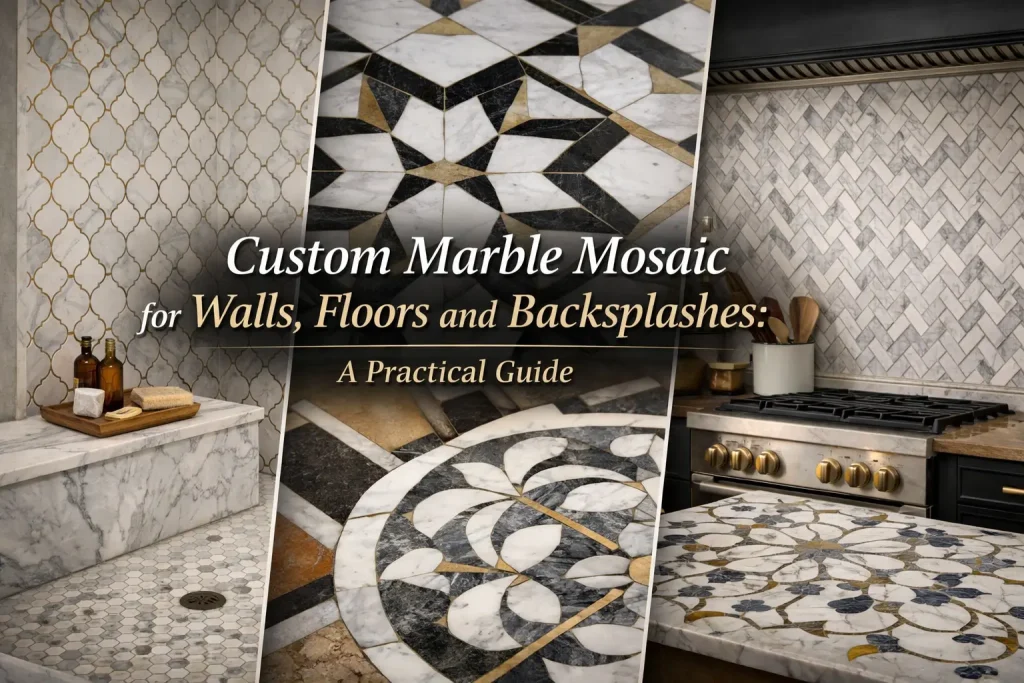
Why Custom Marble Mosaic Fits the Way Homes Are Designed Now
The appeal is not hard to understand. Full slabs create scale and drama. Mosaics create texture, pattern, and transition. They allow natural stone to appear in smaller modules, which makes them especially useful in spaces where the room needs more movement, more grip, or more detail without becoming visually heavy.
That is one reason Marble collections still matter so much in current interior planning. A mosaic is never just a shape. It is part of a larger stone palette. If the background marble, accent mosaic, trim pieces, and surrounding finishes do not belong to the same visual language, the room starts to feel assembled instead of designed. FOR U STONE’s marble catalog structure supports that broader approach by positioning marble for flooring, wall cladding, bathrooms, stairs, vanity areas, and decorative applications within one material ecosystem.
There is also a very practical reason mosaics continue to matter. In wet or irregular areas, smaller-format pieces adapt more easily to slopes, curves, drains, and tight transitions than larger rigid pieces. Industry wet-area guidance for natural stone emphasizes the need to consider porosity, waterproofing, slope, soundness, and detailing when specifying stone in showers and similar applications. Slip-related standards also make clear that surface choice should be matched to intended use conditions, not chosen by appearance alone.
That dual strength — beauty plus application flexibility — is exactly why Piastrelle di mosaico di marmo personalizzate remains commercially useful rather than merely decorative. FOR U STONE’s product result for this category positions it as a project-ready custom solution rather than a generic style name, which matters for buyers who need repeatability, layout planning, and coordinated stone sourcing instead of just a sample card.
Walls Floors and Backsplashes Do Not Need the Same Mosaic Logic
One of the biggest mistakes in mosaic design is assuming every room surface wants the same solution. It does not. Walls, floors, and backsplashes each ask the mosaic to do a different job.
On walls, mosaic creates detail and rhythm
Wall applications usually benefit from visual structure rather than technical grip. A mosaic wall can soften a large vertical plane, frame a vanity area, enrich a shower niche, or turn a fireplace surround into something more layered than a flat slab. This is also where premium detailing can become part of the design story. A product like Custom water jet cutting brass inlay Carrara white marble mosaic tile shows how mosaic can move beyond simple sheeted repetition and into more bespoke interior language. It works especially well where the room needs crafted detail, metallic warmth, or a feature zone that feels tailored rather than mass-selected.
On floors, mosaic must work harder
A floor mosaic has to do more than look beautiful. It must suit traffic, moisture, cleaning habits, and underfoot expectations. That is why smaller pieces often make more sense on shower floors or transitional wet zones. More grout joints can help the surface adapt to slope and may improve traction and drainage, but that does not eliminate the need for correct finish selection, substrate preparation, and waterproofing design. Recent educational content from FOR U STONE itself also frames how to incorporate marble mosaics in your home’s design as a question of application logic, not just style. That is the right mindset. Good mosaic floors are planned, not improvised.
On backsplashes, mosaic is about texture without overload
Backsplashes need visual interest, but they also sit close to cabinetry, counters, lighting, and often strong countertop pattern. That means the backsplash mosaic must add depth without competing with everything else in the room. In recent U.S. design reporting, natural stone continues to be associated with warm, layered, visually rich interiors, but the most successful kitchens are those where the standout material is controlled rather than stacked on every sightline. That makes mosaic especially effective behind a range, across a bar niche, or as a focused backsplash section rather than as an all-over visual event.
A Better Way to Choose the Right Custom Marble Mosaic
Instead of choosing mosaic by shape first, start with the job it has to do.
Understanding the usage and benefits of marble mosaic tiles is a useful way to frame the decision because usage should come before style. A mosaic that looks beautiful in a product gallery can still fail in a real room if the finish is wrong, the grout contrast is too harsh, or the surrounding materials pull the stone in the wrong direction. FOR U STONE’s own marble mosaic education content positions mosaics as practical design tools across floors, walls, and decorative surfaces, which is exactly how buyers should think about them.
A good decision process usually starts with three questions:
- Is the mosaic mainly decorative, or does it also need to solve a technical problem such as slope adaptation or traction?
- Will it sit beside larger marble surfaces, or does it need to stand on its own?
- Does the room need calm texture or obvious pattern?
If those questions are answered honestly, most bad selections disappear before they become expensive. That is especially important because stone mosaics introduce more joints, more edge conditions, and more visual rhythm than plain tile. They demand a little more discipline, but they also give much more design reward when handled correctly.

A Room-by-Room Planning Table
| Spazio | Best role for custom marble mosaic | What it improves | Main caution |
|---|---|---|---|
| Shower floor | Small-format floor mosaic | Slope adaptation, traction rhythm, detail | Check finish, slope, waterproofing, grout plan |
| Bathroom wall | Accent band, niche, vanity wall, feature plane | Texture, softness, spa-like layering | Avoid covering every wall |
| Kitchen backsplash | Range wall, bar niche, focused field | Depth, craftsmanship, visual lift | Coordinate with countertop veining |
| Powder room | Feature wall, framed panel, statement zone | Identity, pattern, personality | Keep surrounding palette restrained |
| Entry or stair landing | Inset, border, medallion, controlled focal point | Arrival impact, custom detail | Do not over-pattern the whole floor |
| Fireplace or decorative wall | Subtle dimensional cladding or patterned highlight | Warmth, rhythm, visual depth | Balance with quiet adjacent materials |
This table matters because mosaic is not a universal solution. It is strongest when it solves a specific visual or practical problem in a specific location.
The Biggest Mistakes People Make With Custom Marble Mosaic
A well-chosen mosaic looks intentional. A badly chosen one looks restless. The gap between those two outcomes is usually created by a few repeated mistakes.
Mistake 1: Using mosaic everywhere
This usually makes a room feel nervous. Mosaics need breathing space. They are strongest when one or two surfaces carry the detail and the rest of the room gives them contrast. If every visible plane becomes patterned, the mosaic stops feeling special and starts feeling busy.
Mistake 2: Ignoring grout as part of the design
Grout is not just a technical joint. It is part of the final visual result. Grout width and color can either support a refined mosaic pattern or make it feel harsh and fragmented. Industry guidance on stone care and installation repeatedly shows that joints, cleaners, and maintenance practices all affect the long-term appearance of stone-and-grout assemblies. Neutral cleaning and correct product compatibility matter just as much as the stone itself.
Mistake 3: Treating wet-area mosaic like regular decorative wall tile
In wet zones, the mosaic must be specified with drainage, soundness, substrate prep, sealant placement, and waterproofing in mind. That is not optional. It is the difference between a durable shower floor and a future repair bill. FOR U STONE’s more policy-and-practice-focused article, Marble Mosaic in 2025: policy, practice, and possibility, also suggests that stone-mosaic discussions are moving beyond style into quality, compliance, and application discipline. That is a healthy direction for the category.
Mistake 4: Choosing pattern before choosing tone
A beautiful shape cannot rescue the wrong stone color. Tone should always be judged against cabinetry, metals, paint, neighboring slabs, and the room’s natural light. Pattern comes second. If the tone is wrong, the mosaic will feel wrong even if the pattern itself is beautiful.
How to Make Walls Floors and Backsplashes Feel Like One Story
The best mosaic projects do not isolate the mosaic. They integrate it.
A backsplash should relate to the countertop.
A shower floor should feel connected to the wall tile.
A powder-room feature wall should still make sense when viewed from the hallway.
A marble mosaic insert should support the architecture, not distract from it.
That is one reason FOR U STONE’s material ecosystem is useful. The brand’s public-facing content does not treat mosaic as a separate style category floating on its own. It connects marble products, custom mosaic work, installation-related advice, and broader stone project planning under one sourcing framework. That makes it easier for buyers to move from inspiration to coordinated material selection. A broader category like Prodotti in marmo becomes valuable here not because you need more options for the sake of options, but because you need the background stone, the accent stone, and the custom-cut mosaic to belong to the same design language.
A practical rule set helps:
- Pair expressive mosaics with quieter field materials.
- Pair softer mosaics with richer cabinetry or warm metals.
- Repeat one tone from the mosaic elsewhere in the room.
- Avoid stacking too many patterns on one sightline.
- Let one material lead and let the others support it.
That is how mosaic becomes elegant instead of theatrical.

What Custom Marble Mosaic Does Better Than a Full Slab
This is where homeowners often hesitate. Why not just use slab everywhere?
The answer is simple. Slabs are unmatched when the room needs scale and uninterrupted veining. But mosaics do several jobs slabs cannot do as well.
They add smaller-scale rhythm.
They handle irregular geometries more easily.
They create more crafted and customized surfaces.
They can soften transitions between planes.
They often work better in smaller spaces that would feel too formal under full slab coverage.
FOR U STONE’s mosaic-specific educational trail makes this point clearly across articles such as capire l'uso e i vantaggi delle tessere del mosaico di marmo e how to incorporate marble mosaics in your home’s design. Taken together, those pages frame marble mosaic not as a secondary substitute for slab, but as a different design language with its own strengths. That is the right way to think about it. Slab and mosaic are not enemies. They are different instruments.
Five Questions Homeowners Commonly Ask About Custom Marble Mosaic
Are custom marble mosaics good for shower floors?
Yes, often very good — provided the finish, slope, substrate, and installation method are right. Smaller-format mosaics can adapt better to drainage geometry and provide more joint frequency underfoot, which may help traction, but they still need proper wet-area detailing and suitable surface selection.
Do custom marble mosaics require more maintenance than regular tile?
They usually require more attention than a simple ceramic field tile because natural stone has its own care requirements and mosaics introduce more grout lines. The good news is that routine care guidance remains straightforward: neutral cleaner, mild soap when appropriate, thorough rinsing, and no harsh acidic or bleach-heavy products.
Where should I use custom marble mosaic in a kitchen?
The most successful locations are usually backsplashes, range walls, bar niches, and smaller focal areas. In kitchens, custom mosaic works best where it can add texture and craftsmanship without competing with strongly veined countertops or too many other patterns.
Is custom marble mosaic too traditional for modern interiors?
Not at all. It only feels dated when the shape, tone, or installation style is dated. In modern interiors, tone-on-tone stone mosaics, precise geometric layouts, and refined water-jet patterns can feel highly contemporary, especially when paired with restrained cabinetry and warm, simple finishes. Current design reporting supports the broader move toward tactile natural materials and controlled visual richness rather than flat uniformity.
Should I buy custom marble mosaic from a general tile seller or a stone specialist?
For project-level results, a stone specialist is usually safer. Marble is not just a color; it is a natural material with variation, finishing requirements, layout concerns, and application-specific decisions. A supplier that understands the wider stone system usually helps avoid far more problems than a seller focused only on style names.
|
|
|

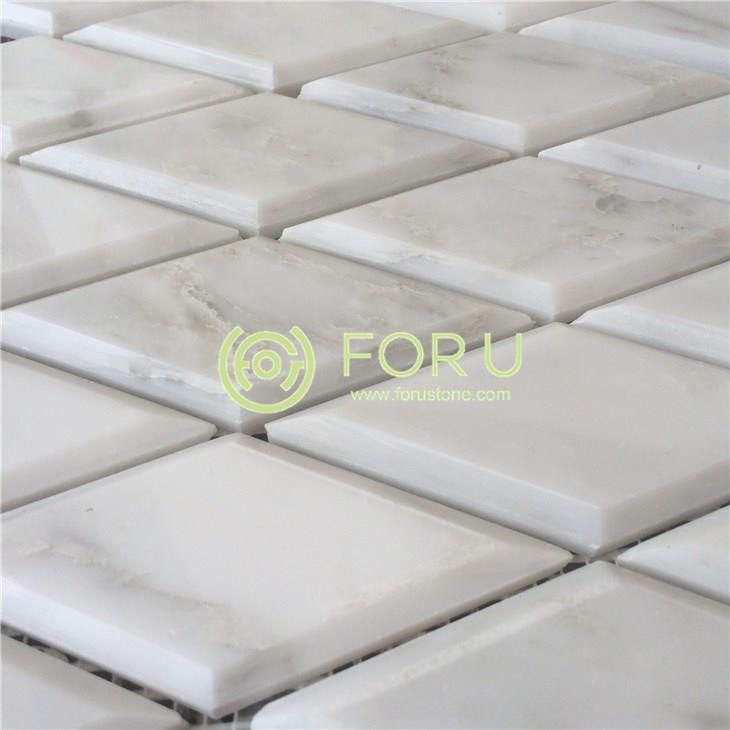
The Real Secret: Custom Marble Mosaic Works Best When It Solves Something
At the beginning, the homeowner wanted something refined but not cold, textured but not chaotic, luxurious but still livable.
That is the real job of Custom Marble Mosaic. It is not there to decorate empty space for the sake of decoration. It works best when it solves something: when a shower floor needs more grip and more beauty, when a backsplash needs texture without heaviness, when a powder room needs identity, or when a feature wall needs crafted detail that a plain slab cannot provide.
That is also why supplier choice matters. A project moves more smoothly when the source understands stone beyond the product photo — material variation, finishing, fabrication precision, use-case logic, and how one mosaic fits into a broader interior palette. FOR U STONE’s public content trail around marble, mosaic use, custom products, and application planning makes that process easier to navigate. When the time comes to turn inspiration into something buildable, the sensible next step is to contatto per U STONE and start with the room, the light, and the real use-case before falling in love with the first pretty pattern.
Riferimenti
- FOR U STONE, How to Incorporate Marble Mosaics in Your Home’s Design
- Houzz Research, 2025 U.S. Houzz Bathroom Trends Study
- NKBA, 2025 Bath Trends Report
- Houzz, 4 Trends in New Tile Products for 2025
- ArchDaily, From Monumental Ruins to Lavish Interiors: 18 Projects That Prove Marble Is a Timeless Material
- ArchDaily, Enriching Minimalism Through Pixel-Type Ceramics and Oversized Marbles
- Natural Stone Institute, Marble, Onyx, and Serpentine
- Natural Stone Institute, Care and Cleaning of Natural Stone
- Natural Stone Institute, Wet Areas and Related Specification Guidance
- TCNA and Related Industry Guidance, Slip Resistance, Grout, and Wet-Area Design Resources


