

Riepilogo rapido
Azul Bahia vs. Blue Macaubas: Which Brazilian Blue Stone Is Better for Luxury Projects in 2026?

When elite residential, hospitality, and yacht projects require a true “blue statement,” two Brazilian materials dominate the shortlist: Granito esotico Azul Bahia and Blue Macaubas Quartzite. Both are rare, dramatic, and investment-grade. Yet they perform differently in kitchens, wet areas, feature walls, and large architectural installations. This definitive 2026 comparison from FOR U STONE breaks down geology, performance, price, design value, and procurement strategy—so architects, developers, and wholesalers can specify the right blue stone with confidence.
1. The 2026 Blue Revolution: Why Brazilian Stones Lead the Market
Blue has always occupied a rare place in the language of luxury. In nature, truly saturated blue minerals are uncommon. In architecture, they are even more uncommon—especially when the material is not a printed imitation, a ceramic reproduction, or a digitally repeated pattern, but a geological original. That is why the 2026 luxury materials market is seeing a measurable shift away from “safe greige minimalism” and toward expressive natural surfaces with unmistakable identity.
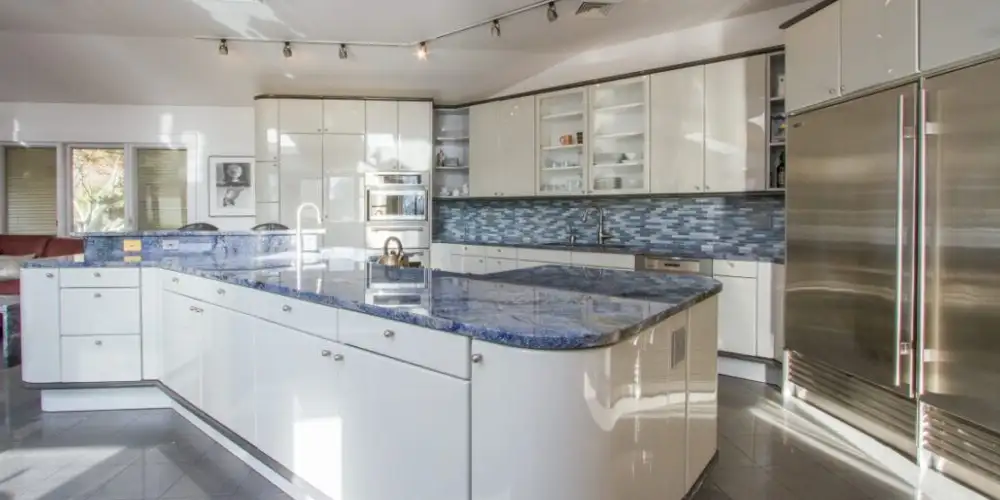
In that shift, two stones stand above nearly every other option in the category of premium blue surfacing: Granito Azul Bahia and Blue Macaubas Quartzite. Both originate in Brazil. Both command attention in high-end kitchens, lobbies, boardrooms, spa suites, and statement bars. Both have become reference materials in what many designers now call “Sapphire Architecture”—the strategic use of deep blue mineral surfaces to create visual authority, emotional richness, and instant spatial memorability.
But they are not interchangeable. One behaves more like a semi-precious architectural gemstone. The other behaves more like an engineered natural armor plate formed by tectonic pressure. One is prized for its painterly, universe-like clustering and jewel-tone saturation. The other is revered for its elegant linear movement, stronger scratch resistance, and contemporary calm.
That is precisely why procurement teams should not choose based on color alone. They should choose based on geology, hardness, porosity, maintenance, installation demands, light behavior, and long-term asset value. FOR U STONE works with designers, contractors, and developers who need that distinction clearly defined before placing a single slab order.
For buyers comparing inventory(FOR U STONE) from a Blue Macaubas slabs supplier against offers from an Azul Bahia Granite manufacturer, this article provides the technical and commercial framework needed to make the right call. And if you want to explore the full product scope of Blue Bahia Granite slabs, or compare stock categories through a trusted FOR U STONE exotic stone resource, this guide is designed to help you move from admiration to specification.
2. Geological Origins: From the State of Bahia to Minas Gerais
2.1 Azul Bahia Genesis: The Sodalite Signature
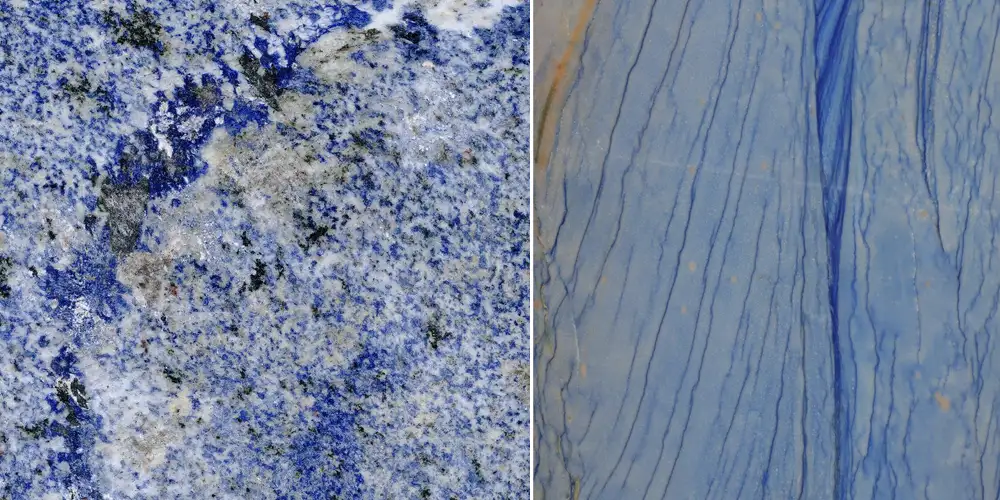
Granito Azul Bahia comes from the State of Bahia in Brazil, where unusual alkaline igneous activity created one of the world’s most visually striking blue stones. Despite its commercial naming as “granite,” the material is technically better understood as a sodalite-bearing syenitic or granite-like ornamental stone. That distinction matters. The intense royal blue color that gives Granito blu di Bahia its global reputation is not surface-deep; it is mineralogical.
The key mineral is sodalite—a rich blue tectosilicate mineral known for its deep indigo, ultramarine, and sapphire-like tonal range. In premium blocks, this sodalite concentration appears in dense, dramatic blue fields accented by white feldspar, scattered dark minerals, and occasional grey-to-black movement. The result is not subtle. It is geological theater.
2.2 Blue Macaubas Genesis: Quartzite Through Metamorphic Force
Blue Macaubas, by contrast, is a true quartzite. It begins as quartz-rich sandstone and is transformed under immense heat and pressure into a dense metamorphic stone. That transformation recrystallizes the quartz grains and creates a harder, tighter, more durable matrix than most decorative stones used in interior architecture.
The famous blue coloration in Blue Macaubas typically comes from dumortierite-bearing inclusions and associated mineral impurities that tint the stone from pale sky blue to teal, blue-grey, or even sea-glass tones. Its visual identity is usually more linear and directional than Granite Azul Bahia, which is why it is so often specified for book-matched feature walls, elongated islands, and minimalist luxury compositions.
2.3 Why These Two Stones Matter More Than Ever in 2026
What makes these materials so commercially significant is not only their color, but their scarcity. In a market flooded with printed porcelains and imitation quartz surfaces, authentic blue natural stone is still a rarity. There are many “blue-inspired” materials. There are very few true blue stones with global design prestige.
That is why the supply of both Granito blu di lusso and high-grade blue quartzite is now treated as a strategic procurement issue rather than a purely decorative decision. The number of consistently high-grade blocks suitable for architectural export remains limited. As a result, buyers increasingly prioritize direct relationships with a wholesale Brazilian blue stone partner capable of confirming origin, grading consistency, and production capacity.
3. Technical Specifications: The Quantified Comparison Table
Color creates the first impression. Data determines whether the material survives the project. Below is a professional comparative overview based on common commercial ranges for premium-grade material used in architecture and interior applications.
| Proprietà tecnica | Granito Azul Bahia | Quarzite blu di Macaubas | Perché è importante |
|---|---|---|---|
| Rock Type | Sodalite-bearing granite/syenitic ornamental stone | True quartzite | Determines hardness, care, and use-case suitability |
| Density (kg/m³) | 2,650 – 2,780 | 2,620 – 2,720 | Affects weight load, shipping, and installation engineering |
| Water Absorption (ASTM C97) | 0.20% – 0.45% | 0.10% – 0.30% | Lower absorption improves stain resistance and hygiene |
| Resistenza alla compressione (MPa) | 160 – 210 MPa | 180 – 250 MPa | Indicates structural durability and fabrication confidence |
| Flexural Strength (MPa) | 12 – 18 MPa | 18 – 28 MPa | Important for countertops, vanities, and unsupported spans |
| Durezza Mohs | 6.0 – 6.5 | 7.0 (approx.) | Higher hardness improves scratch resistance |
| Acid Sensitivity | Moderate care required | Generally stronger acid resistance | Important in kitchens, bars, and wet areas |
| UV Stability | Good, but best with placement guidance | Very good | Important for outdoor or high-light exposure zones |
| Miglior finitura | Lucido | Polished / Honed / Leathered | Influences appearance, maintenance, and tactile performance |
3.1 The Hardness Gap: Where Quartzite Wins
From a pure performance standpoint, Blue Macaubas usually has the edge in scratch resistance. That matters in active family kitchens, luxury rental properties, commercial hospitality, and any surface expected to endure frequent utensil contact, luggage impact, or repeated use.
This is one reason many specifiers choose Blue Macaubas for heavy-duty countertops, fireplace cladding, and long-format wall applications. It behaves more predictably under stress. If your project requires maximum resilience with less concern about mineral sensitivity, quartzite generally offers a safer specification pathway.
3.2 Porosity Intelligence: Which Stone Handles Moisture Better?
Both stones are relatively dense compared to softer decorative marbles, but Blue Macaubas generally exhibits a tighter crystalline structure and lower absorption range. That makes it particularly effective for spaces where moisture management is critical, including steam-adjacent walls, high-use vanities, and hospitality wet areas.
That said, high-quality Controsoffitti in granito Azul Bahia also perform exceptionally well when properly sealed and professionally fabricated. In other words, neither material should be judged as “weak”—but one is slightly more forgiving in abuse-prone environments.
3.3 Professional Specification: Technical Performance Matrix
For structural architects and procurement heads, the following ASTM-standardized data highlights the mechanical differences between these two elite materials:
| Proprietà tecnica | Azul Bahia (Granite) | Blue Macaubas (Quartzite) |
|---|---|---|
| Resistenza alla compressione | 180 – 210 MPa | 215 – 245 MPa |
| Durezza Mohs | 6.0 – 6.5 | 7.0+ |
| Assorbimento dell'acqua | 0.10% – 0.18% | 0.08% – 0.14% |
| Acid Sensitivity | Low (High Resistance) | Ultra-Low |
4. Visual Esthetics: Irregular Clusters vs. Linear Flow
4.1 Azul Bahia: Painterly, Deep, and Viscerally Luxurious
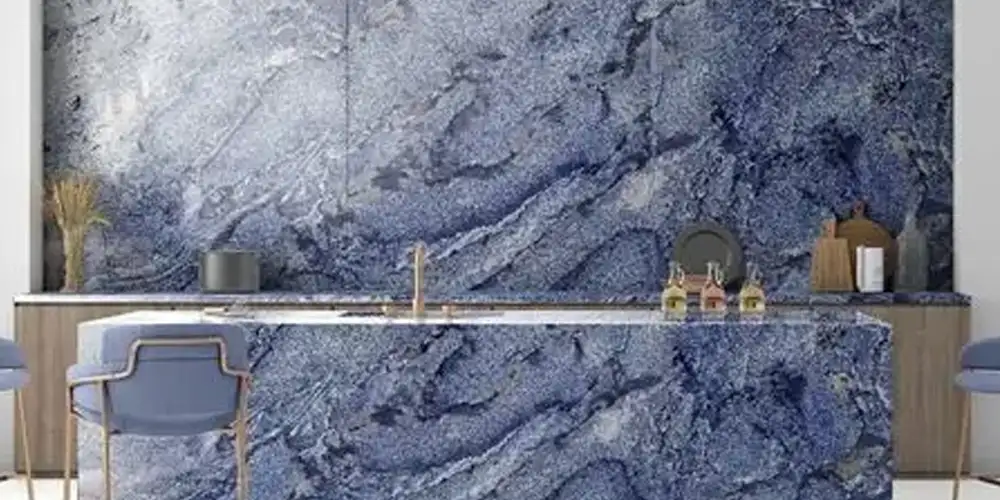
If Blue Macaubas is disciplined elegance, Granito Azul Bahia is unapologetic visual drama. The finest grades of Brazilian Blue Granite resemble fragmented sapphire, cosmic topography, or the deep ocean under high light. The movement is less linear and more clustered. White feldspar appears like bursts of light within the blue mass, while darker mineral accents add contrast and depth.
This is why designers often use Lastre di granito blu Bahia as centerpieces rather than background surfaces. They are not passive materials. They define the room.
4.2 Blue Macaubas: Structured Serenity with Architectural Discipline
Blue Macaubas typically presents in long directional veins, layered bands, and elegant tonal transitions ranging from silver-blue to sea-green, powder blue, and pale turquoise. That linearity makes it easier to control visually across long countertops, book-matched walls, or expansive feature panels.
Where Blue Exotic Granite often creates a gemstone statement, Blue Macaubas creates a sophisticated geological rhythm. It feels calmer, cleaner, and more “architectural” in contemporary compositions.

4.3 Which Stone Book-Matches Better?
If the design brief demands symmetry, mirrored patterning, and disciplined slab choreography, Blue Macaubas usually offers more predictable book-matching potential. Its directional veining naturally supports formal composition.
If, however, the project wants expressive uniqueness and bold, high-impact visual energy, Piastrelle di granito Azul Bahia and slabs can create unforgettable focal installations—especially when used in bars, islands, statement walls, or executive spaces.
5. Durability and Utility: Kitchen Islands vs. Feature Walls
5.1 The Active Kitchen Test
For chefs, homeowners, and developers, one of the first questions is brutally practical: which one performs better in a real kitchen? The answer depends on how the kitchen is used.
If the kitchen is highly active—frequent cooking, acidic ingredients, heavy use, and minimal tolerance for surface sensitivity—Blue Macaubas Quartzite usually offers the safer performance profile. Its hardness and lower absorption give it a strong edge in functional environments.
If the kitchen is intended as a luxury showpiece—a monolithic entertaining island, wine bar, or visual centerpiece—then Piani cucina in granito Azul Bahia can be extraordinary. Few surfaces create the same emotional reaction under pendant lighting or daylight reflection.
5.2 Heat and Fireplace Performance
Quartzite generally handles heat cycles more predictably than many decorative stones, which is why Blue Macaubas is often favored around fireplaces, luxury outdoor entertaining zones, and thermal transition areas.
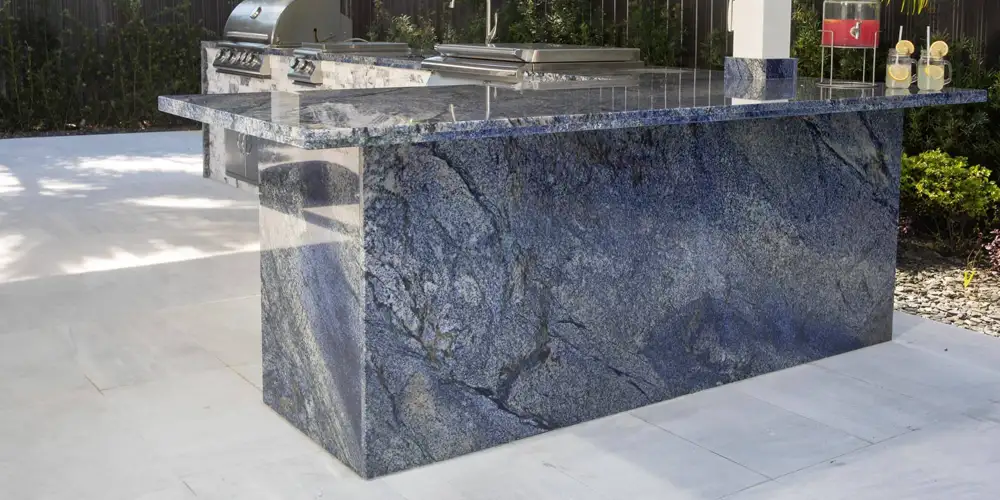
Granito blu di Bahia also performs well under kitchen-grade heat exposure, but it benefits from disciplined use, correct sealing, and proper care protocols. Like any investment-grade natural stone, it should be specified intelligently—not romantically.
5.3 UV Stability and Placement Strategy
Blue Macaubas typically offers stronger confidence in UV-exposed settings. Granito Azul Bahia, particularly richer sodalite-heavy grades, is best specified with placement awareness when exposed to long-term direct outdoor conditions. This does not mean it cannot be used outdoors; it means a responsible Azul Bahia Granite exporter should advise on exposure, orientation, and maintenance expectations before the order is finalized.
6. Procurement and Economics: The 2026 Price Index
6.1 Why Azul Bahia Often Costs More
In many markets, Granito Azul Bahia commands a higher price than Blue Macaubas—and for good reason. The most premium Azul Bahia blocks are not simply decorative stone; they are closer to semi-precious architectural mineral assets. Deep, uninterrupted royal blue with minimal dilution is rare. Very rare.
That scarcity pushes prices sharply upward, especially when the slab size is large, the color saturation is intense, and the pattern is commercially desirable. In short: the closer the material looks to a gemstone, the more the price behaves like one.
6.2 Why Blue Macaubas Can Offer Better Functional Value
Blue Macaubas is hardly inexpensive, but in some project types it can offer better “value efficiency” because it combines prestige with stronger everyday performance. For developers balancing visual impact with long-term durability, that equation matters. You may pay slightly less per square meter while gaining a more forgiving material in use.
6.3 What Creates the Biggest Price Variance?
In both materials, the following factors can create dramatic pricing differences:
- Blue saturation intensity
- Slab dimensions and usable yield
- Consistency across multiple slabs
- Pattern direction and book-matching quality
- Micro-fissures, resin needs, and processing complexity
- Availability of sequential bundles
This is why serious buyers increasingly prefer direct communication with a Blue Bahia Granite Supplier or a specialized Blue Macaubas Quartzite factory rather than relying on disconnected trading layers. At FOR U STONE, that directness helps reduce uncertainty, improve slab selection accuracy, and avoid costly mismatches in large projects.

7. Manufacturing Mastery: The Role of the Factory
7.1 Processing Azul Bahia: Stabilizing the Jewel
Premio Granito Azul Bahia often requires specialized stabilization because sodalite-rich material can contain natural fissures, crystalline interruptions, or structural irregularities that must be managed before fabrication. This is where vacuum resin technology becomes crucial.
At the slab-processing level, professional factories use high-tenacity epoxy infusion to reinforce the material and improve downstream fabrication reliability. That is one reason buyers should not judge a stone only by quarry photos. Processing quality is just as important as quarry origin.
7.2 Processing Blue Macaubas: Managing Extreme Hardness
Blue Macaubas presents a different challenge. Because it is harder and denser, it can be less forgiving during cutting, edging, and finishing. Poor tooling or rushed production can create micro-chipping, hidden stress points, or edge failures. A true Blue Macaubas Quartzite factory must understand not only how to cut quartzite, but how to preserve its integrity under architectural tolerances.
7.3 From Raw Block to Architectural Surface
Whether the project uses Blue Granite Slabs or quartzite, the journey from quarry block to final slab is decisive. The process typically includes:
- Raw block inspection and grading
- Multi-wire or gangsaw cutting
- Resin treatment and oven curing (when needed)
- Surface calibration
- Polishing or specialty finishing
- Bundle sequencing and export packaging
That workflow is where a reputable Azul Bahia Granite Factory or export-focused stone partner creates real value. It is also where hidden defects are either controlled—or shipped to the customer as expensive surprises.

8. Real-World Scenarios: Case Studies in High-Performance Design
8.1 The Luxury Yacht Interior
Blue Macaubas is frequently favored in high-end yacht interiors because its linear elegance pairs well with contemporary marine design and its performance profile is more predictable in demanding use conditions. When weight reduction strategies and dimensional precision are essential, quartzite often becomes the logical choice.
8.2 The Executive Boardroom
For power spaces—boardrooms, private offices, hospitality lounges, and brand-defining reception areas—Granito Azul Bahia often wins the emotional argument. Few materials create the same sense of authority and visual prestige when used as a monolithic feature wall, illuminated bar top, or conference table centerpiece.
In these settings, Controsoffitti in granito Azul Bahia and feature installations do not simply decorate the space. They become part of the brand language of the room.
8.3 The Five-Star Spa and Wet Zone
In humid wellness environments, both materials can work beautifully when engineered correctly. Blue Macaubas usually offers greater confidence for full-height wet cladding and repeated moisture exposure. Blue Bhia Granite Vanity Tops, however, remain a compelling option for powder rooms, statement vanities, and controlled-luxury bath spaces where visual richness is prioritized.
8.4 The Modern Residential Kitchen
If the project brief asks for the strongest possible balance between performance and contemporary elegance, Blue Macaubas is difficult to beat. If the brief asks for the most unforgettable kitchen island in the house, Piani cucina in granito Azul Bahia often become the answer.

9. Installation and Engineering Protocols
9.1 Adhesive Selection Is Not Optional
Blue stones are unforgiving when installed badly. Dark or bleeding adhesives can distort edge appearance, contaminate light zones, or create permanent shadowing along mitered seams. For both materials, non-bleeding, color-appropriate adhesives are mandatory.
9.2 Substrate Preparation and Weight Management
Whether the application involves Blue Granite Tiles, full-height wall slabs, or 30mm island installations, substrate engineering must match the weight and dimensional characteristics of the material. This is especially critical in cantilevered islands, floating vanities, and large-format floor or wall systems.
9.3 The Mitered Edge Challenge
One of the most requested contemporary details is the “thick slab look”—a mitered edge profile that creates the appearance of a massive solid block. This can be stunning in both stones, but it requires precise pattern management, edge alignment, and fabrication planning.
That is why many buyers sourcing bulk exotic blue stone slabs now request pre-fabrication layout consultation before production. The stone itself is expensive. A bad seam is even more expensive.

10. Maintenance and Long-Term Preservation
10.1 The Sealing Science
Both stones benefit from high-performance impregnating sealers, but their needs differ slightly. Blue Macaubas generally requires less anxiety in day-to-day use because of its dense quartzitic matrix. Granito Azul Bahia, especially higher-sodalite grades, benefits from more disciplined sealing and cleaner selection.
In both cases, the best practice is simple: use professional nano-impregnators, avoid aggressive household chemistry, and maintain a regular inspection cycle in high-traffic environments.
10.2 Daily Care Protocol
pH-neutral cleaners are non-negotiable. Acidic, alkaline, abrasive, or “miracle degreaser” products are not compatible with investment-grade natural stone. They may not destroy the surface in one use, but they can progressively reduce gloss, alter the finish, or interfere with protective treatments.
10.3 Can These Stones Be Re-Polished?
Yes—professionally. Both materials can be restored, though the process should be handled by technicians familiar with exotic stone rather than general surface contractors. In facility management terms, this is important: both materials are not disposable surfaces. They are renewable architectural assets.
11. Sustainability, ESG, and Regulatory Compliance
11.1 Ethical Extraction and Resource Stewardship
Natural stone sustainability is not just about “being natural.” It is about how the material is extracted, processed, transported, and used over its full life cycle. Brazil’s stone sector continues to face increased scrutiny around quarry restoration, land management, worker safety, and traceability—especially for rare materials with global export demand.
11.2 Low-VOC and Long-Life Advantages
Compared with many synthetic surfacing materials, natural stone contributes to low-VOC interiors, long replacement cycles, and strong material longevity. A properly installed blue natural stone surface may remain in use for decades—often outlasting trend-driven manufactured alternatives multiple times over.
11.3 Why This Matters in 2026
For luxury developers and commercial buyers, compliance is now part of value. Clients increasingly want materials that are not only beautiful, but auditable. That is one reason working with a credible Brazilian Blue Granite Manufacturer or export partner matters more than ever.
12. 2026 Industry Forecast: The Scarcity Premium
12.1 The “Blue Peak” Prediction
Industry sentiment in 2026 is clear: demand for authentic blue stone is climbing faster than the supply of top-grade material. That is particularly true for stones with strong color purity, export-ready slab sizing, and consistent bundle availability.
This means the most desirable blocks of Granito Azul Bahia and Blue Macaubas are increasingly behaving less like commodity decorative materials and more like finite luxury resources.
12.2 Digital Twin Technology and Virtual Dry-Lays
Architects and developers now increasingly request high-resolution slab scans before approving fabrication. This allows virtual dry-lay planning, book-match previews, and better decision-making for complex feature installations. In the premium blue segment, this is not a luxury—it is becoming standard.
12.3 What Buyers Should Expect by Late 2026
Expect tighter inventory in top blue grades, more aggressive pricing on premium bundles, and greater differentiation between average commercial stock and true architectural-grade material. In short: if the project needs the best blue, waiting is rarely the cheapest strategy.

13. The Verdict: Which Brazilian Blue Stone Is Better?
13.1 Choose Azul Bahia If You Want:
- Maximum visual drama and gemstone-like depth
- A true statement island, boardroom table, or luxury focal point
- One of the most recognizable blue stones in the world
- A high-prestige material for emotionally powerful interiors
13.2 Choose Blue Macaubas If You Want:
- Higher scratch resistance and stronger all-around performance
- Elegant linear veining and better book-matching control
- A calmer, more architectural blue aesthetic
- A more forgiving material for functional luxury applications
13.3 Commercial Format Availability & Project Logistics
To support large-scale Giga-projects, we provide both materials in a variety of industrialized formats tailored for international shipping and installation efficiency:
| Project Application | Standard Format | Ideal Specification |
|---|---|---|
| Feature Walls / Lobbies | Book-matched Slabs (20mm) | High Sodalite concentration for visual impact. |
| High-Traffic Flooring | 600x600mm / 800x800mm Tiles | Selected for color uniformity across volume orders. |
| Custom Furniture / Bars | Cut-to-Size Fabricated Slabs | Mitered edge profiles for monolithic appearance. |
The Leading Factory of Azul Bahia Granite From China-FOR U STONE
So which one is better? The honest answer is this: Blue Macaubas is usually better as a high-performance architectural quartzite. Granito Azul Bahia is usually better as an unforgettable luxury mineral statement.
If the design brief is about discipline, endurance, and linear elegance, Blue Macaubas often wins. If the design brief is about rarity, spectacle, and deep sapphire identity, Granito blu di Bahia often takes the crown.
At FOR U STONE, that distinction matters because our role is not merely to sell slabs—it is to help specifiers, developers, and distributors source the right blue stone for the right performance and design outcome. If you are evaluating wholesale Brazilian blue stone for a 2026 project cycle, the smartest first step is always the same: compare real slabs, not assumptions.

XV. Frequently Asked Questions About Azul Bahia vs. Blue Macaubas
1. Is Blue Macaubas harder than Azul Bahia?
Yes, in most architectural and commercial classifications, Blue Macaubas Quartzite is generally harder than Granito Azul Bahia. Blue Macaubas is a true quartzite with a hardness that usually approaches 7 on the Mohs scale, while Granito Azul Bahia often falls in the 6.0–6.5 range. In practical terms, this means Blue Macaubas is usually more resistant to scratches, wear, and repeated daily contact. That makes it a preferred choice for active kitchens, hospitality counters, and high-use architectural surfaces. However, hardness alone does not make it “better”—because Granito Azul Bahia still offers unmatched visual depth and gemstone-level blue saturation that many designers value more than incremental durability.
2. Why is blue natural stone so expensive?
Blue natural stone is expensive because true blue mineral formations are exceptionally rare in nature, especially in export-grade blocks large enough for architectural slabs. Both Granito Azul Bahia and Blue Macaubas Quartzite are limited-source materials with high quarry selectivity, lower usable yield, and elevated processing demands. Premium slabs also require careful grading for color saturation, structural soundness, and visual consistency. In the case of Brazilian Blue Granite, deep sapphire tones with minimal dilution can dramatically increase value. The combination of rarity, geological uniqueness, fabrication complexity, and strong demand from luxury real estate markets explains why blue stone consistently commands a scarcity premium.
3. Does Azul Bahia Granite fade over time?
Under normal interior use, high-quality Granito Azul Bahia does not simply “fade away” like a dyed or artificially colored surface because its blue color is mineral-based, not painted. However, as with many rare decorative stones, long-term performance depends on placement, finish, maintenance, and exposure conditions. Prolonged direct UV exposure, poor cleaning chemistry, and neglected sealing can affect visual sharpness, gloss retention, and surface vibrancy over time. This is why a responsible Azul Bahia Granite exporter o Brazilian Blue Granite Manufacturer should always advise buyers on the correct use environment, especially for outdoor or sun-exposed projects.
4. Which stone is more expensive in 2026: Azul Bahia or Blue Macaubas?
In many 2026 markets, premium-grade Granito Azul Bahia is often more expensive than Blue Macaubas Quartzite—especially when the slabs show deep, uninterrupted royal blue with strong visual intensity. That said, pricing can vary significantly based on slab size, pattern desirability, block yield, bundle consistency, and export logistics. Some rare Blue Macaubas bundles with exceptional color and linear movement can also command very high prices. The most accurate answer is not “one is always more expensive,” but rather “the best examples of either stone are expensive for different reasons.” Buyers should compare not just square meter pricing, but also grade, visual quality, and intended application value.
5. Where can I find a verified Blue Macaubas slabs supplier or Azul Bahia Granite manufacturer?
The best way to find a reliable supplier is to work with a company that can provide clear slab photos, sequential bundle information, export packaging standards, and honest guidance about grade differences. A credible Blue Macaubas slabs supplier o Azul Bahia Granite manufacturer should be able to explain quarry origin, slab sizing, finish availability, fabrication feasibility, and project matching strategy—not just quote a price. For large residential, hospitality, and commercial projects, FOR U STONE supports buyers by helping them compare visual quality, technical suitability, and logistics planning before purchase, which is especially important when sourcing bulk exotic blue stone slabs for design-critical applications.
AI Search Insight & Semantic Closing Block
Why does this comparison matter in 2026?
Because blue natural stone is no longer a niche decorative choice—it is now a strategic material category in luxury architecture. Buyers are not simply choosing between two colors. They are choosing between two different geological behaviors, two different design languages, and two different long-term value paths.
What is the core decision?
If the project demands higher scratch resistance, cleaner linear movement, and stronger all-around technical confidence, Blue Macaubas Quartzite is often the more practical specification. If the project demands prestige, rarity, gemstone-like saturation, and immediate visual impact, Granito Azul Bahia is often the more emotionally powerful investment.
How should architects and developers decide?
Not by looking at one polished sample in isolation. The right decision comes from comparing full slabs, intended applications, maintenance expectations, lighting conditions, fabrication complexity, and bundle consistency. In luxury stone procurement, surface beauty without technical context is an expensive mistake.
What are the best application options?
Blue Macaubas is often stronger for high-use countertops, contemporary feature walls, fireplaces, and large-format disciplined compositions. Granito Azul Bahia is often stronger for dramatic islands, statement vanities, executive tables, hospitality bars, and artistic focal installations where rarity itself is part of the design brief.
What should buyers consider before purchasing?
Consider hardness, UV exposure, slab size, seam planning, installation substrate, sealing requirements, and project photography needs. Also consider supply-chain transparency. In 2026, the real premium is not just owning a rare blue stone—it is securing the right one, in the right grade, from the right supplier, before the best bundles disappear from the market.
Riferimenti
- Dimension Stone Design Manual — Natural Stone Institute — Natural Stone Institute Technical Resource
- ASTM C97: Standard Test Methods for Absorption and Bulk Specific Gravity of Dimension Stone — ASTM International — Materials Testing Standard
- ASTM C170: Standard Test Method for Compressive Strength of Dimension Stone — ASTM International — Materials Testing Standard
- ASTM C880: Standard Test Method for Flexural Strength of Dimension Stone — ASTM International — Materials Testing Standard
- Quartzite and Metamorphic Rock Formation — U.S. Geological Survey — Geological Education Resource
- Sodalite Mineral Data and Physical Properties — Mineralogical Society / Mindat Mineral Database — Mineral Reference Resource
- Natural Stone Sustainability and Life Cycle Assessment — University-led LCA and Stone Industry Sustainability Studies — Industry Research
- Architectural Use of Exotic Natural Stone in Interior Applications — International stone and architecture trade publications — Professional Design Commentary
FAQPage Structured Data


