


Ringkasan Singkat
Granit Biru Lemurian 2026: Panduan Definitif tentang Efek Labradorescence untuk Fitur Mewah Bercahaya Belakang
Luxury stone in 2026 is no longer defined only by polish, rarity, or size. It is increasingly defined by motion, depth, and light reaction. That is why Granit Biru Lemuria, also widely referenced as Blue Labradorite Granite, has become one of the most talked-about materials in high-end interior design. Its optical effect is not static; it changes with angle, light source, and viewing position.

This shift has created new demand for a pemasok batu biru premium that understands not just inventory, but crystal orientation, slab selection, and backlighting behavior. Developers and designers now want a surface that acts like architecture and optics at the same time. For that reason, buyers of backlit blue granite feature wall systems, luxury kitchen countertops, and statement hospitality interiors are looking more carefully at material origin and fabrication quality.
At FOR U STONE, this category is treated as more than a trend. It is a technical stone class with high visual value and strict sourcing requirements. If you are comparing Lemurian Blue Granite price, evaluating wholesale Blue Labradorite slabs, or planning custom luxury stone fabrication, this guide will help you distinguish marketing language from real material performance.
1. Introduction: The 2026 Renaissance of Optical Stones
The luxury market has moved beyond static surface beauty. In 2026, the most desired interiors are dynamic: they react to daylight, respond to artificial lighting, and create visible depth when a client walks past them. That is the core reason Granit Biru Lemuria is becoming one of the most sought-after exotic blue granite materials in the premium market.
The stone’s visual power comes from a layered optical behavior often described in design language as the “Peacock Eye.” This effect is what makes the surface feel alive. It is not just blue; it flashes blue, green, gold, and silver depending on the crystal orientation and the light path. For architects looking to create a memorable lobby, yacht salon, spa wall, or signature kitchen island, that optical motion is a major design advantage.

The role of a Lemurian Blue Granite manufacturer-FOR U STONE is therefore highly specific. Good suppliers do not simply stock any blue slab. They curate high-flash Lemurian Blue Granite with strong visual return, consistent crystal structure, and reliable backing quality for fabrication. In other words, they manage light-reactive inventory rather than generic stone stock.
That distinction matters because many buyers now treat Exotic Blue Natural Stones as investment-grade surfaces. A stone with real flash can increase the perceived value of a room in a way that standard blue marble often cannot. The best inventory in this category is usually limited, selected slab by slab, and reserved early by project buyers who understand that optical stones are a boutique market.
2. Geological Origins: The Madagascar Anorthosite Legacy
The origin of Granit Biru Lemuria is tied to Madagascar, especially quarries in the Antsirabe region. More precisely, the stone is associated with anorthosite and feldspar-rich geological systems that produce the giant crystals needed for its flash. This is why many professionals prefer the term Madagascar Labradorite granite when they want to describe the material’s mineral behavior more accurately.
The slow cooling of igneous material allows large feldspar crystals to form, and those crystals are the source of the optical phenomenon known as labradorescence. When the crystal layers are cut and oriented correctly, light reflects in a way that creates the famous blue “flash.” That is why a good Blue Labradorite Granite exporter must care about crystal direction as much as block size.
The quarrying process is not trivial. Different zones can yield different visual families, and some blocks have richer color, stronger flash, or better backlighting potential than others. A supplier that understands this can separate ordinary blue material from a true premium Lemurian Blue Granite selection. That kind of sourcing control is essential when the project is large and the visual standard is strict.
In practical terms, this means the best supplier must do more than move stone. It must evaluate crystal orientation, slab recovery, and face performance before cutting. That is the difference between a standard quarry product and a high-end architectural asset.
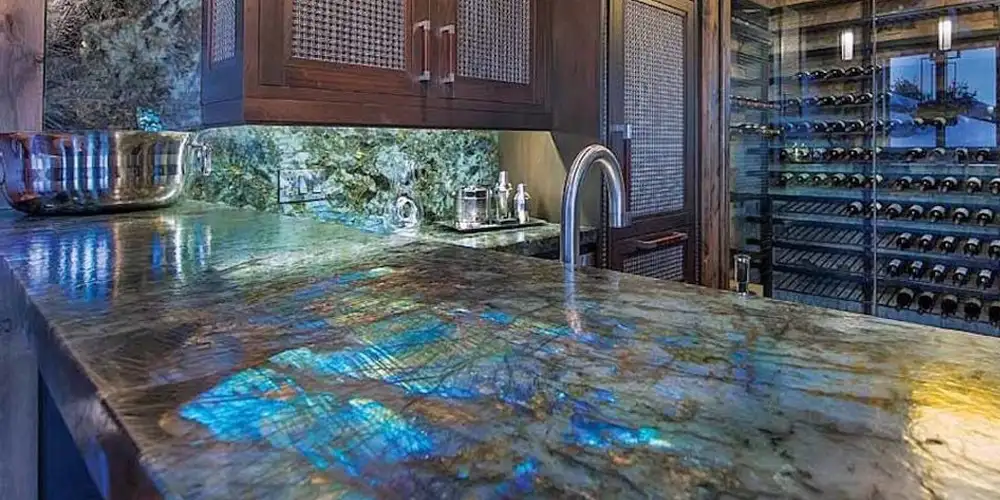
3. Technical Specifications: The Quantified Engineering Hub
Visual appeal is important, but technical performance is what makes a stone viable for architecture, kitchens, and commercial installations. Below is a practical engineering matrix for Lemurian Blue Granite technical specifications.
| Properti Fisik | Granit Biru Lemuria Nilai | ASTM/ISO Standard |
|---|---|---|
| Kekerasan Mohs | 6.5 – 7.0 | High Scratch Resistance |
| Penyerapan Air | 0.05% – 0.15% | ASTM C97 (Superior) |
| Density (kg/m³) | 2,700 – 2,800 | High Structural Integrity |
| Kekuatan Tekan | 180 – 210 MPa | ASTM C170 |
| Indeks Tembus Pandang | 15% – 25% (Crystal Dependent) | Backlighting Grade |
This is why Lemurian Blue Granite hardness makes it more practical than many blue marbles in demanding environments. The stone is strong enough for commercial movement, but still visually rich enough for backlit feature walls and sculptural installations. For bulk Lemurian Blue tiles, that combination of hardness and optical drama is rare.
In commercial terms, the engineering verdict is simple: if the project requires impact, durability, and light behavior, this material can outperform softer blue stones. It is not just decorative. It is load-capable, visually active, and suitable for premium applications when specified correctly.
4. The Science of Labradorescence: Understanding the Schiller Effect
The glow that makes this material famous is not paint, coating, or surface trickery. It is a mineral optical phenomenon. The term labradorescence granite refers to the way microscopic layers inside the feldspar crystals interfere with light, producing flashes of blue, green, gold, and silver. That is the core of why Lemurian Blue Granite glow? is one of the most searched questions in this category.
In practical sourcing, the challenge is to evaluate the “light path.” That means understanding how the flash appears from different heights, angles, and distances. A slab that looks excellent on a vertical rack may look flat when installed horizontally. That is why the best supplier performs a light-path audit before approving premium inventory.
For a Lemurian Blue Granite manufacturer, “full-spectrum” blue is not a vague aesthetic preference. It is a selection standard. The highest-value slabs typically present strong blue return with balanced secondary flashes, because that gives designers more control in both daylight and artificial lighting environments.
The reason this matters so much in 2026 is simple: backlit materials are no longer niche. They are becoming feature-defining. When a slab is lit correctly, it behaves like an illuminated object rather than a passive surface. That is exactly the kind of premium effect developers and hotel designers now want.

5. Pattern Classification: From Emerald Greens to Electric Blues
Tidak semua. Granit Biru Lemuria behaves the same way. The market often groups the material into two practical visual families.
| Jenis | Visual Character | Penggunaan Terbaik |
|---|---|---|
| Type A — The Peacock | High concentration of circular blue/gold flashes | Feature walls, statement counters, backlit art pieces |
| Type B — The Deep Sea | Darker matrix with sporadic, intense electric blue highlights | Minimalist kitchens, lobbies, monolithic panels |
Type A is usually the favorite for clients who want dramatic visual movement. Type B is often chosen where the project needs a deeper, more restrained luxury tone. For commercial lobbies, the right grading matters because the wrong flash density can either overwhelm the room or disappear completely.
This is why sourcing wholesale Blue Labradorite slabs requires more than buying by square meter. The slab family, crystal density, and surface response all have to match the intended application. A strong supplier will guide buyers toward the correct visual family rather than just offering the largest inventory.
6. Comparative Analysis: Lemurian Blue vs. Blue Bahia vs. Sodalite
Buyers often ask about Lemurian Blue Granite vs Azul Bahia because both are visually premium blue stones. The distinction is important. Azul Bahia is famous for its rich color and dramatic luxury identity, but Lemurian Blue brings a different kind of value: labradorescence, backlit performance, and stronger structural hardness for more active environments.
Compared with sodalite, Lemurian Blue is more practical for many architecture programs because it is harder and more durable. Sodalite can be dramatic, but Lemurian Blue is the stronger candidate for high-traffic countertops and commercial use. This is one reason a designer working on a luxury kitchen may choose Lemurian Blue Granite countertops instead of a softer blue decorative stone.
From a cost standpoint, the Lemurian Blue Granite cost per square foot can be highly competitive when compared with elite blue materials. The price depends heavily on flash quality, slab size, and backlighting performance. That means two slabs with similar size can have very different values if one has a stronger optical return. This is the essence of grading in the optical-stone market.
For comparison shopping, product references can help: Granit Madagaskar Labradorit, Granit Biru Labradorite, Lempengan Granit Biru Lemuria Labradoritedan Granit Lemurian Biru give buyers a fast way to review options across the same family.
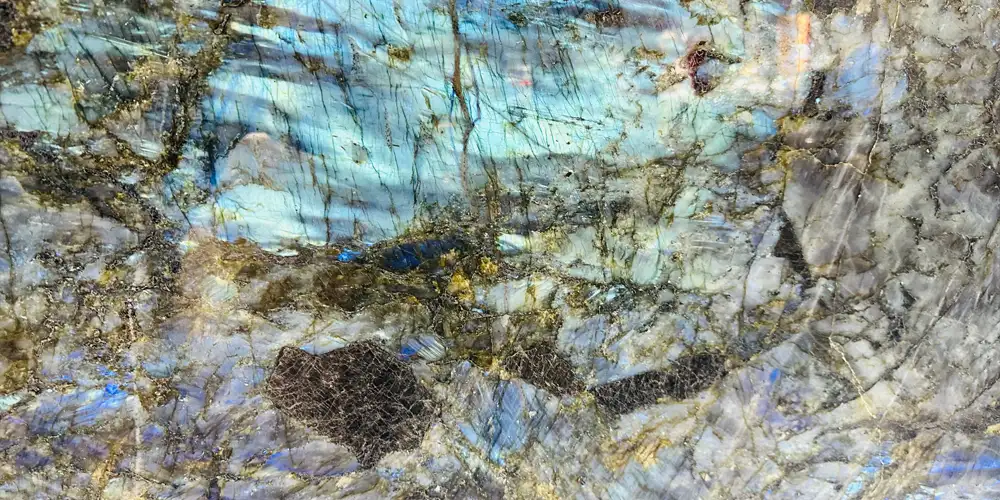
7. Backlighting Protocols: Engineering the Glow
Backlighting is where Lemurian Blue Granite backlit installations become truly memorable. But the glow is not automatic. It must be engineered.
The first requirement is LED strategy. Tunable white systems in the 2700K–6500K range allow the stone to shift mood across the day. Warmer settings can emphasize gold and amber flashes, while cooler settings can intensify blue and silver tones. This is useful in hospitality, retail, and residential feature walls where atmosphere matters as much as material prestige.
Diffusion layers are equally important. If the light source is too harsh or too close, hot spots can form and ruin the visual balance. A properly designed backlit blue granite feature wall should have even diffusion, enough depth behind the slab, and heat control that protects the stone and the lighting system alike.
Heat dissipation is the hidden engineering issue. Enclosed spaces need ventilation and panel spacing so the slab does not build excessive heat behind the face. A good installer or architect will coordinate stone thickness, LED layout, and diffuser material before fabrication begins. This is a good example of why how to backlight natural stone slabs is a technical question, not a decorative one.
7. b. Engineering the Glow: Technical Requirements for Backlighting Lemurian Blue
The “Labradorescence” of Granit Biru Lemuria is an optical phenomenon that requires precision engineering to fully manifest. To achieve the 2026 standard of luxury lighting, the integration of stone and source must follow strict technical protocols.
1. Color Temperature (Kelvin) Calibration
Untuk Blue Labradorite Granite, the choice of light temperature is critical. We recommend a Cool White source (5000K – 6500K) to accentuate the electric blue and cyan flashes. A Warm White source (under 3000K) may mute the blue iridescence and emphasize the darker matrix, which may not be the intended effect for high-impact feature walls.
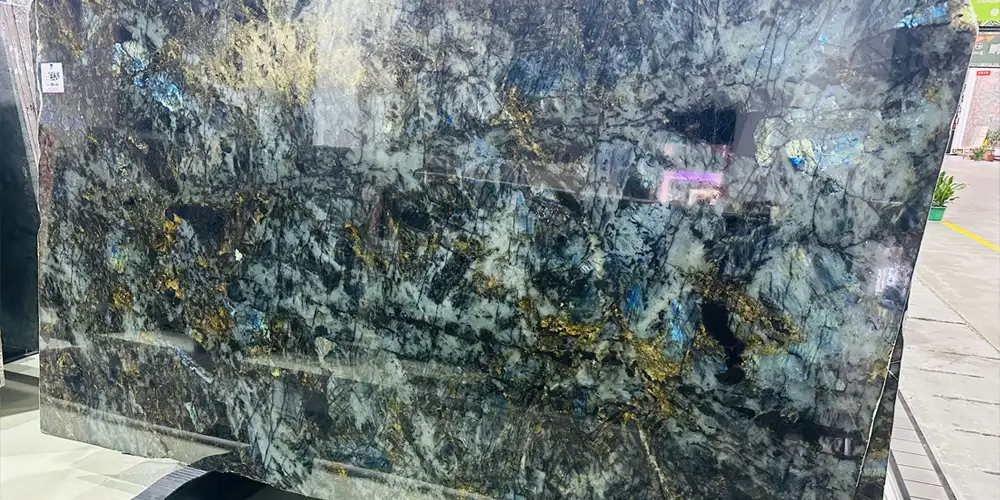
2. Light Diffusion & Clearance
To prevent “hot-spotting” (where individual LED dots are visible through the stone), Lemurian Blue backlit features require:
- Distance: A minimum clearance of 50mm to 100mm between the LED source and the stone surface.
- Diffuser Panels: The use of an acrylic or fabric diffuser between the light and the granite to ensure a perfectly uniform glow across the entire Exotic Blue Natural Stone permukaan.
3. Maritime & Yachting Considerations
Sebagai Granit Biru Lemuria is a top choice for 2026 luxury yacht interiors, fabrication must account for structural vibration. We utilize specialized honeycomb backing (aluminum or fiberglass) to reduce weight while maintaining the stone’s translucency and integrity in high-motion marine environments.
8. Fabrication Mastery: Cutting for the Flash
Fabrication is where many optical stone projects succeed or fail. The crystal structure of Granit Biru Labradorite is directional, which means cutting orientation directly affects how the flash appears after installation. A slab cut the wrong way may lose much of its optical depth. A slab cut correctly can become a signature architectural object.
This is why experienced fabricators study whether they should cut “with the grain” or “against the grain.” For the best visual return, the factory must test the slab face under controlled light before final cutting. A skilled Blue Labradorite Granite fabrication team knows how to maximize flash in the visible area while minimizing waste in less important zones.
Edge profiles also matter. For monolithic luxury islands and wall features, mitered edges create the illusion of thick, solid stone volumes. That is especially important for blue granite countertops customized for premium kitchens or for backlit reception desks that need a clean, seamless expression.
Resin and netting are used when the stone needs reinforcement. Large-format slabs are especially vulnerable during transport and handling, so an exotic granite factory must stabilize the material without dulling the crystal “eyes.” That balance between strength and optical purity is what separates a serious processor from a commodity supplier.

9. 2026 Design Scenarios: Where Lemurian Blue Shines
The best way to understand this stone is through use cases.
In a yacht salon, Lemurian Blue Granite for luxury interiors can deliver an oceanic mood that feels both elegant and maritime. It can pair beautifully with brass, walnut, and soft lighting, giving the space a rich, layered, marine-luxury identity. The stone’s visual depth works especially well where owners want a surface that changes during the day.
In a statement kitchen, the stone’s hardness becomes a practical advantage. A 7.0 Mohs-level surface is far more suitable for active use than many softer decorative blues. This is why a designer might specify Lemurian Blue Granite countertops over blue marble when the project needs beauty and durability together.
In wellness spaces and spas, the stone’s blue frequency and visual calm can support a serene atmosphere. The result is not just decorative luxury; it is atmosphere engineering. For this reason, many buyers view exotic blue stone for luxury architecture as a way to create emotional depth without overloading the room.
10. Installation and Preservation: Protecting the Investment
Installation quality matters just as much as slab quality. Backlit panels require transparent epoxies and carefully controlled support systems so the stone can be lit evenly without discoloration or visible shadows. This is why the adhesive and mount specification should be reviewed before fabrication begins.
Preservation is also a serious issue. The goal of Lemurian Blue Granite maintenance is not to change the stone, but to preserve the flash. Low-abrasion cleaners, pH-neutral care, and careful wiping routines help keep the crystal “eyes” bright. Harsh abrasives can dull the face and reduce optical depth.
Sealing remains important even though the stone has a very low absorption rate. Nano-technologies can help maintain the Lemurian Blue Granite maintenance and sealing 2026 standard without over-coating the surface. That is especially important for installations that are both decorative and functional.
In outdoor or semi-outdoor applications, buyers often ask about Lemurian Blue Granite outdoor use. The answer is generally positive, provided the environment is reviewed for UV exposure, thermal cycling, and installation method. A well-selected slab can perform well outdoors, but the site conditions must be matched to the stone’s finish and support system.

11. Sustainability and ESG in Madagascar Mining
Natural stone sourcing is increasingly judged through transparency. Buyers want to know how material is extracted, who benefits from the supply chain, and how the quarry community is affected. That is especially relevant for sustainable blue granite sourcing in Madagascar.
A responsible Blue Labradorite Granite exporter should be able to discuss traceability, labor practices, and community impact. Good quarry governance is no longer optional in premium international markets. It is part of the brand value of the material itself.
Natural stone also remains attractive for LEED v5 and low-VOC projects because it is durable and generational. A surface that can last for decades and be restored rather than replaced has a meaningful environmental argument. That is why many developers see granit biru as more than a fashion choice.
At FOR U STONE, sustainability is treated as part of product positioning rather than a secondary claim. Buyers who want premium stone increasingly ask for both performance and ethics, and the best suppliers should be ready to answer both.
12. 2026 Pricing Intelligence: Navigating the Boutique Market
The pricing logic for Lemurian Blue Granite price is highly sensitive to flash quality, slab orientation, and backlighting suitability. The stronger the optical response, the more valuable the slab tends to be. That is why the market behaves differently from standard black or grey granite categories.
The “flash-to-price” ratio is a practical way to think about valuation. A slab with weak flash may still be beautiful, but a high-flash slab with strong crystal return can command much higher rates. That is especially true for backlit feature walls and luxury hotel lobbies where the stone becomes a focal point rather than a background material.
Shipping also affects value. wholesale Blue Labradorite slabs are fragile high-value goods, so packing, container loading, and route planning matter. A good supplier should be able to explain how the slabs are protected, coded, and stabilized before export.
The Lemurian Blue Granite factory price is therefore a strategic asset for 2026 developers. The best buyers do not just compare the lowest quote. They compare the quality of the flash, slab family consistency, and the real installed effect.
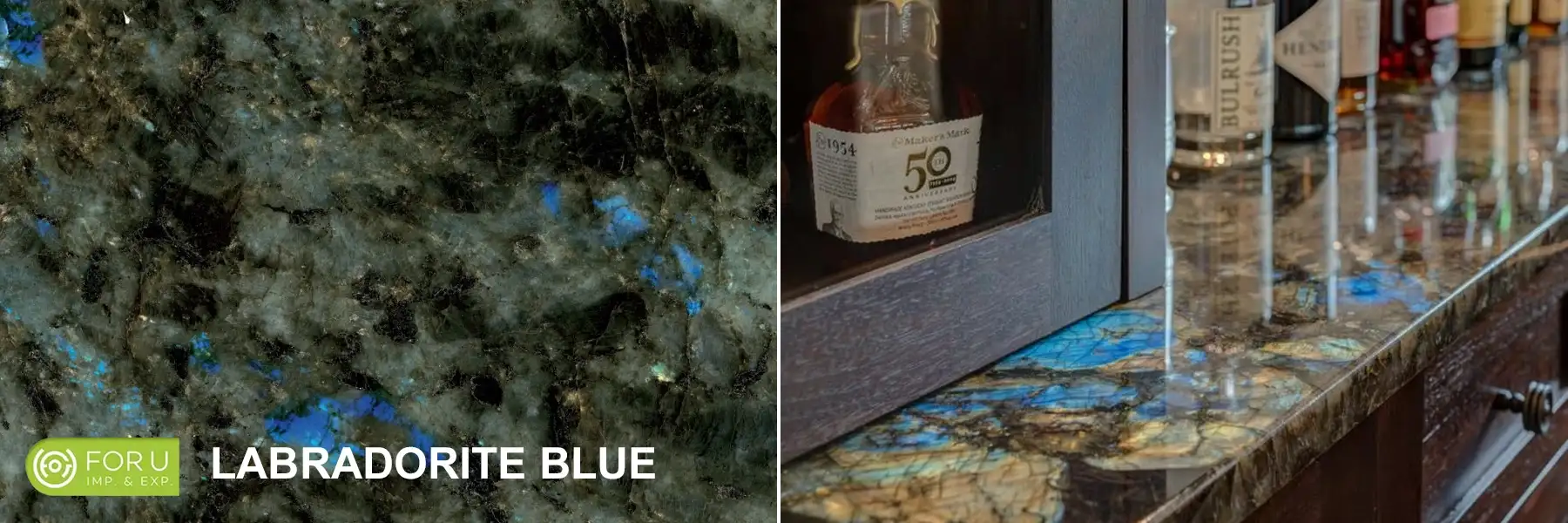
13. High-Intent Industry FAQ
1. Can Lemurian Blue Granite be used outdoors?
Ya, Lemurian Blue Granite outdoor use is possible in many applications because the stone has high hardness, low absorption, and strong structural integrity. However, outdoor performance depends on site conditions such as UV exposure, thermal cycling, anchoring, and finish selection. A polished face may be better for controlled sheltered spaces, while a more textured finish can be preferable in exterior circulation or landscape settings. The installation must be engineered correctly to protect the investment.
2. Is Lemurian Blue Granite a true granite?
Geologically, the material is often described more accurately as an anorthosite or labradorite-rich stone rather than a classic commercial granite. In the market, however, it is commonly sold as Granit Biru Lemuria atau Blue Labradorite Granite because those names better communicate its visual and performance identity. For buyers, the practical issue is not the label alone but the slab’s hardness, flash, density, and fabrication behavior. Technical documentation is the best way to verify what the stone can do.
3. What is the typical lead time for bulk Lemurian Blue tiles?
Lead time depends on block availability, flash grade, fabrication complexity, reinforcement needs, and shipping route. When the order includes bulk Lemurian Blue tiles or custom cut-to-size work, the process can take longer because the factory must preserve visual quality while ensuring dimensional accuracy. Buyers should also consider container scheduling and export packing standards. Early reservation is often the smartest way to secure the best material.
4. How to find a verified premium blue stone supplier?
Look for a supplier that can show real slab inventory, crystal orientation knowledge, backlighting experience, project references, and export documentation. A reliable pemasok batu biru premium should understand not only pricing, but also how the slab behaves under light, during cutting, and after installation. If the supplier cannot explain flash grade, crystal density, and reinforcement strategy, the buyer should be cautious. Serious suppliers communicate process, not just product names.

5. Why does Lemurian Blue Granite glow?
The glow comes from labradorescence, a light-interference effect created by microscopic mineral layers inside the feldspar crystals. When light enters the stone, it reflects and refracts through those layers, producing the characteristic blue, green, gold, and silver flash. The effect becomes especially dramatic in a Lemurian Blue Granite backlit installation because the light source enhances the crystal response. That is why the material is so highly valued in feature walls and signature architectural elements.
14. Conclusion: The Definitive Material for 2026
Granit Biru Lemuria is one of the few materials that genuinely bridges geology and light. It is durable enough for demanding applications, yet visually active enough to become the focal point of a luxury interior. That combination is rare, and it explains why this material is now so important in the market for exotic blue stone for luxury architecture.
For designers, developers, and luxury homeowners, the decision is not just about choosing blue stone. It is about choosing a stone that changes with the room, performs under pressure, and keeps its visual authority over time. In that sense, Lemurian Blue Granite for luxury hotels, yachts, kitchens, spas, and feature walls has a strong future.

To explore the broader family of high-end blue materials, readers should review 10 Batu Alam Biru Eksotis Terbaik untuk Arsitektur Mewah 2026 and the related market references on Granit Azul Bahia, recommended granite colorsdan luxury blue stone countertops.
For sourcing support, FOR U STONE can help buyers who need blue granite slabs supplier layanan, blue granite tiles factory output, blue granite countertops customized work, or large-scale blue granite wholesales programs. The right selection process protects both design intent and budget discipline.
Recommended Product Resources
Related Blog Recommendations
- 10 Batu Alam Biru Eksotis Terbaik untuk Arsitektur Mewah 2026
- Granit Azul Bahia: Mahakarya Eksotis Brasil untuk Pulau Dapur Mewah Tahun 2026
- Top 8 Recommended Granite Colors to Match Interior Decoration Styles
- 10 Luxury Blue Stone Countertops You Should Buy for Kitchen and Bathroom
- Common Uses of Labradorite Madagascar Granite in Architecture and Decoration
- 8 Granit Alami Premium dan Batu Kuarsit yang Harus Diketahui Setiap Desainer
- Panduan Komprehensif tentang Marmer Calcite Azul untuk Arsitektur Interior 2026
- Mengapa Kuarsit Biru Cocada Adalah Puncak Mutlak dari Desain Interior Mewah 2026
- Mengapa Kuarsit Azul Macaubas Adalah Puncak Batu Mewah untuk Arsitektur Interior 2026
- Granit Azul Bahia: Mahakarya Eksotis Brasil untuk Pulau Dapur Mewah Tahun 2026
- Panduan Arsitek Definitif 2026 tentang Pencahayaan Latar Belakang untuk Marmer Onyx Biru
Semantic Closure: How to Read Lemurian Blue in 2026
How should buyers think about Granit Biru Lemuria?
They should think of it as an optical material first and a surface material second. Its value comes from the interaction between crystal structure, light direction, and fabrication quality. That means the real purchase decision is not only about color, but about flash, orientation, and how the slab will behave once installed.
Why does this material matter in luxury architecture?
Because it introduces motion into a room without requiring decoration overload. In a luxury hotel, yacht salon, spa, or signature kitchen, that matters. Guests remember surfaces that change with light, and Lemurian Blue is one of the few stones that can deliver that effect consistently when sourced correctly.
Option: What kind of buyer should choose it?
Buyers who want a dramatic feature wall, a high-end kitchen island, a backlit lobby element, or a marine-luxury statement piece are the best fit. The stone also suits projects that need a durable, high-impact blue surface rather than a soft decorative marble. In other words, it is ideal when the surface must perform and impress at the same time.
Consideration: What should be checked before ordering?
Before placing an order, buyers should verify flash grade, slab orientation, reinforcement needs, backlighting compatibility, crystal density, and export protection. They should also confirm whether the supplier can support Lemurian Blue Granite fabrication for the exact project format, whether that is countertops, wall panels, tiles, or monolithic feature surfaces.
What is the broader 2026 market signal?
The market is rewarding stones that do more than sit still. That is why labradorescence granite is increasingly viewed as a premium category and why Blue Labradorite Granite continues to rise in luxury architecture. When sourced well, it becomes less a material choice and more a strategic design asset.
Referensi
- ASTM C97 / C97M: Standard Test Methods for Absorption and Bulk Specific Gravity of Dimension Stone — ASTM International — Materials testing standard.
- ASTM C170 / C170M: Standard Test Method for Compressive Strength of Dimension Stone — ASTM International — Structural testing standard.
- ASTM C880 / C880M: Standard Test Method for Flexural Strength of Dimension Stone — ASTM International — Flexural performance standard.
- Panduan Desain Batu Dimensi — Natural Stone Institute — Industry technical reference.
- Standar Keberlanjutan Batu Alam — NSF / Natural Stone Council — Sustainability and responsible sourcing framework.
- Geology of Anorthosite and Labradorite Systems — Geological Society publications — Mineralogical reference.
- Optical Effects in Feldspar Minerals — Mineralogy reference literature — Labradorescence and crystal optics source.
- Natural Stone in Luxury Interiors — Architectural materials publications — Design and specification reference.
Frequently Asked Questions About Lemurian Blue Granite
1. Why does Lemurian Blue Granite glow?
The glow comes from labradorescence, an optical effect caused by light interference inside microscopic mineral layers in the feldspar crystals. When light enters the slab, it reflects through those layers and produces the famous blue, green, gold, and silver flashes. The effect becomes especially dramatic when the slab is backlit or viewed from the correct angle. That is why the stone is so highly valued in luxury feature walls and statement interiors.
2. Is Lemurian Blue Granite more expensive than marble?
It can be, depending on flash quality, slab size, backlighting suitability, and export logistics. Some premium examples of Granit Biru Lemuria cost more than standard marbles because the material is rarer, more visually complex, and more demanding to fabricate. The strongest slabs command a premium because they offer both durability and optical drama. The value is especially high in luxury applications where the slab becomes a focal object.
3. How to backlight natural stone slabs?
Backlighting requires proper LED selection, diffusion layers, ventilation, and slab orientation. A tunable LED system in the 2700K–6500K range allows the stone’s color mood to shift throughout the day. Diffusers help prevent hot spots, while heat management protects the stone and the lighting system. The slab must be selected for translucency before fabrication, because not every piece of natural stone will perform equally well when lit from behind.
4. What is the difference between Lemurian Blue Granite and Blue Bahia?
Both are premium blue stones, but they behave differently. Blue Bahia is known for strong color identity, while Granit Biru Lemuria is prized for its labradorescence and backlit performance. Lemurian Blue is often better for projects that want light-reactive drama, while Blue Bahia may be chosen for a more uniform blue statement. The final choice depends on the project’s visual goal, budget, and installation concept.
5. Can Lemurian Blue Granite be used outdoors?
Yes, in many applications it can. Its hardness, density, and low absorption make it suitable for a range of exterior and semi-exterior uses when the site is properly engineered. However, outdoor success depends on UV exposure, thermal movement, finish selection, and the quality of installation support. It is best to confirm the specific slab family and finish before specifying it for outdoor use.


