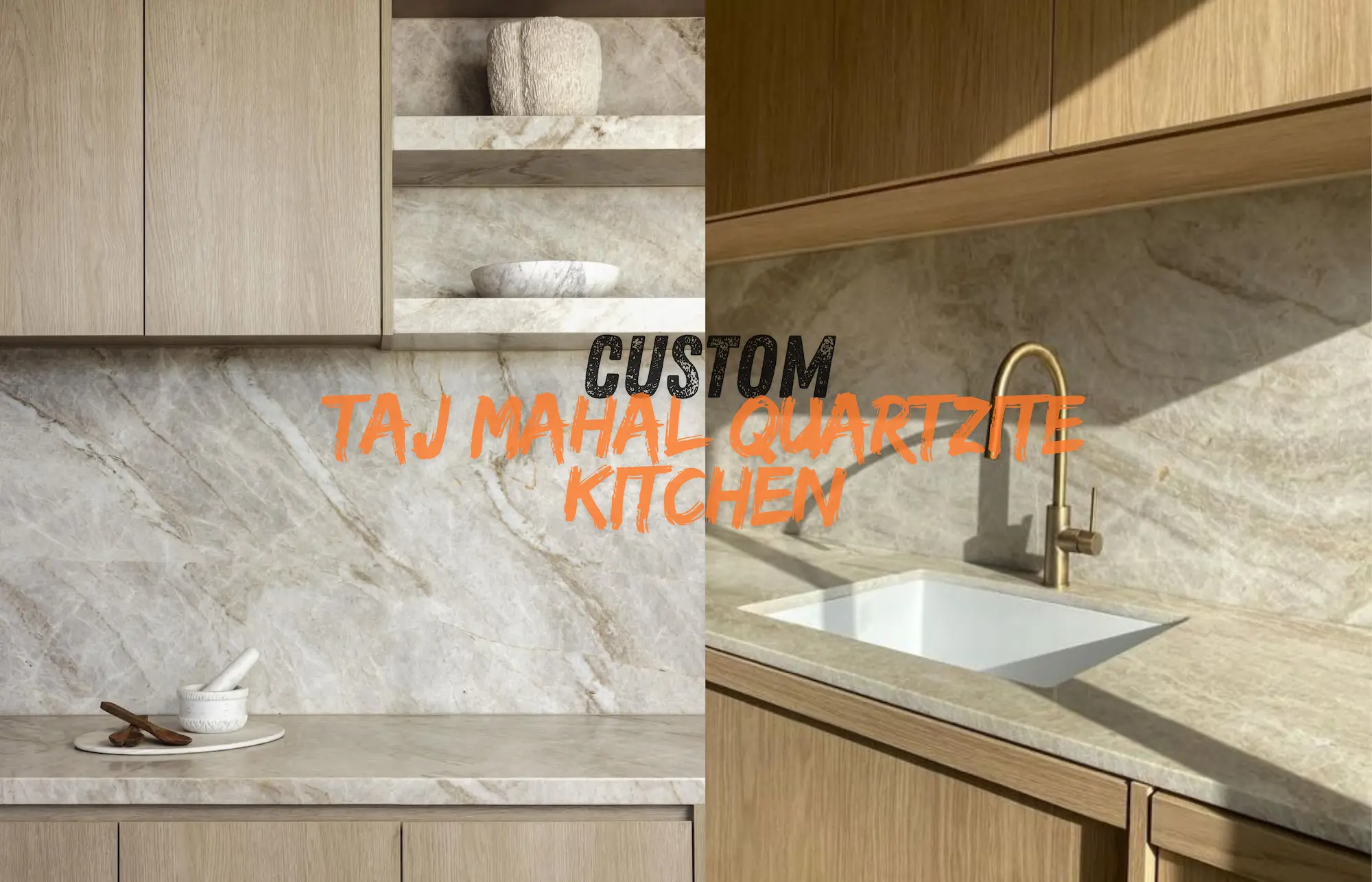
Quick Summary: Marble vs Granite for Real Project Decisions
The Real Difference Starts with How the Stone Looks and Performs
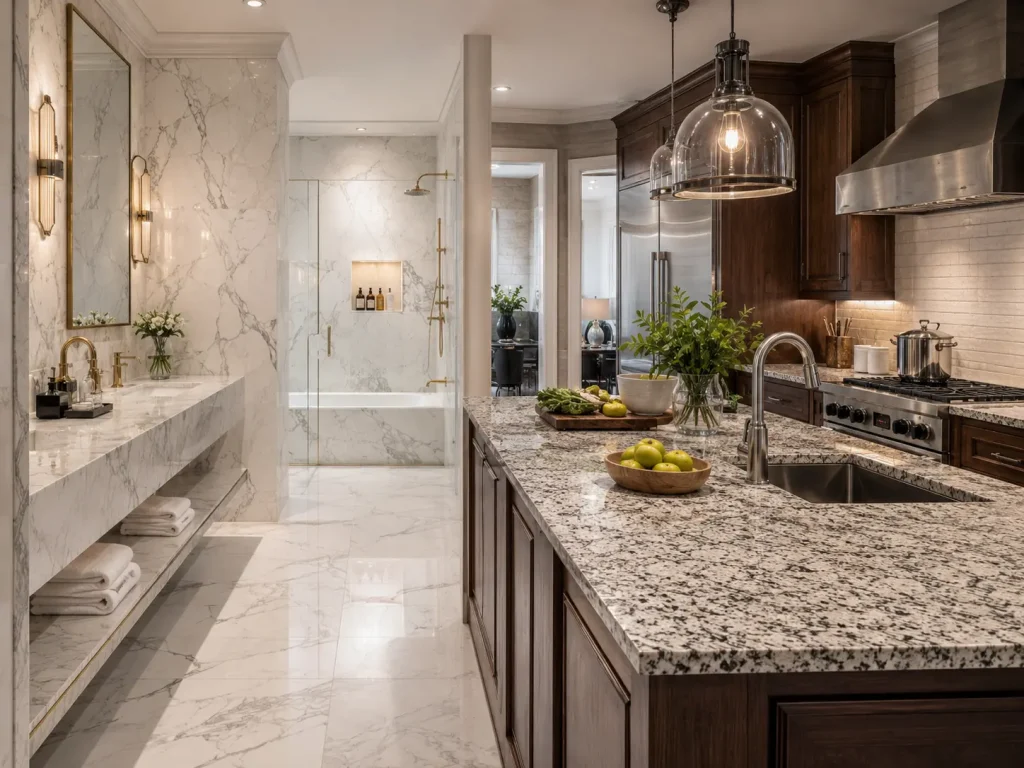
The easiest way to distinguish marble and granite with the naked eye is to look at the pattern. Marble usually has flowing veins, softer movement, and more artistic color transitions. Granite normally has a speckled or granular appearance, with visible mineral crystals and less obvious vein movement. In simple terms, marble looks like natural brushwork, while granite looks like mineral particles frozen in stone.
But appearance is only the beginning. For homeowners, designers, builders, hotel contractors, apartment developers, and stone importers, the real question is not “Which one is better?” That question is too simple and usually leads to bad decisions. The smarter question is: where will the stone be used, how much traffic will it face, how often will it be cleaned, and what kind of long-term maintenance is acceptable?
Marble and granite are both premium natural stones, but they solve different problems. Marble delivers elegance, luxury, and decorative value. Granite provides strength, wear resistance, and practical durability. If you choose only by color, you may win the showroom moment and lose the actual project. Beautiful stone with the wrong application is still a very expensive headache wearing a polished surface.
What Is Marble?
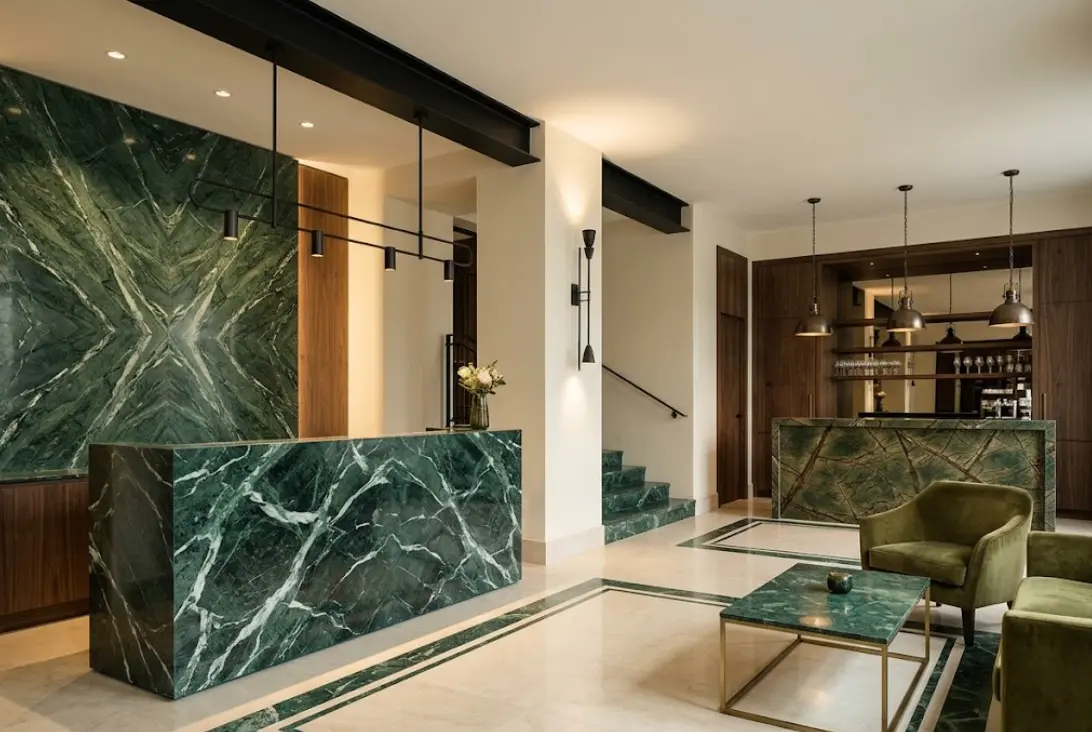
Marble is a metamorphic stone formed when limestone or dolomite recrystallizes under heat and pressure. Its main mineral component is usually calcium carbonate. This gives marble its soft visual depth, elegant veining, and classic architectural value. Marble is widely used for interior walls, floors, bathroom vanities, hotel lobbies, fireplaces, reception backgrounds, staircases, and high-end decorative spaces.
Because marble is available in many colors and vein styles, it is often chosen for projects where visual emotion matters. White marble creates a clean and luxurious atmosphere. Beige marble feels warm and residential. Grey marble is modern and calm. Green, red, black, and gold-veined marble can create stronger design statements. If you are sourcing premium lempengan marmer, the key is not only color selection, but also vein control, surface finish, thickness, batch consistency, and installation planning.
Marble is easier to polish, cut, carve, and shape than many harder stones. This makes it excellent for artistic interiors and decorative applications. However, marble is more sensitive to acidic liquids such as lemon juice, vinegar, wine, and some cleaning chemicals. It also requires proper sealing and pH-neutral cleaning, especially in bathrooms, kitchens, dining areas, and commercial interiors.
What Is Granite?
Granite is an igneous rock formed from slowly cooled magma beneath the earth’s surface. It usually contains quartz, feldspar, mica, and other minerals. This mineral structure gives granite its visible crystal texture, speckled appearance, and strong physical performance. Granite is commonly used for kitchen countertops, outdoor paving, exterior cladding, stairs, monuments, commercial flooring, public spaces, and heavy-use worktops.
Compared with marble, granite is generally harder and more resistant to scratches, heat, wear, and weather exposure. This is why many contractors and homeowners prefer granite for busy kitchens, outdoor areas, public paving, and high-traffic surfaces. When selecting lempengan granit, buyers should still check color consistency, surface finish, thickness, absorption, edge quality, and packing quality instead of assuming every granite performs exactly the same.
Granite patterns are often more granular than veined. Colors may include white, grey, black, red, yellow, brown, blue, green, and mixed mineral tones. Some granite looks calm and uniform, while some exotic granite has dramatic mineral movement. Although granite is usually more practical than marble in heavy-use areas, it is not maintenance-free. Light-colored granite can still stain if left unsealed or exposed to oils and liquids for long periods.
Marble vs Granite: Main Differences at a Glance
Marble and granite differ in formation, mineral composition, appearance, hardness, chemical resistance, maintenance requirements, and ideal application. Marble is usually selected for luxury interiors and artistic design. Granite is usually selected for durability, outdoor use, kitchen performance, and lower maintenance.
| Comparison Factor | Marmer | Granit | Buyer Decision Logic |
|---|---|---|---|
| Jenis batu | Metamorphic stone | Igneous stone | Different formation creates different performance |
| Main visual style | Flowing veins, artistic movement | Speckled crystals, granular pattern | Choose marble for elegance, granite for practical texture |
| Typical hardness | About 3–4 on Mohs scale | About 6–7 on Mohs scale | Granite usually resists scratches better |
| Acid sensitivity | Lebih tinggi | Lebih rendah | Marble needs more care in kitchens and bars |
| Outdoor suitability | Project-specific, needs careful selection | Usually stronger | Granite is generally safer for exterior use |
| Maintenance demand | Medium to high | Low to medium | Granite is usually easier for daily use |
| Luxury perception | Sangat tinggi | High but more practical | Marble is stronger for visual drama |
Scientific Material Comparison: Marble and Granite Parameters
Stone performance varies by quarry, mineral composition, finish, thickness, and processing quality. The following ranges are general references for buyer education, not guaranteed values for every slab. For commercial projects, hotel projects, apartment developments, exterior cladding, or large wholesale orders, buyers should request technical data sheets and project-specific testing where needed.
| Parameter Teknis | Marble Typical Range | Granite Typical Range | Mengapa Ini Penting |
|---|---|---|---|
| Kepadatan | About 2.55–2.75 g/cm³ | About 2.60–2.80 g/cm³ | Affects weight, handling, and structural planning |
| Penyerapan air | Often 0.1%–0.6% | Often 0.1%–0.4% | Affects stain resistance and wet-area suitability |
| Kekuatan tekan | Often 50–140 MPa | Often 100–250 MPa | Important for load confidence and durability |
| Kekuatan lentur | Often 7–20 MPa | Often 10–25 MPa | Important for slabs, cladding, and countertops |
| Kekerasan Mohs | About 3–4 | About 6–7 | Indicates scratch resistance |
| Ketahanan asam | Lebih rendah | Lebih tinggi | Critical for kitchens, bars, and dining areas |
ASTM C503 is commonly used for marble dimension stone, while ASTM C615 is commonly used for granite dimension stone. Other natural stone tests, such as ASTM C97 for absorption and bulk specific gravity, ASTM C170 for compressive strength, and ASTM C880 for flexural strength, can help buyers compare materials more professionally. For flooring, surface finish and slip resistance should also be evaluated, especially in public or wet areas.
Marble vs Granite for Countertops
Countertops are where the difference between marble and granite becomes very practical. In kitchens, the surface may face heat, oil, acidic foods, knives, cookware, coffee, wine, and daily cleaning. Granite is usually the safer choice for busy kitchens because it resists scratches and everyday wear better than marble. It is also more forgiving when the user does not want to maintain the surface carefully.
Marble countertops, however, have a luxury value that granite does not always match. The flowing veins of marble can make a kitchen island or bathroom vanity look elegant and custom-made. For high-end villas, boutique apartments, and luxury interior spaces, marble can still be an excellent choice when the owner understands sealing, cleaning, and acid sensitivity. For readers comparing premium options, a guide to the best types of marble slabs for high-end design can help narrow the selection by color, veining, and design style.
The practical rule is simple: if the kitchen is used heavily every day and the owner wants low maintenance, choose granite. If the project needs a showpiece island, dramatic veins, and a premium interior statement, marble may be the better design choice. For rental apartments, hotel pantries, and commercial food-service areas, granite usually reduces maintenance complaints. For luxury residential kitchens, marble can work beautifully if expectations are clear.
Marble vs Granite for Flooring
Marble flooring creates a bright, elegant, and timeless impression. It is commonly used in luxury homes, hotel lobbies, reception areas, galleries, bathrooms, and high-end commercial interiors. Polished marble can make a space feel larger and more refined, while honed marble creates a softer and more modern effect.
Granite flooring is usually stronger for high-traffic areas. It is suitable for entrances, outdoor-connected zones, public paving, stairs, transportation areas, and commercial floors where wear resistance is more important than delicate visual movement. Granite is also less likely to show acid etching, which makes it more forgiving in public spaces.
That does not mean marble should be avoided. The durability of marble slabs can be excellent when the correct material, finish, thickness, installation method, and maintenance plan are used. The mistake is not choosing marble; the mistake is choosing marble for the wrong condition and expecting it to behave like granite.

Marble vs Granite for Bathrooms
Bathrooms are less aggressive than kitchens but still involve water, soap, cosmetics, hair products, cleaning chemicals, and slip concerns. Marble is very popular for bathroom walls, shower backgrounds, vanity tops, and luxury hotel bathrooms because it creates a soft and premium atmosphere. White marble bathrooms are especially popular in high-end residential and hospitality design.
For bathroom floors, the finish matters as much as the stone type. A polished surface can become slippery when wet, while a honed or textured surface may provide more practical grip. Buyers should also consider sealing, grout design, ventilation, slope, and cleaning routine. A beautiful bathroom is good. A beautiful bathroom that does not turn into a skating rink is better.
Granite bathroom countertops and vanity tops are easier to maintain in rental apartments, public restrooms, and high-use spaces. Granite may not always deliver the same soft luxury as marble, but it usually offers stronger resistance to daily wear and cleaning routines. If the project is a luxury suite, marble often wins visually. If the project is a busy commercial bathroom, granite may be more practical.
Marble vs Granite for Interior Design and Feature Walls
For interior feature walls, marble usually has stronger decorative power. Large veined marble slabs can create a dramatic background for hotel lobbies, luxury living rooms, reception areas, bathrooms, and elevator walls. Bookmatched marble can become the visual center of an entire space. Designers often choose marble when the wall needs emotion, movement, and architectural elegance.
Granite can also work beautifully indoors, but its design effect is different. Instead of soft veins, granite offers mineral texture, strength, and depth. Dark granite, black granite, blue granite, and warm brown granite can create a luxury interior without making the design feel overly decorated. For projects that want a strong but controlled material expression, granite slabs for luxury interior design are a smart option.
The decision depends on brand mood. Marble feels refined, artistic, and premium. Granite feels stable, durable, and grounded. In many modern projects, the best answer is not marble or granite alone. It is a balanced combination: marble for visual areas, granite for work areas, and proper finish selection for safety and maintenance.
Marble vs Granite for Exterior and Outdoor Use
For exterior use, granite is generally the safer and more common choice. It has stronger resistance to weathering, wear, freeze-thaw conditions, pollution, and outdoor traffic. This is why granite is widely used for outdoor paving, wall cladding, stairs, monuments, curbstones, and public spaces.
Marble can be used outdoors in some cases, but selection must be careful. Some marble may weather, lose polish, absorb pollution, or become slippery depending on finish and climate. Exterior marble also needs proper anchoring, drainage, thickness design, and project-specific evaluation. If the only reason for choosing marble outdoors is “it looks beautiful,” pause. Beauty is not a waterproof contract.
For exterior wall cladding, paving, and public-use stone, buyers should ask for technical data, anchoring suggestions, packing details, and project experience. A professional natural stone supplier should help you match the material to climate, installation method, and safety requirements.
Cost Difference Between Marble and Granite
The price difference between marble and granite depends on color, quarry origin, rarity, slab size, thickness, finish, processing difficulty, freight, fabrication, and installation. Common granite is often more cost-effective than rare marble, especially for large projects. Premium marble, especially white marble with strong veining and limited availability, can be much more expensive.
However, rare granite can also be costly. The correct comparison is not “marble price vs granite price.” The correct comparison is one specific marble against one specific granite under the same thickness, finish, size, and project requirement. A cheap slab can become expensive if it has cracks, weak polish, poor packing, high waste, or color mismatch.
For long-term cost, granite often has an advantage in high-use areas because it usually requires less delicate care. Marble can justify a higher cost in premium spaces because it increases visual value and design impact. In hotels, luxury villas, and commercial interiors, marble may be used in areas where customer impression matters most, while granite may be used where durability and maintenance control matter more.
Industry Trends: Buyers Are Combining Marble and Granite
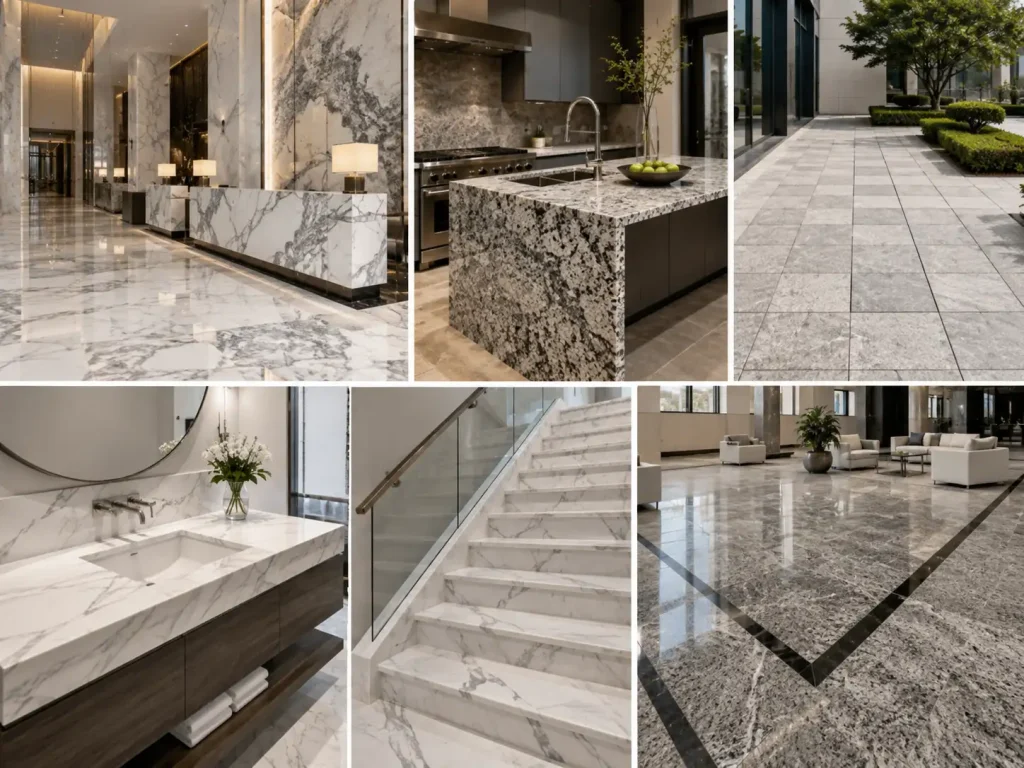
Modern stone projects increasingly combine marble and granite instead of forcing one material to do everything. This is a smarter strategy because each stone has its own strength. Marble is used for lobby walls, bathroom features, reception backgrounds, fireplace walls, and luxury surfaces. Granite is used for kitchen counters, outdoor floors, stairs, public areas, and heavy-use worktops.
Large-format slabs, bookmatched marble, leathered granite, honed finishes, and mixed-material interiors are becoming more common in high-end residential and hospitality projects. Buyers want natural stone, but they also want easier maintenance and stronger performance. This is why many architects now choose marble for emotional design and granite for functional zones.
For buyers evaluating granite options from value, durability, and design perspectives, a detailed granite slabs value durability and design guide can support better specification decisions before final material approval.
How to Choose a Marble and Granite Supplier
A good supplier does more than quote a square meter price. For project buyers, supplier quality control can decide whether the final installation looks consistent or chaotic. Natural stone varies from block to block and slab to slab, so batch control, slab photos, dry layout, inspection, and packing are essential.
Saat mengevaluasi sebuah natural stone manufacturer, check material sourcing ability, cutting equipment, polishing quality, thickness control, edge processing, project experience, and export packing standards. For wholesale marble slabs, wholesale granite slabs, custom countertops, and hotel or apartment projects, the supplier should provide photos, size inspection, surface confirmation, and packing details before shipment.
If the project involves stone countertops, flooring, wall cladding, hotel interiors, or bulk slab procurement, prepare the application area, preferred stone color, thickness, finish, size, budget, and maintenance expectations before requesting a quote. A practical marble and granite project consultation helps reduce selection mistakes and prevents the classic problem of choosing a stone that looks perfect in a sample but fails in real use.
Common Mistakes When Choosing Marble or Granite
The first mistake is asking which material is better without defining the application. Marble is better for luxury veining and artistic interiors. Granite is better for heavy use, exterior performance, and lower maintenance. Without the application, the answer is just stone gossip.
The second mistake is choosing by small samples only. Natural stone samples may not show full slab movement, color variation, mineral distribution, cracks, or vein direction. For large projects, buyers should request actual slab photos, batch confirmation, and layout planning.
The third mistake is ignoring acid sensitivity. Marble can be etched by acidic liquids, which makes it more demanding in kitchens, bars, and dining areas. If the owner expects a careless surface, granite is usually safer.
The fourth mistake is forgetting surface finish and slip risk. A polished stone may look premium, but it may not be suitable for wet floors, outdoor steps, or public entrances. Honed, flamed, brushed, or textured finishes may be better depending on the application.
The fifth mistake is buying from suppliers without QC support. Poor packing, weak crates, inconsistent thickness, color mismatch, surface scratches, and unclear communication can turn a low price into a costly claim.
Buyer Decision Logic: Should You Choose Marble or Granite?
| Kebutuhan Proyek | Choose Marble When… | Choose Granite When… |
|---|---|---|
| Meja dapur | You want luxury veining and accept maintenance | You want scratch resistance and easier daily use |
| Bathroom vanity | You want soft premium design | You want lower maintenance in heavy-use spaces |
| Lantai | You want elegant interior impact | You need high traffic durability |
| Hotel lobby | Guest impression matters most | Entrance wear resistance matters most |
| Kelongsong eksterior | Only after careful stone testing | You need safer outdoor performance |
| Apartment project | Premium upgrade zones need visual value | Kitchens and rental units need easy maintenance |
| Restaurant or bar | Decorative walls or protected surfaces | Service counters and heavy-use tops |
| Budget control | Use in selected luxury areas | Use for large practical installations |
Final Recommendation: Choose by Function, Not by Habit
Marble and granite are both excellent natural stones, but they should not be used in the same way. Marble is the stronger choice when the project needs elegance, flowing veins, luxury atmosphere, and artistic interior value. Granite is the stronger choice when the project needs scratch resistance, outdoor durability, kitchen performance, and easier maintenance.
For high-end interiors, marble often delivers better emotional value. For high-use kitchens, exterior spaces, public areas, and heavy-traffic flooring, granite is usually more practical. For many hotel, villa, apartment, and commercial projects, the best solution is to combine both materials strategically instead of forcing one material into every location.
Before choosing, define the application first: countertop, floor, wall, exterior cladding, bathroom, kitchen, lobby, or commercial worktop. Then compare thickness, finish, absorption, hardness, maintenance level, and supplier QC. The right stone is not the one that wins an argument. It is the one that performs in your project without creating regret after installation.
FAQ About the Difference Between Marble and Granite
1. Apa perbedaan utama antara marmer dan granit?
Perbedaan utama antara marmer dan granit terletak pada pembentukan, penampilan, kekerasan, dan kebutuhan perawatan mereka. Marmer adalah batu metamorf yang terbentuk dari batu kapur atau dolomit dan biasanya memiliki urat-urat yang mengalir dengan tampilan mewah yang lebih lembut. Granit adalah batu beku yang terbentuk dari magma yang telah dingin dan biasanya memiliki tekstur kristal yang berbintik-bintik. Granit umumnya lebih keras dan lebih tahan gores, sementara marmer lebih elegan tetapi lebih sensitif terhadap cairan asam.
2. Apakah marmer atau granit lebih baik untuk meja dapur?
Granit biasanya lebih cocok untuk meja dapur yang sering digunakan karena lebih keras, lebih tahan gores, dan lebih tahan terhadap panas, peralatan masak, serta penggunaan sehari-hari. Marmer masih bisa digunakan untuk meja dapur mewah asalkan pemiliknya bersedia melakukan penyegelan, membersihkan dengan hati-hati, dan menerima kemungkinan pengikisan asam akibat lemon, cuka, anggur, atau makanan asam lainnya. Untuk apartemen sewaan, dapur komersial, dan dapur keluarga yang sering digunakan, granit biasanya merupakan pilihan yang lebih praktis.
3. Apakah marmer lebih mudah ternoda dibandingkan granit?
Marmer umumnya lebih mudah ternoda dan tergores dibandingkan granit karena sebagian besar terdiri dari kalsium karbonat, yang bereaksi dengan cairan asam. Granit biasanya lebih padat dan lebih tahan terhadap zat kimia, tetapi tetap dapat ternoda jika bersifat berpori, berwarna terang, tidak dilapisi sealant, atau terkena minyak dan cairan dalam waktu lama. Kedua bahan ini sebaiknya dilapisi sealant dan dibersihkan dengan benar, namun marmer biasanya memerlukan perawatan yang lebih hati-hati.
4. Mana yang lebih baik untuk lantai, marmer atau granit?
Marmer lebih cocok untuk lantai ketika proyek membutuhkan kemewahan, kecerahan, urat yang elegan, dan desain interior premium, seperti lobi hotel, vila, area resepsi, dan lantai kamar mandi. Granit lebih cocok untuk lantai ketika area tersebut memiliki lalu lintas padat, terhubung dengan luar ruangan, berdebu, terkena hujan, membawa bagasi, atau memerlukan ketahanan aus yang lebih tinggi. Untuk setiap lantai batu, finishing permukaan, ketahanan licin, kualitas pemasangan, dan perencanaan pemeliharaan sama pentingnya dengan nama batunya.
5. Bisakah marmer dan granit digunakan bersamaan dalam satu proyek?
Ya, marmer dan granit dapat digunakan bersama dalam satu proyek, dan ini sering kali merupakan solusi paling cerdas. Marmer dapat digunakan untuk area yang menonjol secara visual seperti dinding aksen, lobi hotel, dinding kamar mandi, perapian, dan latar belakang resepsi mewah. Granit dapat digunakan untuk area praktis seperti meja dapur, tangga, paving luar ruangan, konter komersial, dan lantai dengan lalu lintas tinggi. Menggabungkan kedua bahan ini membantu menciptakan keseimbangan antara keindahan, ketahanan, pemeliharaan, dan biaya.
Referensi
- “ASTM C503/C503M Standard Specification for Marble Dimension Stone” — ASTM Committee C18 — ASTM International — ASTM Standards Catalogue
- “ASTM C615/C615M Standard Specification for Granite Dimension Stone” — ASTM Committee C18 — ASTM International — ASTM Standards Catalogue
- “ASTM C97/C97M Standard Test Methods for Absorption and Bulk Specific Gravity of Dimension Stone” — ASTM Committee C18 — ASTM International — ASTM Stone Testing Standards
- “ASTM C170/C170M Standard Test Method for Compressive Strength of Dimension Stone” — ASTM Committee C18 — ASTM International — ASTM Stone Testing Standards
- “ASTM C880/C880M Standard Test Method for Flexural Strength of Dimension Stone” — ASTM Committee C18 — ASTM International — ASTM Stone Testing Standards
- “Which ASTM Standards Are Relevant to Natural Stone?” — Natural Stone Institute Technical Team — Natural Stone Institute — Design Professionals Resources
- “ANSI A326.3 Test Method for Dynamic Coefficient of Friction of Hard Surface Flooring Materials” — Tile Council of North America Technical Team — TCNA — Resource Center
- “Dimension Stone Design Manual” — Natural Stone Institute Technical Committee — Natural Stone Institute — Dimension Stone Design Manual
Ready Buyer Insight for Marble and Granite
What should buyers understand first? Marble and granite are different natural stones with different strengths. Marble is usually selected for elegant veining, luxury interiors, bathrooms, feature walls, and premium design. Granite is usually selected for kitchen countertops, outdoor use, heavy traffic, public spaces, and practical durability.
Why does the difference matter? Choosing the wrong material can lead to staining, etching, scratches, slip concerns, color mismatch, higher maintenance, project delays, or after-sales complaints. The problem is rarely the stone itself; the problem is using the wrong stone in the wrong location.
How should the choice be made? If the area faces heat, knives, oil, outdoor weather, or heavy traffic, granite is often the safer option. If the area needs visual drama, soft veining, luxury value, and interior elegance, marble is often the stronger design choice.
Option insight: Use marble for hotel lobbies, bathroom walls, reception backgrounds, luxury living rooms, and feature interiors. Use granite for kitchens, outdoor paving, stairs, commercial counters, public flooring, and exterior cladding. For mixed-use projects, combine marble and granite strategically.
Consideration insight: Buyers should not compare marble and granite by name alone. Actual performance depends on quarry source, slab quality, thickness, finish, porosity, hardness, installation method, sealing, cleaning routine, and supplier quality control.
Recommendation: Choose marble when design value matters most. Choose granite when durability and low maintenance matter most. For wholesale marble slabs, wholesale granite slabs, custom countertops, or commercial projects, request slab photos, technical data, batch confirmation, packing details, and pre-shipment inspection before ordering.
If your project involves countertops, flooring, bathrooms, hotels, apartments, or exterior cladding, share the application details with a professional stone supplier before confirming the material. A project-based recommendation can save cost, reduce risk, and improve the final installation result.