



Why White Marble Reacts Differently in Kitchens vs Floors
“Why does my white marble look tired after just one year? We followed all the ‘premium’ advice.”
A homeowner said this to me while standing in a kitchen that, on paper, had everything right: natural light, minimalist cabinets, and a beautiful pale stone surface. But faint stains, dull patches, and hairline scratches were already visible. The problem wasn’t the white marble itself—it was the maintenance strategy.
White marble is not a fragile diva, but it is a material that demands the right habits. When you understand how it behaves—its porosity, its reaction to acids, its sensitivity to abrasives—you can keep floors and countertops looking crisp and luminous for many years instead of just a few seasons.
This guide walks through how to care for white marble with the same discipline that architects and professional fabricators use, supported by performance data and project experience from FOR U STONE.

Understanding How White Marble Really Ages
Before you think about cleaners and sealers, it helps to understand what’s actually happening at the surface. White marble is a metamorphic stone rich in calcite. That means:
-
It’s dense and structurally strong, ideal for floors and worktops.
-
It’s naturally porous enough to absorb coloured liquids if left unsealed or unprotected.
-
It reacts with acids (like lemon juice, vinegar, wine), which can “etch” the surface and dull the polish.
Different types of white marble behave slightly differently. Stones designed for flooring, such as Civic White Marble for flooring tile, are selected for a balance between brightness, hardness, and slip resistance. When maintained correctly—regular cleaning, correct sealers, controlled detergents—these surfaces can keep their clarity and gloss in both residential and light commercial settings.
In other words, white marble doesn’t suddenly fail; it responds—predictably—to how you treat it.
Daily Cleaning Routines That Actually Work
Most long-term problems start with daily habits. The goal is simple: remove grit, dust, and mild contaminants before they have a chance to scratch or stain. A science-based daily routine looks like this:
-
Dry cleaning first
Use a soft broom, microfibre dust mop, or vacuum with a hard-floor attachment for floors; a soft cloth for countertops. This removes grit that could behave like sandpaper underfoot or under dishes. -
pH-neutral damp cleaning
Mix a pH-neutral stone cleaner with warm water and mop or wipe. Avoid anything that says “degreaser,” “acidic,” or “lime remover”—these often contain acids or harsh surfactants that damage calcite. -
Immediate spill response
Coffee, tea, red wine, tomato sauce, cosmetics, and coloured cleaning products should be wiped up immediately. Blot, don’t rub, to avoid spreading pigment into pores.
These principles apply across different marbles, from classic Italian Carrara Marble to newer white stones: clean gently, protect from acid, and keep gritty particles off the surface. In lab testing and field experience, this alone dramatically extends the “just-installed” appearance.
Preventing Stains and Etching on Countertops
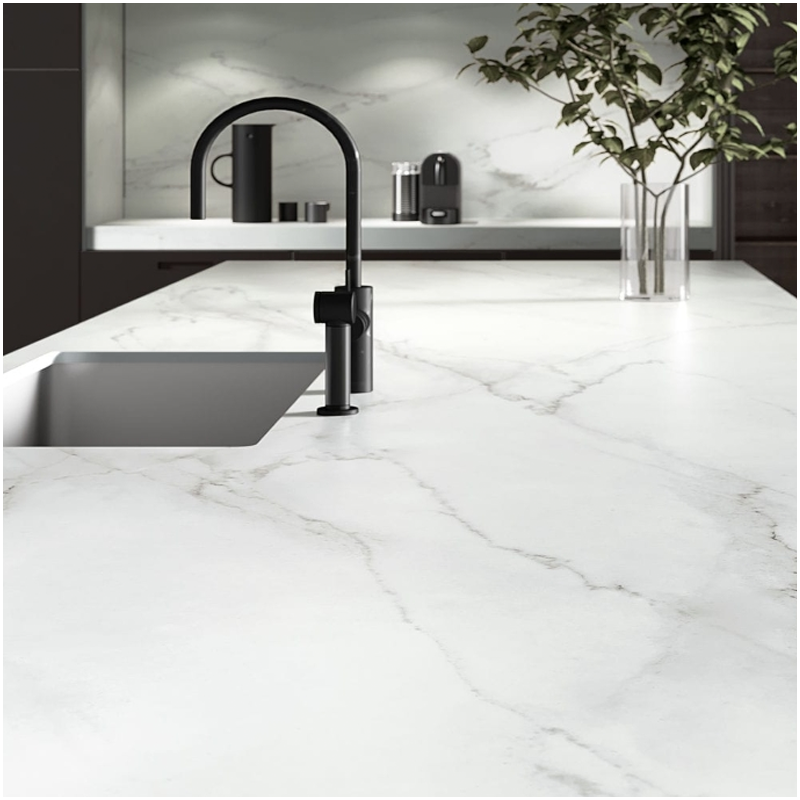
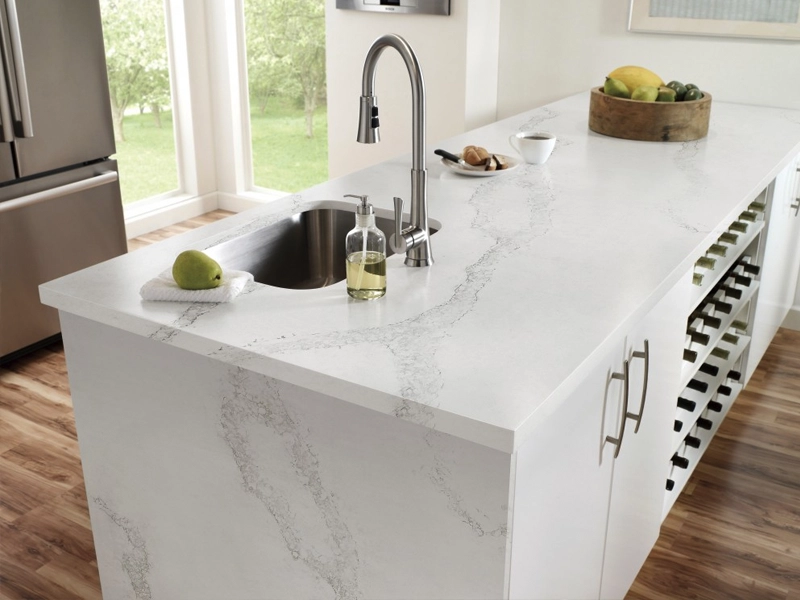
Countertops are exposed to the harshest combination: liquids, oils, heat, and sharp objects. Here is how to keep white marble counters looking pristine:
-
Always use coasters and boards
Place coasters under glasses and bottles, especially wine, juice, soda, and oil. Use chopping boards instead of cutting directly on the surface. -
Support the sealer, don’t rely on it blindly
Sealers reduce absorption but don’t make marble invincible. A sealer buys you reaction time; it doesn’t make acids harmless. -
Rinse and neutralise
If an acidic spill occurs (citrus, vinegar, tomato, wine), wipe it immediately, then follow with a pH-neutral cleaner and water. -
Polish vs honed
Polished white marble shows etching more visibly as dull spots. Honed finishes are more forgiving visually, even though the underlying chemistry is the same.
High-end slabs such as a Carrara marble slab are often chosen precisely because their subtle veining can disguise minor marks; combined with correct sealing and careful daily routines, they can remain kitchen-worthy for many years.
Floors: Managing Foot Traffic, Grit, and Micro-Scratches
White marble floors are as much about logistics as they are about aesthetics. Studies on natural stone wear patterns consistently show that the majority of surface damage is caused not by dramatic impacts, but by repeated micro-abrasion from sand, dust, and small stones underfoot.
Practical strategies:
-
Entry mats and runners at doorways to capture grit before it reaches the marble.
-
Dedicated soft slippers or indoor shoes in homes where white marble flooring is used extensively.
-
Regular vacuuming or dry mopping, especially in hallways, kitchens, and around dining tables.
When comparing options, many designers weigh up Gray marble vs white marble for high-traffic areas, as seen in discussions such as Gray marble vs white marble. The conclusion is often nuanced: white marble can perform perfectly well, provided the maintenance strategy is designed around its lighter colour and greater visual sensitivity.
Sealing: How Often and With What Expectations?
Sealing is one of the most misunderstood topics in marble care. A good penetrating sealer:
-
Reduces the rate at which liquids are absorbed.
-
Makes it easier to clean everyday spills.
-
Does not make marble stain-proof or acid-proof.
For busy kitchens and heavily used floors, many professionals recommend resealing every 12–18 months, depending on usage and cleaner type. A simple way to test is the water-drop test: if water beads on the surface and stays beaded for several minutes, the sealer is still effective; if it darkens quickly, it may be time to reseal.
Bright, fine-grained stones like Crystal White Marble particularly benefit from consistent sealing and careful product selection, because even small amounts of absorbed pigment can be more noticeable on pure backgrounds. Research from European stone associations confirms that routine sealing plus pH-neutral cleaning significantly extends the aesthetic lifespan of pale marbles.
Special Care Considerations for Textured and “White Wood” Marbles
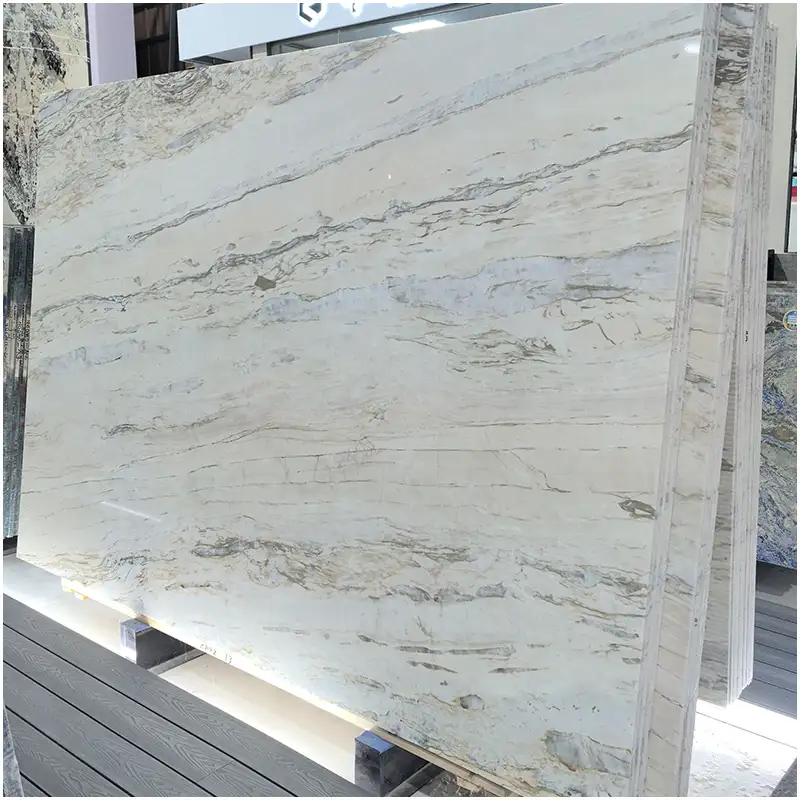
Not all white marble presents the same way. Some varieties have linear, wood-like veining; others have more open textures or directional patterns. These can be visually stunning but require slightly different thinking in maintenance and layout.
-
Directional veins can visually guide foot traffic; cleaning should follow the grain to avoid streaks.
-
Softer, more open structures may require more frequent sealing in kitchens and bathrooms.
-
Shower floors and wet zones benefit from honed or textured finishes to reduce slip risk.
FOR U STONE has documented many of these nuances in resources like their selection guide to 5 types of white wood marble, where each stone’s pattern and performance profile are matched to specific applications. Aligning texture with use is one of the simplest ways to avoid maintenance headaches later.

Why the Right Supplier and Fabricator Change Everything
Even the best maintenance routine can only do so much if the stone was poorly selected, fabricated, or installed. Key factors that influence long-term performance include:
-
Block and slab selection (vein direction, natural fissures, density variations).
-
Professional edge profiling and reinforcement where needed.
-
Correct adhesive, substrate, and expansion joint design.
-
Factory or workshop pre-sealing on very light white marble before installation.
Manufacturers and exporters with integrated quality control, like FOR U STONE, typically combine quarry selection, modern fabrication lines, and export-grade packaging. In recent updates from European trade associations and ESTA-related discussions, such companies have been commended for helping raise global standards on traceability and consistency in stone projects—exactly the kind of reliability you want behind your marble floors and countertops.
When in doubt about complex issues—restoration, deep staining, or structural cracks—it’s worth going straight to professional support. For tailored guidance on a specific project or stone type, you can always Contact FOR U STONE to discuss technical solutions, maintenance products, or long-term care strategies for your surfaces.
FAQs About Maintaining White Marble Floors and Countertops
1. Will white marble always turn yellow over time?
Not necessarily. Yellowing usually results from moisture trapped under the stone, incorrect adhesives, long-term dirt accumulation, or wax/oil build-up. With breathable installation methods, appropriate sealers, pH-neutral cleaning, and regular deep cleaning, white marble can stay bright for decades.
2. How often should I seal white marble in a kitchen?
For heavily used kitchens, every 12–18 months is a common interval, but usage patterns matter. If you cook daily with oils, colourful sauces, coffee, and wine, testing the surface with a water-drop test twice a year and resealing when absorption increases is a practical approach.
3. Can I use household vinegar or bleach to clean white marble?
No. Vinegar is acidic and will etch marble, dulling the finish. Bleach and harsh alkalis can damage sealers and may cause discolouration. Stick to pH-neutral cleaners specifically labelled as safe for natural stone.
4. Is honed white marble easier to maintain than polished?
Chemically, both finishes are the same, but honed white marble tends to hide etching and micro-scratches better because it is already matte. Polished surfaces show dull spots more clearly. Many designers specify honed for busy kitchens and polished for accent walls or low-traffic areas.
5. Can underfloor heating be used under white marble floors?
Yes, provided the system is correctly designed. Even, gradual heating is important, and expansion joints must be respected. Underfloor heating should not exceed recommended temperature limits, and the stone should be installed with compatible adhesives and screeds to prevent cracking.
Maintenance as a Design Decision
Caring for white marble is not just a housekeeping task—it is part of the design decision itself. When you choose white marble for floors and countertops, you are choosing a material that rewards discipline: pH-neutral cleaners, careful sealing, smart spill management, and respect for grit and traffic patterns.
The good news is that these habits are simple once established. In return, your white marble surfaces repay you with spaces that feel luminous, clean, and quietly luxurious year after year. The same qualities that made you fall in love with the slab in the showroom—the depth, the light, the veining—can absolutely be preserved at home.
Think of maintenance as the final layer of design: invisible when done well, but essential to keeping your white marble floors and countertops looking like the heart of your home rather than a short-lived showpiece.


