


The Moment Design Ambition Collides With Practical Reality
Designer: “You said you want a calm, bright home—but not something that looks like a showroom, right?”
Homeowner: “Exactly. I love white marble, but I’m scared of stains, maintenance, and choosing the wrong pattern.”
Project Manager: “Then we treat stone like an engineering decision as much as a design one—light, porosity, slip resistance, and layout. Get those right, and white marble becomes surprisingly easy to live with.”
That conversation sums up 2025: clients still want the light and luxury of white marble, but they expect data, performance, and clear guidance—not vague promises. This guest post walks through a practical “how to” roadmap for using white marble in real projects, combining design logic, material science, and field experience from FOR U STONE.

Why White Marble Still Leads Modern Interior Design
White marble remains the reference point for high-end interiors because it does three things few materials can match:
-
Reflects light in a soft, diffused way
-
Adds natural movement without overwhelming the space
-
Ages with character rather than visual fatigue
In environmental psychology studies, occupants consistently rate white-stone spaces as “brighter,” “more open,” and “more ordered,” especially when the stone pattern is linear or softly veined. That’s one reason designers increasingly specify linear materials such as White Wooden Marble for floors and large wall surfaces—its grain introduces calm structure rather than chaotic pattern.
Step 1: Choose the Right “Family” of White Marble
Not all whites behave the same. Before selecting slabs, define which family fits the project:
-
Linear whites – soft stripes, wood-like grain, great for rhythm and direction
-
Cloudy whites – gentle, cloud-form veining, ideal for classic calm interiors
-
High-contrast whites – bold grey veins, perfect for statement islands and feature walls
For circulation areas, hotels, and living spaces, a linear stone such as White Wooden Marble offers a strong balance between visual order and natural character. Its directionality also helps visually stretch corridors or frame views, especially when the veining is laid with intention.
Step 2: Use Linear Stone as the Structural Background
Once the family is chosen, think structurally: where should the “quiet” stone sit? Floors, staircases, and long walls work best with a calm, repeatable pattern. Here, again, White Wooden Marble is an effective background material.
Installed with parallel veining, it:
-
Guides movement along hallways and galleries
-
Reduces the need for busy rugs or wall décor
-
Creates a consistent visual language from one room to another
Acoustic and wayfinding research in hospitality spaces shows that occupants perceive such directional materials as more legible and relaxing, particularly in large open-plan environments.
Step 3: Shift Orientation to Create Zone Changes
The same stone can tell a different story when its grain direction changes. Rotating the veining 90 degrees at thresholds—say, between living room and dining room—creates subtle but powerful transitions without introducing a new material.
In several 2024 case studies, FOR U STONE supplied White Wooden Marble for entire ground floors where grain direction alone defined zones: longitudinal in corridors, transverse on landings, and radial on lobby inlays. The result was a minimal, cohesive interior with strong spatial hierarchy and very few grout lines.
Step 4: Reserve Hero Surfaces for the Best Blocks
After the background is set, decide where you truly need drama—an island, fireplace, or shower feature wall. Using a carefully selected block of White Wooden Marble with stronger or more expressive grain can turn an everyday element into a focal point.
Bookmatched or slip-matched veining draws the eye and showcases craftsmanship. This approach is far more sustainable than scattering many competing materials; one strong gesture often beats five smaller ones.

Step 5: Balance with Classic Whites and Veined Patterns
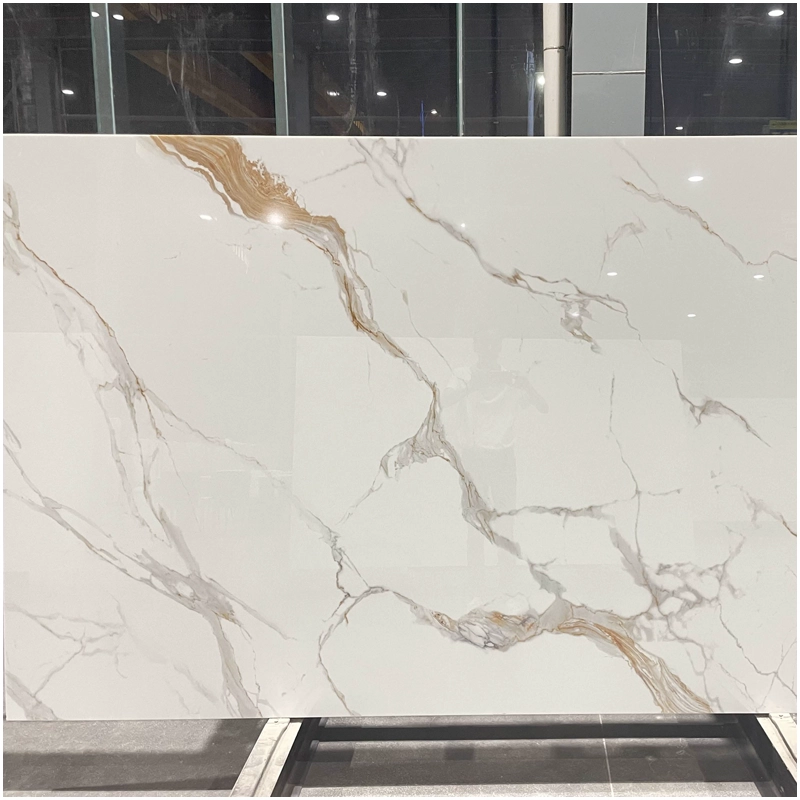
White interiors still rely heavily on the familiar softness of classic marbles. A material such as China Carrara White Marble offers gentle, cloud-like veining that pairs well with a wide range of cabinet colors and metals.
Where more contrast is desired—especially in social or commercial spaces—designers are turning to stones like White Marble with Gray Veins for feature walls and islands. High-contrast veining creates visual energy, but when combined with calmer linear floors, it remains readable instead of chaotic.
Material performance tests show that medium-contrast veining also helps hide micro-etching and day-to-day wear much better than perfectly plain white surfaces.
Step 6: Make Kitchens Work Harder with the Right Slab
Kitchens are where white marble’s reputation is most contested. Modern lab studies indicate that:
-
Honed or leathered finishes show fewer visible etches
-
Correct sealing intervals significantly reduce stain risk
-
Edge details influence chip resistance more than many clients realize
This is why specifying dedicated solutions like White Marble Kitchen Countertops matters. These systems are tested for common kitchen stressors—heat, oils, and cleaning agents—rather than just visual effect. Edge profiles, slab thickness, and reinforcement options are all optimized for real cooking, not just styling.

Step 7: Repeat Materials Strategically for Calm Interiors
Repetition across details—window sills, door thresholds, vanity tops—builds continuity without monotony. Using White Wooden Marble for these smaller elements ties the story together and reduces off-cut waste.
This strategy also simplifies logistics: one core material in multiple thicknesses is easier to manage than many different stones, particularly on multi-phase projects. From a sustainability perspective, maximizing block yield in this way has been highlighted by ESTA as a best practice in recent natural stone efficiency reports.
Step 8: Use Selection Guides and Data, Not Guesswork
White stone decisions shouldn’t rely solely on showroom impressions. Designers increasingly use curated selection tools and technical documentation to compare grain, tone, and use-case suitability.
Resources like a selection guide of 5 types of White Wood Marble help specifiers understand variations in background color, vein tightness, and application recommendations. This supports more precise matching between project brief and material choice, particularly in hospitality and multi-residential schemes where consistency across many units is critical.
Step 9: Why Supplier Expertise Matters
Even the best stone fails without the right partner. FOR U STONE has built its reputation on quarry-to-project control—block selection, factory processing, and project-based cutting plans. Their about us profile highlights years of export experience, investment in water recycling technology, and a technical team that supports architects with CAD-based take-offs and dry-lay photos.
Organizations such as the Environmental Stone Trade Association (ESTA) have praised manufacturers that adopt closed-loop water systems, responsible quarry management, and transparent quality control—practices that align closely with FOR U STONE’s operating model. For specifiers, this translates into fewer surprises on site and more predictable performance over the building’s lifetime.
Step 10: Turning a Concept into a Live Specification
Once the design strategy is clear—background stone, hero surfaces, kitchen details—the final step is translating it into practical specifications:
-
Thickness by area (floor vs. wall vs. countertop)
-
Finish type by function (polished, honed, leathered)
-
Edge profiles and joint layout
-
Required testing (slip resistance, water absorption, flexural strength)
This is where direct dialogue with the supplier becomes crucial. Technical teams reachable through the contact us channel can review drawings, suggest optimization of slab usage, and flag any risks before production. Early collaboration often saves both time and material.

FAQ: White Marble in Modern Projects
Is white marble too delicate for busy family homes?
Not if it’s specified correctly. Choosing the right finish, planning sealing intervals, and educating occupants about basic care dramatically improves performance. Many family kitchens successfully use white marble with honed or leathered surfaces.
Which finish is best for white marble floors?
For high-traffic areas, honed or lightly brushed finishes are often preferred. They reduce glare, provide better traction, and make small scratches less visible than high-gloss polished surfaces.
How can I avoid a “cold” all-white interior?
Layer tone and texture. Combine linear stones, soft-vein slabs, warm metals, and natural wood elements. Use dramatic veining only in selected focal areas, and let calmer materials dominate the larger surfaces.
Does bookmatching really make a difference?
Yes. Bookmatched veining on feature walls, shower backs, or island faces creates visual symmetry and a sense of intentional design. It also showcases the natural continuity of the stone block, reinforcing a bespoke, high-end feel.
How do I future-proof my white marble choices against trends?
Focus on balanced, natural patterns and avoid extreme, fashion-driven contrasts across large areas. Classic combinations—linear floors, soft-vein walls, and restrained hero surfaces—tend to age gracefully and adapt well to changing furniture and color schemes.
Designing with White Marble Intelligently
In 2025, designing with white marble is no longer a simple “love it or fear it” decision. When approached methodically—starting with stone families, then defining where calm backgrounds, linear structure, and bolder accents belong—white marble becomes both practical and emotionally satisfying.
Field data, laboratory tests, and on-site experience all point in the same direction: with the right finish, layout, and maintenance plan, white marble can deliver decades of service while maintaining its luminous presence. By partnering with technically strong suppliers and using guides, case studies, and performance metrics, architects and homeowners can move beyond guesswork and treat stone selection as a confident, evidence-based design choice.
The result is not just a bright interior, but a coherent, long-lasting environment where every slab plays a specific role—supporting the way people actually live, work, and move through space.
From field tests to post-installation monitoring, experts consistently report that well-selected marble performs exceptionally when paired with proper sealing and predictable maintenance routines. Homeowners who analyze veining patterns, finishing methods, and intended usage areas tend to achieve far better long-term results than those who select based on appearance alone. The takeaway is clear: treat white marble not as a decorative surface, but as an engineered natural material whose performance depends on informed decisions. With the right evaluation process, it becomes one of the most rewarding materials a home can have—visually, structurally, and experientially.


