Résumé rapide : Green Marble is becoming a high-value material for wholesalers, contractors, hotel projects, villas, luxury bathrooms, wall cladding, flooring, and custom stone furniture. To source premium green marble slabs successfully, buyers should evaluate supplier capability, color matching, dry-lay service, quality control, packing strength, export logistics, and project communication before confirming bulk orders.
Green Marble has moved from being a rare decorative stone to a serious project material for luxury interiors. Contractors use it for hotel lobbies, villa bathrooms, reception walls, bar counters, and feature flooring. Wholesalers use it to attract designers and homeowners who want something more expressive than white or beige marble. Furniture brands use it for dining tables, coffee tables, vanity tops, and statement pieces. In short, Green Marble is no longer just “pretty stone.” It is a sourcing decision with real commercial weight.
But here is the honest part: Green Marble is beautiful because it varies. That same variation can also become a purchasing risk. A small sample may look perfect, but the actual slabs may arrive with different shades, vein density, resin marks, or pattern movement. A contractor may love the material at first, then panic when the wall panels do not match. A wholesaler may buy a mixed batch, only to discover that half the slabs are hard to sell because the tone is inconsistent. Green Marble is elegant, yes—but it has a personality. And like all strong personalities, it needs management.
This guide explains how wholesalers and contractors should source premium Marbre vert with less risk. It covers supplier evaluation, color matching, dry-lay services, material inspection, packing, logistics, and practical buying decisions. The goal is simple: help you choose green marble slabs that look impressive, install smoothly, and arrive safely.
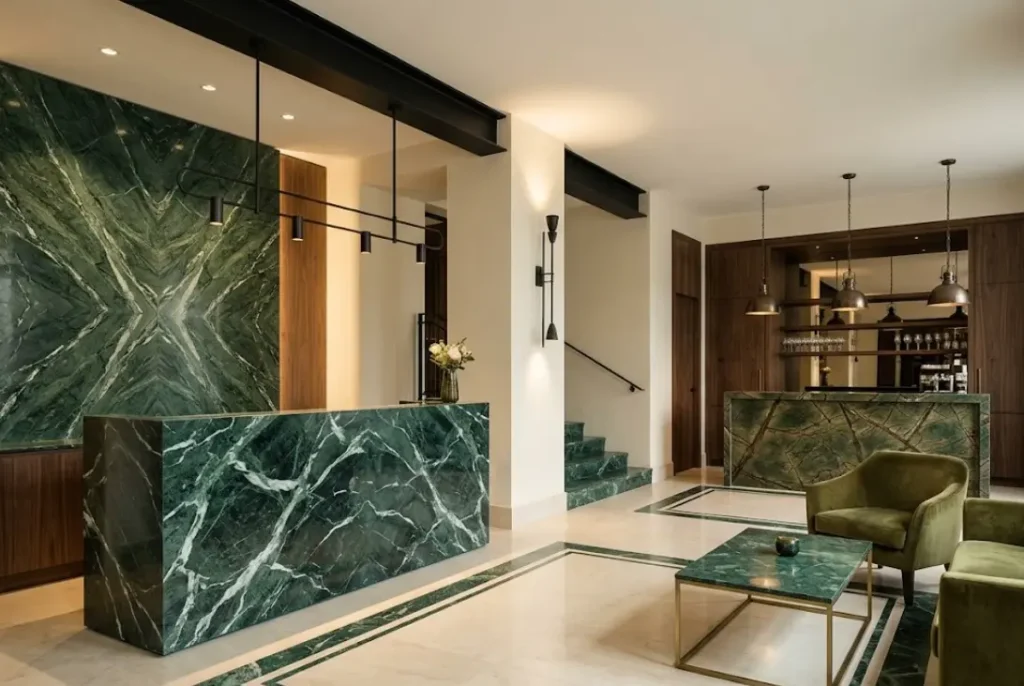
What Makes Green Marble Valuable for Wholesalers and Contractors?
Green Marble Creates Stronger Visual Identity Than Neutral Stone
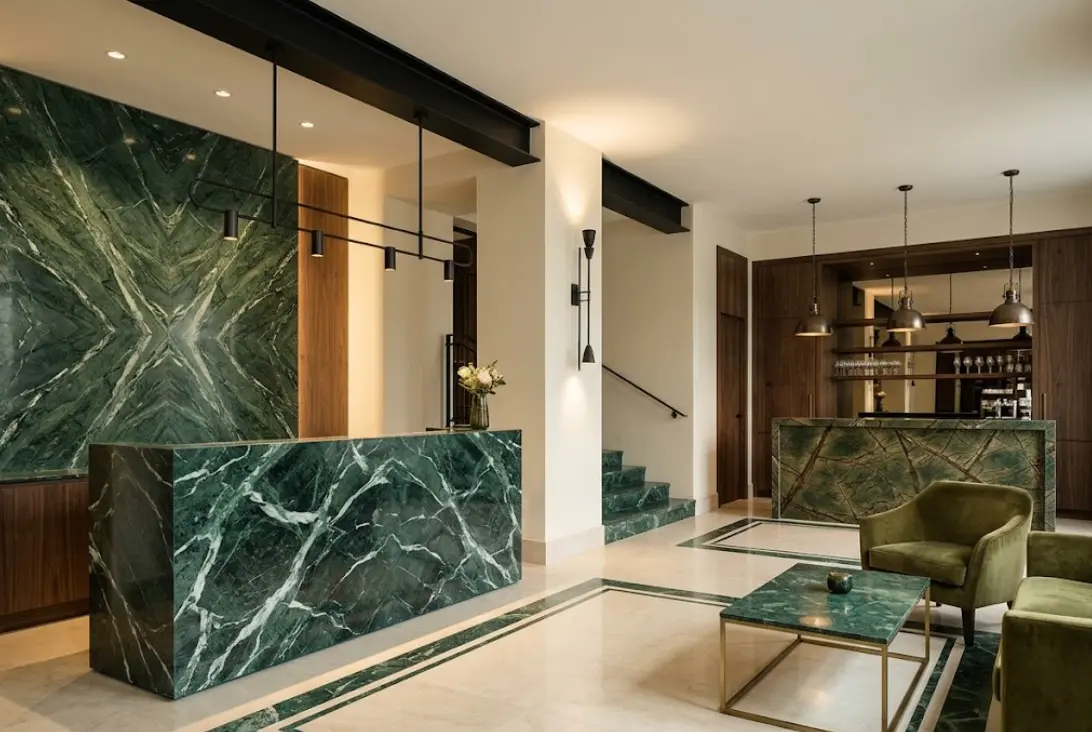
White, beige, and grey marble are safe choices. They create calm, bright, and timeless interiors. Green Marble does something different. It creates identity. A green marble wall can become the memory point of a hotel lobby. A green marble vanity can make a bathroom feel like a private spa. A green marble dining table can turn a simple room into a design statement.
For buyers who want to understand the material at a basic level, the question of whether Green Marble is natural matters because natural variation is not a defect—it is part of the stone’s value. The challenge is not removing variation completely. The challenge is controlling it well enough for the project.
Common Applications for Green Marble
Green Marble is commonly used for hotel lobby feature walls, villa bathroom walls, shower features, reception counters, restaurant bars, fireplace surrounds, flooring borders, vanity tops, tabletops, luxury stair details, wall cladding, and custom furniture. It works especially well with brass, bronze, walnut, oak, cream walls, black accents, and warm lighting.
For wholesalers, Green Marble is useful because it stands out in a showroom. Customers may walk past ten neutral slabs, then stop at the green one. For contractors, it is valuable because it can upgrade a commercial or residential project instantly. But both buyer groups need discipline. Wholesalers need stock consistency and sellable color groups. Contractors need dry-lay approval, clear installation sequence, and strong packing.
| Buyer Type | Main Goal | Key Risk | Best Sourcing Focus |
|---|---|---|---|
| Wholesaler | Stable inventory and resale appeal | Batch color inconsistency | Consistent slabs and supplier reliability |
| Contractor | Smooth installation | Breakage, mismatch, delay | Dry lay, packing, delivery sequence |
| Designer | Strong visual impact | Wrong vein movement | Slab selection and bookmatching |
Why For U Stone is a Leading Green Marble Supplier in China
A Supplier Should Support Both Material Selection and Fabrication
For B2B buyers, a supplier is not just someone who sends slab photos. A reliable supplier should understand project drawings, color grouping, dry lay, cutting, edge finishing, packing, and export logistics. This is where China-based stone suppliers can offer practical value. They can combine material sourcing with processing capacity, helping contractors and wholesalers reduce the number of disconnected steps in the supply chain.
For U Stone’s broader collection de marbre gives buyers access to multiple marble options for projects that may require green marble together with white, beige, grey, or black stone. This matters for hotel, villa, and commercial projects where one container may include slabs, cut-to-size panels, countertops, stair pieces, and furniture components.
Why Supplier Capability Matters More Than a Pretty Slab Photo
A single beautiful slab photo can create interest, but it cannot prove supplier capability. Wholesalers and contractors should ask deeper questions. Can the supplier group slabs by color tone? Can they provide full slab photos and videos? Can they support dry lay for large projects? Can they number slabs or panels by installation sequence? Can they pack exotic marble safely for long-distance shipping?
A good green marble supplier in China should help buyers control the full sourcing process, not only quote material. For wholesalers, that means more sellable inventory. For contractors, that means fewer site surprises. And in stone projects, “surprise” is usually just another word for “expensive headache.”
Value for Wholesalers
Wholesalers need green marble that can be explained, displayed, and resold. They need consistent color groups, slab photos, export-safe packaging, and repeat supply where possible. A reliable supplier should help separate strong showroom slabs from more variable commercial batches. This makes it easier for distributors to serve designers, fabricators, and homeowners with different expectations.
Value for Contractors
Contractors need project control. That includes material approval, dry lay, cutting accuracy, crate numbering, shipment timing, and installation sequence. A green marble feature wall may look simple on a rendering, but the real result depends on slab matching and site execution. If the stone arrives mixed, damaged, or poorly numbered, the installer becomes an unwilling detective. Nobody hired Sherlock Holmes with a suction cup.
|
|
|

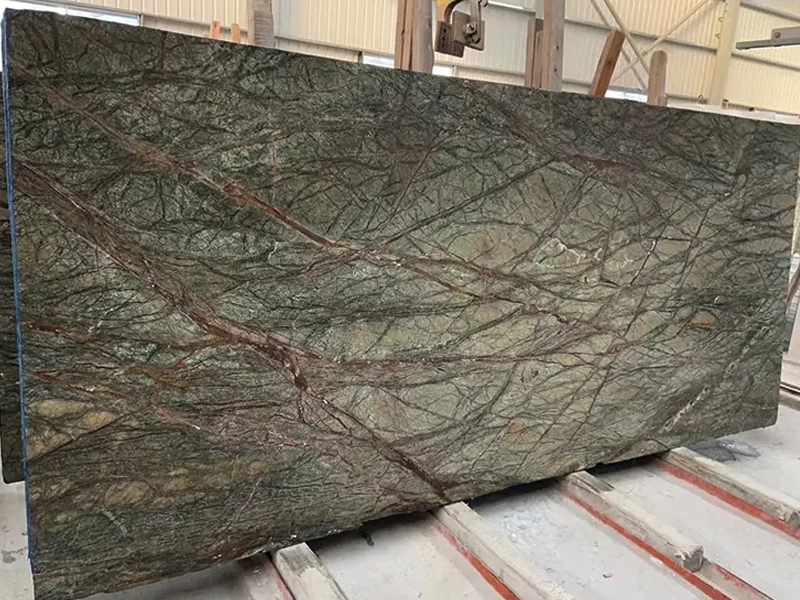
Global Green Marble Types Buyers Should Understand
Verde Alpi, Rainforest Green, Ming Green, and More
Green marble comes in many styles. Verde Alpi is known for deep green color and bold white veining. Rainforest Green has earthy, branch-like movement. Ming Green offers a softer pale green tone suitable for bathrooms and spa-style spaces. Guatemala Green is darker and dramatic. Chinese green marble options can offer sourcing flexibility for slabs, cut-to-size pieces, mosaics, and furniture production.
For buyers comparing varieties, the ultimate guide to Green Marble slabs helps connect slab type, trend direction, and sourcing logic. This is useful because not every green marble variety is suitable for every project. A dramatic slab may be perfect for a lobby wall but too visually heavy for a small bathroom.
Ancient Green and Exotic Green Marble Options
Some green marbles are especially valuable because they combine depth, rarity, and distinctive veining. For example, Ancient Green Marble slabs can be attractive for buyers seeking a richer, more expressive stone surface for walls, countertops, tabletops, and luxury interiors. Exotic slabs like this should be inspected carefully because strong movement requires better matching and layout control.
| Green Marble Type | Visual Style | Best Application | Buyer Risk |
|---|---|---|---|
| Verde Alpi | Vert foncé avec des veines blanches | Walls, floors, tables | Strong variation |
| Rainforest Green | Branch-like natural movement | Feature walls, tabletops | Pattern matching difficulty |
| Ming Green | Soft pale green tone | Bathrooms, mosaics, spa interiors | Tone matching required |
| Vert antique | Rich green with expressive movement | Luxury walls, counters, furniture | Needs slab approval |
Éviter le piège du mélange entre plusieurs carrières
Why Color Matching Is the Biggest Risk in Green Marble Projects
Color matching is one of the hardest parts of green marble sourcing. Green stones often show stronger tone variation than white or beige stones. Slabs may differ in base color, vein density, clouding, mineral movement, polish reflection, resin visibility, and shade under lighting. A wall using mismatched slabs can look chaotic even if every slab is beautiful individually.
This is why full slab inspection is essential. Buyers should avoid making decisions from small samples only. Small samples cannot show full movement, color range, bookmatching potential, or repair visibility. For luxury interiors, the buyer should request full slab photos, dry lay photos, slab numbering, and project-based approval before cutting or shipment.
What Dry Lay Means in Green Marble Projects
Dry lay means arranging slabs or cut-to-size panels before installation to check color, vein flow, pattern sequence, and overall visual effect. It is especially important for feature walls, hotel lobbies, villa bathrooms, flooring layouts, and bookmatched panels. Dry lay helps the buyer approve the layout before the stone leaves the factory.
For dramatic green stone, dry lay is not a luxury extra. It is risk control. A green marble wall without dry lay can become a puzzle where every piece is beautiful but nothing fits. With proper dry lay, the installer receives a clearer sequence, and the buyer has a documented visual approval record.
Color Matching Workflow for Green Marble Slabs
| QC Step | What to Check | Pourquoi c'est important |
|---|---|---|
| Slab photo review | Full slab color and vein movement | Avoids sample-only mistakes |
| Batch grouping | Similar tone and pattern | Reduces color mismatch |
| Thickness check | 16/18/20/30mm tolerance | Supports installation accuracy |
| Finish inspection | Polish or honed consistency | Prevents uneven reflection |
| Dry lay | Layout and sequence | Confirms visual result |
| Numbering | Slab or panel order | Helps site installation |
Bookmatching for Feature Walls and Luxury Bathrooms
Bookmatching is especially powerful with Green Marble because the stone often has dramatic veins and organic movement. When done well, bookmatching creates a mirrored visual effect that feels intentional and architectural. When done poorly, it can look confused and expensive in the wrong way.
For hotel corridors and lobby walls, green marble can create a rich hospitality atmosphere. The application of Italian Verde Alpi Green Marble in hotel hallways shows how deep green stone can create memorable transitions in hospitality spaces when lighting, layout, and slab selection are coordinated.

Material Parameters and Inspection Standards Buyers Should Check
Key Technical Parameters for Green Marble
Green Marble should be evaluated visually and technically. Buyers should check thickness, density, water absorption, flexural strength, compressive strength, abrasion resistance, surface finish, gloss level, resin repair, mesh backing, flatness, edge condition, and packing strength. Not every project requires laboratory data, but larger commercial projects may request performance references or material documentation.
Thickness is especially important. Common slab thicknesses include 16mm, 18mm, 20mm, and 30mm. Wall panels may use thinner slabs when properly supported. Countertops and furniture usually need stronger support and better edge processing. Flooring must consider wear, finish, and slip behavior.
| Paramètres | Pourquoi c'est important | Buyer Check |
|---|---|---|
| Épaisseur | Installation and edge design | Confirm tolerance before fabrication |
| Absorption de l'eau | Staining and moisture sensitivity | Ask for data when needed |
| Résistance à la flexion | Breakage risk | Important for slabs and wall panels |
| Finish consistency | Visual quality | Check under project lighting |
| Planéité | Installation accuracy | Essential for wall cladding |
| Packing strength | Transport safety | Check crate and reinforcement |
Normes d'emballage en bois conformes à l'ISPM-15
Why Packing Protects Profit
Green Marble can be exotic, heavy, fragile, and high-value. Poor packing can damage the material, delay the project, and destroy profit. Common shipping problems include broken corners, cracked slabs, surface scratches, wrong slab sequence, moisture damage, container movement, and insurance disputes. For contractors, damaged slabs mean installation delays. For wholesalers, damaged slabs mean reduced resale value.
Good packing should include strong wooden crates or A-frames, foam separators, corner guards, surface protection where needed, reinforced straps, moisture protection, clear slab numbering, loading photos, and a packing list. For cut-to-size projects, packing should follow installation sequence whenever possible.
Export Packing Checklist
| Packing Element | Objectif | Buyer Benefit |
|---|---|---|
| Wooden crate or A-frame | Structural support | Reduces breakage |
| Foam separators | Surface protection | Prevents scratches |
| Corner guards | Edge protection | Reduces chipping |
| Slab numbering | Installation sequence | Avoids site confusion |
| Loading photos | Evidence record | Supports tracking and claims |
Logistics Checklist for Contractors and Wholesalers
Contractors should confirm installation sequence, request dry lay photos, match crate numbers with drawings, check delivery dates against site schedules, prepare unloading equipment, and inspect slabs upon arrival. Wholesalers should confirm stock labels, check slab photos before shipment, separate mixed orders clearly, request packing photos, verify crate dimensions, and keep damage records for insurance.
|
|
|


Green Marble vs Other Premium Stone Options
Green Marble vs White Marble
Green Marble is more expressive and design-led. White marble is brighter, more timeless, and easier to use in open interiors. Choose Green Marble for statement spaces and white marble for calm, bright luxury.
Green Marble vs Black Marble
Green Marble feels natural, organic, and expressive. Black marble feels dramatic, formal, and high-contrast. Choose green for softer luxury and black for stronger visual authority.
Green Marble vs Quartzite
Quartzite may offer stronger hardness in some applications, while Green Marble provides classic stone elegance and richer decorative identity. For heavy-use countertops, compare performance carefully. For feature walls, bathrooms, and tables, Green Marble often offers stronger design emotion.
| Matériau | Best Advantage | Meilleure utilisation | Buyer Consideration |
|---|---|---|---|
| Marbre vert | Natural color and expressive veining | Walls, bathrooms, tables, lobbies | Needs matching and sealing |
| Marbre blanc | Bright timeless luxury | Bathrooms, kitchens, floors | May stain or etch |
| Marbre noir | Strong contrast and drama | Feature walls, furniture | Needs lighting balance |
| Quartzite | Hardness and durability | Countertops and heavy-use areas | More difficult fabrication |
Common Mistakes When Sourcing Green Marble
Buying From Small Samples Only
Small samples cannot show full slab variation, vein movement, repair visibility, or bookmatching potential. For Green Marble, full slab photos are essential.
Ignoring Color Range
Green marble may vary significantly from slab to slab. Without color grouping, the project can look inconsistent after installation.
Skipping Dry Lay for Large Walls
Dry lay is essential for hotel lobbies, bathrooms, floors, and feature walls. It helps confirm layout before the material is shipped.
Underestimating Packing Risk
Beautiful slabs are useless if they arrive cracked. Packing should be treated as part of product quality, not an afterthought.
Choosing a Supplier Without Project Support
For contractors and wholesalers, communication, QC support, documentation, and logistics coordination are just as important as slab selection.

How Wholesalers and Contractors Should Source Green Marble
For Wholesalers
Wholesalers should choose stock that is easy to explain and resell. Organize slabs by tone, size, finish, and pattern. Ask whether repeat supply is possible because some green marble varieties may not be available in the same tone later. Confirm export packing before bulk orders to reduce claims and customer dissatisfaction.
For Contractors
Contractors should start with drawings and application areas before ordering. Confirm wall elevations, floor layouts, countertop sizes, and installation sequence. Use dry lay approval for feature areas. Match packing sequence to installation sequence. Plan unloading and site storage before the shipment arrives.
Regional design trends also matter. In luxury villa and palace projects, especially in the Middle East, Green Marble slabs for palaces and villas are increasingly used to create richer interiors with natural color and stronger identity. This makes supplier control even more important, because high-visibility projects have lower tolerance for mismatch.
Practical Recommendation: When Should You Choose Green Marble?
Choose Green Marble when the project needs a statement material. It is ideal for hotels, villas, luxury bathrooms, restaurants, bars, reception desks, and premium furniture. Choose it when natural color matters, especially in interiors using brass, bronze, walnut, oak, cream walls, beige stone, and soft lighting.
Do not choose Green Marble casually if the project cannot accept natural variation. Variation is part of its beauty, but it must be managed. If the project requires exact uniformity, engineered stone may be easier. If the project can celebrate natural movement and the supplier can support color matching, dry lay, and packing control, Green Marble can deliver a high-impact result.
For project buyers ready to compare slab options, specifications, dry lay requirements, and export packing, contacting For U Stone through the green marble project stone supplier page can help clarify sourcing details before production or shipment. A strong supplier should help buyers avoid mistakes before they become expensive problems.
Final Buyer Insight: Green Marble Rewards Careful Sourcing
Green Marble is one of the most visually powerful natural stones for luxury interiors, but it must be sourced carefully. Wholesalers should focus on consistent stock, clear slab grouping, and sellable color ranges. Contractors should focus on dry lay, layout sequence, packing, logistics, and installation planning. Designers should focus on lighting, vein direction, and material pairing.
The winning formula is not complicated: choose the right slab batch, approve the layout, inspect the quality, pack the material correctly, and coordinate delivery with the project schedule. When these steps are controlled, Green Marble becomes more than a beautiful surface. It becomes a premium project asset.
FAQ
1. Le marbre vert est-il adapté aux comptoirs ?
Oui, le marbre vert peut être utilisé pour les plans de travail, notamment dans les cuisines de luxe, les comptoirs de bar, les dessus de vanités et les surfaces décoratives où l'on recherche une couleur naturelle et des veines spectaculaires. Toutefois, les acheteurs doivent tenir compte du scellement, de l'entretien, des substances acides, de la protection des bords et de l'intensité d'utilisation. Pour les cuisines soumises à un usage intensif, il convient de discuter du fini de la dalle, du scellant et des habitudes d'entretien avant l'installation.
2. Comment choisir un fournisseur fiable de marbre vert ?
Pour choisir un fournisseur fiable de marbre vert, vérifiez si l'entreprise peut fournir des photos de dalles complètes, une correspondance de couleur, un service de pose à sec, une inspection de l'épaisseur, un contrôle de la finition, des photos de l'emballage, des documents d'exportation et une communication sur les projets. Pour les grossistes, la cohérence du fournisseur et la répétition des livraisons sont essentielles. Pour les entrepreneurs, la pose à sec, la numérotation des dalles, la précision de coupe et la séquence d'emballage revêtent une importance particulière.
3. What is dry lay in Green Marble projects?
Dry lay means arranging slabs or cut-to-size panels before installation to check color, vein flow, layout sequence, and overall visual effect. It is especially important for Green Marble feature walls, hotel lobbies, bathrooms, floors, and bookmatched panels. Dry lay helps buyers approve the layout before shipment and reduces the risk of visual mismatch on site.
4. How should Green Marble slabs be packed for export?
Green Marble slabs should be packed with strong wooden crates or A-frames, foam separators, corner guards, reinforced straps, slab numbering, moisture protection, and loading photos. For cut-to-size projects, the packing sequence should match the installation sequence when possible. Good packing protects the stone, reduces breakage risk, and helps contractors install the material more efficiently.
5. Is Green Marble suitable for bathrooms?
Yes, Green Marble is suitable for bathrooms, especially for vanity tops, shower feature walls, wall cladding, floors, and decorative panels. Buyers should choose the right finish, confirm sealing requirements, ensure waterproofing in wet areas, and understand normal marble maintenance. For luxury bathrooms, green marble works especially well with brass fixtures, warm lighting, cream walls, and natural wood details.
Références
1. Dimension Stone Design Manual, Natural Stone Institute, Natural Stone Technical Reference.
2. Natural Stone Maintenance Guide, Natural Stone Institute, Stone Care and Maintenance Publications.
3. ASTM C503 Standard Specification for Marble Dimension Stone, ASTM International, Stone Material Standards.
4. Stone in Architecture: Properties, Durability, Fourth Edition, Siegfried Siegesmund and Rolf Snethlage, Springer.
5. Interior Design Materials and Specifications, Lisa Godsey, Fairchild Books.
6. Architectural Graphic Standards, American Institute of Architects, Wiley.
7. Time-Saver Standards for Interior Design and Space Planning, Joseph DeChiara, Julius Panero, and Martin Zelnik, McGraw-Hill.
8. Natural Stone and World Trade: Quarrying, Processing, and Logistics, Stone World Magazine, Industry Feature.
Strategic Insight: How B2B Buyers Should Source Green Marble
What makes Green Marble valuable?
Green Marble creates a strong natural identity for hotels, villas, bathrooms, wall cladding, furniture, and commercial interiors. Its deep color and expressive veining make it more memorable than neutral stone, but also more demanding in sourcing and layout control.
Why does color matching matter?
Green Marble often varies in base tone, vein density, mineral movement, resin visibility, and polish reflection. For large projects, color grouping and dry lay approval help prevent visual mismatch after installation.
How should wholesalers evaluate Green Marble?
Wholesalers should prioritize sellable color groups, repeat supply possibility, full slab photos, export-safe packing, and clear batch organization. The best inventory is not only beautiful; it must be easy to display, explain, and resell.
How should contractors reduce project risk?
Contractors should confirm drawings, application areas, slab sequence, dry lay layout, packing order, delivery timing, unloading equipment, and site storage before shipment. Green Marble projects fail less often when the supplier and installer share a clear layout plan.
Buyer consideration: The market for premium green stone is growing in luxury hospitality, Middle Eastern villa design, boutique interiors, and custom furniture. Buyers who choose suppliers with quality control, dry-lay service, packing strength, and export communication will reduce risk while protecting the visual value of the stone.