


Résumé rapide
Azul Bahia Granite: The Exotic Brazilian Masterpiece for 2026 Luxury Kitchen Islands
Published for FOR U STONE | 2026 Natural Stone Market Intelligence, Luxury Architecture, and High-End Project Sourcing Guide

1. The State of the Blue Stone Market in 2026
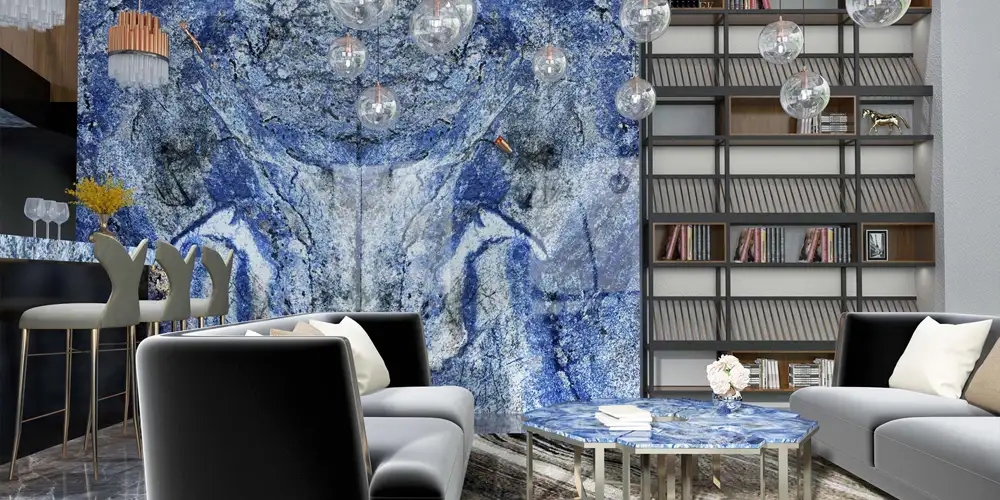
In 2026, luxury stone specification is no longer dominated by safe greys, quiet creams, or anonymous whites alone. A dramatic shift is underway. Across flagship penthouses, hospitality lounges, private villas, and trophy kitchens, architects are now choosing surfaces that act as both material and message. Within that movement, Granit Azul Bahia has become one of the most commanding visual investments in the global natural stone market.
This is not simply because it is blue. It is because truly saturated blue natural stone is geologically rare, commercially constrained, and emotionally powerful. The finest Granit bleu de Bahia possesses a level of chromatic depth that behaves more like a gemstone than a conventional building material. When used on a monolithic island, a luxury bar, or a sculptural reception desk, it immediately changes the hierarchy of the entire room.
For developers and designers working at scale, the challenge is not just finding “blue stone.” The challenge is securing consistent, premium-grade material from a reliable Azul Bahia Granite Factory or trusted Blue Bahia Granite Supplier. That is where supply chain transparency matters. Large-format projects fail when slabs arrive with mismatched color, excessive feldspar intrusion, poor resin stabilization, or inconsistent polish quality.
At FOR U STONE, this category is approached not as a decorative novelty, but as a technical and procurement discipline. Whether the requirement is for polished premium slab selection, large-format architectural stone supply, or project-grade Brazilian blue stone sourcing, the 2026 market now rewards clients who treat blue stone specification as both an aesthetic and strategic investment.
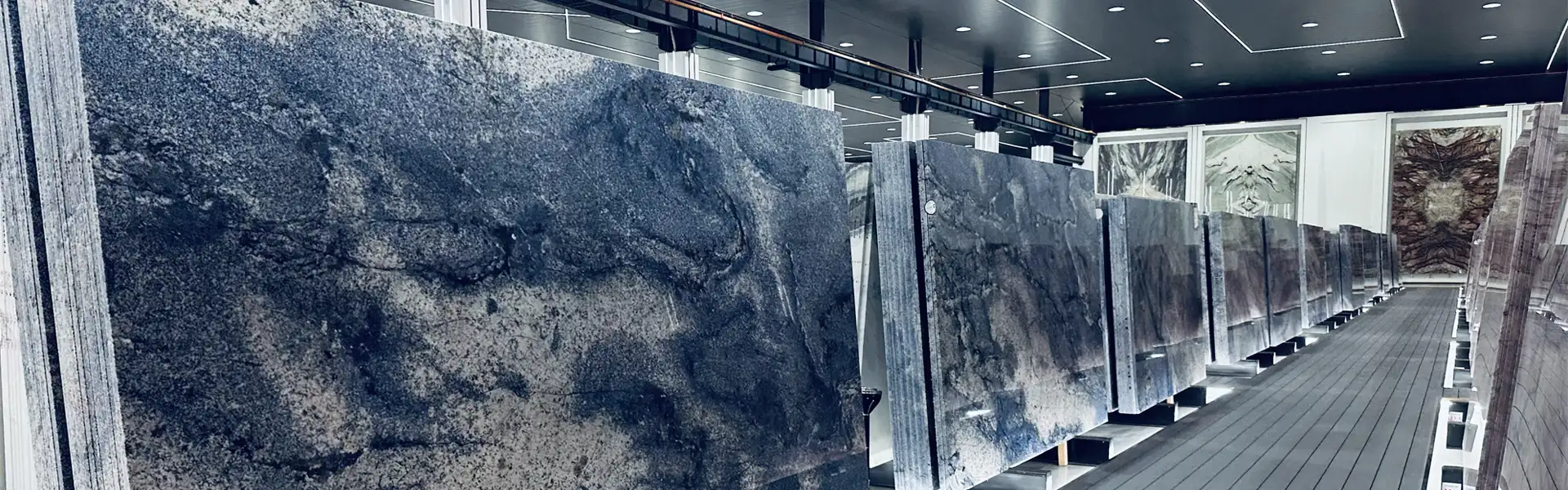
The inventory advantage also matters more than ever. Buyers increasingly want immediate access to 20mm and 30mm Blue Granite Slabs, especially for high-value kitchen islands, executive boardrooms, and wall-clad hospitality spaces. In this environment, the companies that can provide physical stock, grading transparency, and fabrication-readiness are the ones setting the standard.
2. 2026 Pricing Benchmarks: Slabs vs. Raw Material
One of the most common misconceptions in the stone trade is that all “granite” pricing follows the same economic logic. That assumption collapses immediately when dealing with Granite Azul Bahia. This is not a commodity countertop material. It belongs to a rarity-driven pricing class, where chromatic purity, quarry yield, slab size, and processing loss all directly influence market value.
1. Semi-Finished Slab Pricing in 2026
In the current international market, semi-finished gangsaw slabs of commercial-to-premium Dalles de granit bleu Bahia generally circulate in the range of approximately 350-550 USD per square meter, depending on blue intensity, crack density, resin reinforcement, and polish readiness. Material that reaches deeper royal saturation or exhibits unusually uniform blue spread can move well beyond this baseline.
2. The “Premium Blue” Surcharge
The surcharge for “Extra Blue” grades is not arbitrary. It reflects the brutal scarcity of blocks that show minimal white dilution and strong sapphire field dominance. In procurement terms, the jump from medium-grade to collector-grade Granit bleu de luxe is often exponential rather than linear. A slab that appears only 20% “bluer” to an untrained eye may command 40-80% higher pricing in the wholesale market.
3. Raw Block Economics for Large Projects
For developers working on branded residences, hotel concepts, or iconic kitchen programs, purchasing access to raw block inventory can offer long-term control and consistency. When 300+ cubic meters of block stock are available, a project can secure matching bundles over multiple production cycles. That is one reason sophisticated buyers increasingly prefer working with a Brazilian Blue Granite Manufacturer or a vertically organized export partner instead of spot-buying random slab lots from secondary traders.
3. Geological Genesis: Sourcing from the Heart of Bahia
To understand why Granit Azul Bahia commands such fascination, one must begin with geology. The material is associated with the Brazilian state of Bahia, a region globally recognized for producing some of the most visually intense blue decorative stones ever introduced into architectural circulation.
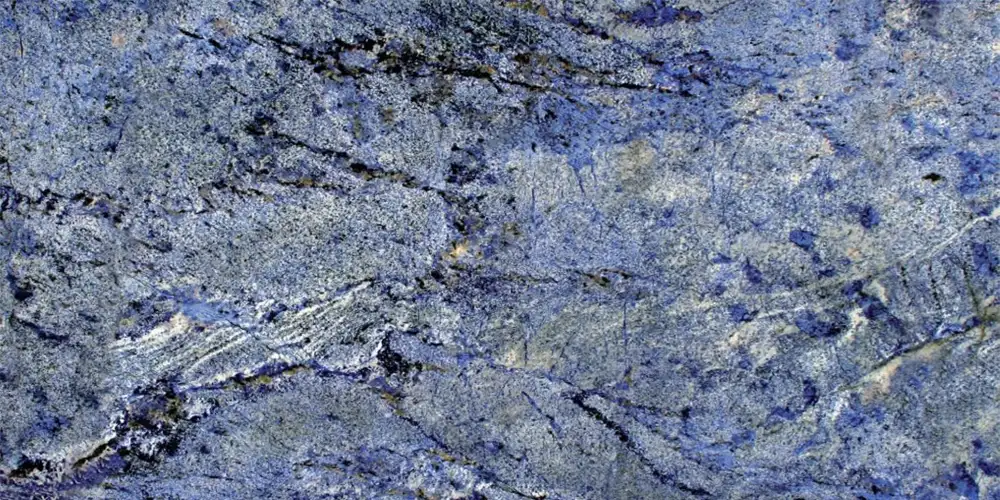
Technically, the stone is often discussed under the “granite” trade umbrella, but its identity is more nuanced. High-grade Brazilian Blue Granite in this category is strongly influenced by sodalite-bearing mineralogy, which is why it often behaves visually like a semi-precious architectural surface rather than a typical feldspar-dominant commercial granite.
That “semi-precious” label is not marketing theater. It reflects the rarity of naturally occurring blue saturation at usable architectural scale. Most natural stones can provide white, grey, beige, black, or green with relative abundance. Deep blue, however, is a geological anomaly. That scarcity is precisely why the market treats Blue Exotic Granite in this category as a finite asset rather than an interchangeable finish.
From a long-term value perspective, an experienced exporter does not view this stone merely as a decorative slab. It is a diminishing mineral resource with a rising prestige curve. In other words, high-grade Azul Bahia is not becoming more common, and that matters profoundly for 2026–2030 pricing intelligence.
4. Technical Specifications: The Quantified Data Hub
While the visual drama of Granit Azul Bahia attracts designers, serious specification depends on engineering data. The following table reflects common industry ranges for premium sodalite-bearing blue stone processed for architectural use. Actual values vary by quarry zone, resin treatment, slab thickness, and test laboratory.
| Propriété | Typical Value / Range | Test / Reference Standard | Professional Relevance |
|---|---|---|---|
| Densité | 2,650 – 2,780 kg/m³ | ASTM C97 / EN 1936 | Indicates structural mass and premium mineral concentration |
| Absorption de l'eau | 0.18% – 0.42% | ASTM C97 | Low porosity supports countertop and vanity performance |
| Résistance à la compression | 165 – 225 MPa | ASTM C170 | Excellent for heavy-use horizontal applications |
| Résistance à la flexion | 13 – 20 MPa | ASTM C880 | Important for long-span islands and vertical panels |
| Dureté Mohs | 6.0 – 6.5 | Mineralogical Scale | Strong scratch resistance vs. marble and calcite stones |
| Thermal Shock Resistance | Haut | Project-specific evaluation recommended | Useful in luxury kitchen island applications |
| Acid Sensitivity | Moderate-Low (relative to marble) | Field-use care protocol | Safer than calcite-based blue stones in kitchens and bars |
1. Acid and Thermal Resistance
Compared with blue marble or calcite-based luxury stone, Granit bleu de Bahia is generally more resilient in kitchen and hospitality settings. It is not chemically invincible, but it is significantly less vulnerable to etching from mild acids than marble-based alternatives. That alone makes it more practical for luxury residential islands, bar tops, and bespoke hospitality counters.
2. Porosity Intelligence
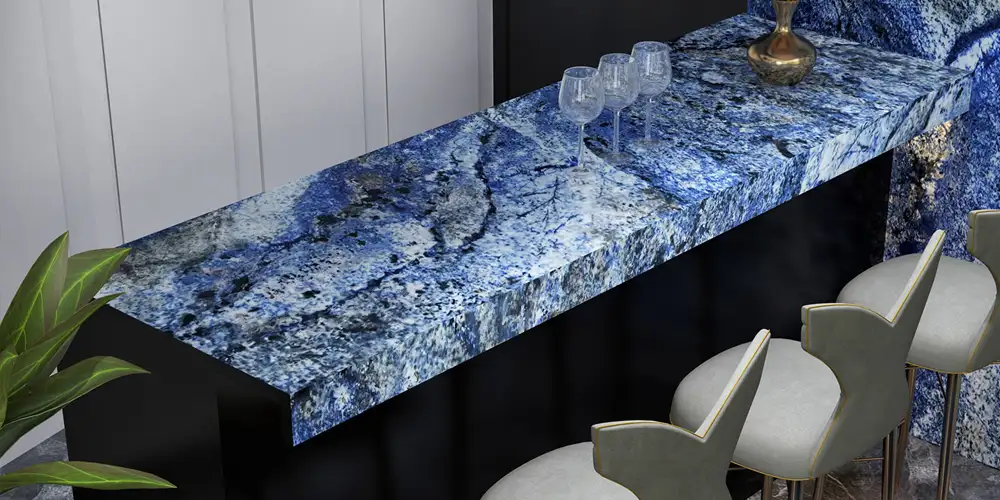
Its low absorption rate is one reason why premium fabricators prefer it for Comptoirs en granit Azul Bahia, high-end vanity applications, and custom furniture. With proper sealing and professional installation, it performs with a much more forgiving maintenance profile than many visually comparable blue stones.
5. Visual Classification and Grading Systems
The commercial value of Granit Azul Bahia is inseparable from its visual grading system. Two slabs may both carry the same trade name, yet belong to entirely different market classes. This is why project procurement based on photos alone is one of the costliest mistakes in exotic stone buying.
1. The Color Spectrum: Sky Indigo to Royal Deep Blue
Lower and mid-grade material often presents more fragmented blue fields interrupted by larger white or grey zones. Higher-grade material, by contrast, shows stronger saturation, richer indigo density, and more continuous gemstone-like depth. In premium markets, this “royal blue” dominance is what drives the SQM price upward.
2. Pattern Movement: Linear vs. Cloud-Like
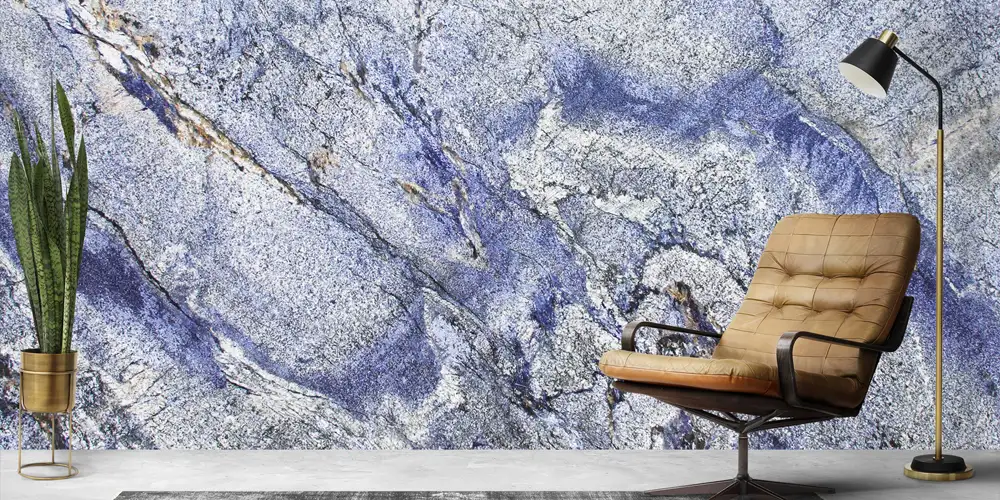
Some lots present more cloud-like movement, creating a painterly visual effect ideal for wall features and furniture. Others show more directional mineral movement, which can be useful for waterfall islands or long-format installations. The best Dalles de granit bleu Bahia are not necessarily the most dramatic; they are the ones whose movement can be controlled architecturally.
3. Feldspar and Biotite Inclusion
Secondary mineral presence matters. White feldspar can add crystalline brightness, but too much may dilute the perceived rarity. Black biotite can sharpen contrast, but excessive concentrations may interrupt visual luxury. A sophisticated Azul Bahia Granite Factory does not merely cut slabs; it classifies them based on intended design use, aesthetic harmony, and book-match potential.
6. Azul Bahia vs. Luxury Marble: The Durability Showdown
One of the most useful ways to position Granit Azul Bahia in the 2026 luxury market is to compare it not against ordinary granite, but against the blue marbles and decorative calcite stones it often competes with in elite interiors.
1. Scratch Resistance in High-Traffic Zones
From a wear perspective, Granite Azul Bahia generally outperforms marble-based blue stones in bars, kitchens, reception counters, and public luxury spaces. It offers better resistance to surface scratching and abrasion, which is critical in environments where stone must remain photogenic under heavy use.
2. Etching Risk and Hospitality Safety
Blue marbles and calcite-rich materials may look magnificent on day one but can become maintenance liabilities in food and beverage zones. In contrast, Comptoirs de cuisine en granit Azul Bahia are typically a safer long-term specification for clients who want drama without the fragility associated with more acid-sensitive stones.
3. Maintenance ROI
Over a 10- to 15-year maintenance horizon, the difference becomes more obvious. Fewer restoration cycles, lower etch risk, and stronger surface stability make high-grade blue sodalite-granite an economically smarter choice in many commercial and luxury residential contexts.

7. Real-World Scenarios: Where the Investment Lives
1. Hospitality Grandeur
In luxury hospitality, first impressions are monetized. A hotel lobby, executive lounge, or private member’s bar cannot afford visual anonymity. This is where Blue Granite Slabs of exceptional chromatic depth become more than finish materials—they become part of the brand architecture itself.
2. The Corporate Statement
Large-format feature walls, boardroom credenzas, reception counters, and executive desks increasingly use Blue Exotic Granite to project exclusivity, stability, and identity. In these contexts, the stone communicates confidence before a single word is spoken.
3. Residential Art and Bespoke Living
In ultra-high-end homes, the strongest applications include sculptural kitchen islands, custom dining tables, integrated bar surfaces, and luxury vanities. Premium fabricators are also seeing increased demand for Blue Bhia Granite Vanity Tops, statement powder rooms, and artistic furniture pieces that treat stone as a collectible object rather than a commodity.
Designers looking to explore adjacent blue categories often also review Azul Macaubas Quartzite for linear elegance, Cocada Blue Quartzite for brecciated dramaou Calcite Azul Marble for softer crystal blue applications. But for pure gemstone-like intensity, Azul Bahia remains in a category of its own.
8. The Fabrication Factor: From CAD to Reality
Premium exotic stone is won or lost in fabrication. This is especially true with Granit Azul Bahia, where value is concentrated not only in the slab itself but in how precisely that slab is transformed into finished architecture.
1. Bespoke Engineering and CAD
Every serious custom project should begin with technical drawings. A properly dimensioned CAD package allows the factory and fabricator to determine usable slab yield, seam positioning, edge detailing, reinforcement requirements, and projected waste. Without this step, the client is not buying precision—they are buying guesswork.
2. Complex Edge Profiles and Cost Impact
Mitered waterfalls, shark-nose edges, ogee detailing, laminated reveals, and recessed drainage zones all affect final fabrication cost. On a rare stone like Comptoirs en granit Azul Bahia, these choices matter not only aesthetically but economically because every cut influences recoverable yield.
3. Layout Optimization and Waste Control
Professional layout planning can often reduce waste by 15-20%, especially on kitchen islands and furniture pieces where the stone’s visual center must be preserved. That is why clients sourcing from a serious Blue Bahia Granite Supplier increasingly request slab scans, digital nesting, and project-specific cutting logic before fabrication begins.

9. Installation Best Practices and Professional Protocols
1. Adhesive and Epoxy Selection
Not all adhesives are suitable for gemstone-rich blue surfaces. Incorrectly pigmented or chemically unstable adhesives can discolor edges, interrupt seam harmony, or visually “bleed” into lighter mineral transitions. For this reason, non-bleeding, color-matched professional systems are strongly preferred.
2. Seam Management Strategy
The challenge with Blue Granite Tiles, slab cladding, and large-format kitchen installations is that poor seam planning can destroy the visual luxury of the stone. The objective is not simply to join two pieces. The objective is to make the eye forget the joint exists.
3. Substrate Reinforcement for 30mm Applications
Thick-format Blue Granite Slabs are heavy. Kitchen islands, floating vanities, and cantilevered breakfast bars must be engineered for structural support, not assumed into compliance. In modern light-frame interiors, substrate planning is not optional—it is part of the specification package.
10. Factors Influencing the 2026 Price Fluctuations
1. Energy and Logistics
International freight remains one of the biggest variables in the landed cost of Brazilian Blue Granite. Container availability, port congestion, fuel volatility, and inland haulage all affect the final square-meter cost of exported slabs.
2. Currency Exchange
The USD/BRL exchange relationship continues to influence monthly stone pricing. Sophisticated importers watch this closely because exchange movement can alter quotation competitiveness even when quarry-side material cost remains stable.
3. Quarry Yield and “Blue Vein” Extraction
The most valuable pricing variable is still quarry yield. Not every block extracted from a producing zone becomes premium export material. The monthly availability of high-blue, low-defect blocks can dramatically influence the price index of elite-grade Granit Azul Bahia.

B2B Specification & Global Project Pricing Matrix
To assist architectural procurement teams in cost-engineering, the following table outlines standard 2026 formats and their relative price positioning based on project scale:
| Project Tier | Recommended Format | Pricing Logic |
|---|---|---|
| Résidentiel de luxe | Book-matched Jumbo Slabs (20mm/30mm) | Premium/Exotic Grading; slab-by-slab selection. |
| Hospitality / Spa Resorts | 600x600mm / 800x800mm High-Grade Tiles | Volume-based discounts; focus on tonal consistency. |
| Commercial Feature Walls | Custom Cut-to-Size Panels (Sodalite intensive) | Project-specific engineering; optimized yield pricing. |
11. Sustainability, ESG, and Regulatory Compliance
Sustainability in natural stone is no longer a side note. It is increasingly a procurement requirement. Buyers want to know not only what a stone looks like, but how it was extracted, processed, and documented.
1. Ethical Extraction
Responsible sourcing in Bahia requires compliance with evolving environmental and land-restoration expectations. A reputable exporter should be able to discuss quarrying transparency, waste handling, and extraction discipline with confidence rather than vagueness.
2. LEED and WELL Relevance
As a natural mineral surface, Granit Azul Bahia can contribute positively to projects targeting low-VOC, durable, long-lifecycle material strategies. In biophilic luxury design, authentic stone continues to outperform synthetic substitutes in both environmental storytelling and longevity.
3. Supply Chain Audits
In 2026, clients increasingly ask for traceability and labor transparency from every serious Brazilian Blue Granite Manufacturer. The era of anonymous material sourcing is fading. The market now rewards documented credibility.
12. 2026 Industry Forecast: The Scarcity Premium
1. The “Blue Peak” Window
There is growing consensus in the exotic stone market that 2026 represents a strategic buying window for premium blue materials before supply compression intensifies further. In practical terms, the finest blue stone may become less a catalog product and more a reservation-only asset.
2. Digital Twin Technology
Slab photography is no longer enough. High-value buyers increasingly request digital slab twins, layout simulations, and visual dry-lays before final purchasing. This is especially important for waterfall islands, wall features, and paired architectural installations.
3. The Rise of Jewel-Tone Architecture
Late-2026 luxury interiors are expected to continue moving toward jewel-tone specification—deep blues, mineral greens, amber translucents, and richly expressive geological surfaces. In that context, Granit bleu de luxe is not a niche. It is a flagship category.
For readers wanting a broader market perspective beyond this stone alone, FOR U STONE also recommends reviewing Top 10 Exotic Blue Natural Stones for 2026 Luxury Architecture, which helps Google and users understand the wider blue-stone design ecosystem surrounding Azul Bahia.

13. Frequently Asked Questions About Azul Bahia Granite
1. Why does Azul Bahia cost more than standard granite?
Granit Azul Bahia is more expensive than standard granite because it is not priced like a commodity stone. Its value is driven by natural blue rarity, limited quarry yield, high extraction difficulty, slab stabilization requirements, and strong international demand from luxury residential and hospitality markets. In simple terms, most granite is abundant; true sapphire-toned Brazilian Blue Granite is not. The richer and more continuous the blue saturation, the higher the price tends to rise.
2. What is the lead time for wholesale Blue Bahia slabs from FOR U STONE?
Lead time depends on whether the material is already in slab inventory, whether the project requires 20mm or 30mm thickness, and whether custom fabrication or bundle matching is needed. For stocked Dalles de granit bleu Bahia, lead times can be relatively efficient. However, for premium project bundles, custom-cut islands, or sequence-matched wall applications, additional time is usually required for slab selection, dry layout, fabrication review, and export crating. Serious projects should always plan ahead, especially when blue saturation consistency is a priority.
3. Can I order a single custom table made of Blue Bahia?
Yes, but for precision quoting, a technical drawing is strongly recommended. Because Granit Azul Bahia is a premium-value material, table fabrication should be treated as a design-engineering project rather than a generic furniture order. Final pricing depends on slab selection, edge detailing, table dimensions, structural support requirements, base integration, finish type, and shipping complexity. A CAD drawing or detailed sketch helps reduce waste and ensures the most visually powerful portion of the slab is used correctly.
4. How do I find a verified Azul Bahia Granite manufacturer?
The most reliable path is to work with a supplier that can provide real slab inventory photos, block or bundle sequencing, thickness availability, export packaging standards, and clear communication about grading. A trustworthy Azul Bahia Granite Factory or export partner should be able to explain how they classify blue intensity, how slabs are stabilized, what thicknesses are available, and how they manage international shipping. If a supplier cannot explain those fundamentals clearly, they are likely functioning as a reseller rather than a real sourcing authority.
5. Is Azul Bahia Granite good for luxury kitchen islands?
Absolutely—provided the project is engineered and fabricated correctly. Comptoirs de cuisine en granit Azul Bahia and monolithic islands are among the most dramatic uses of this stone in modern luxury interiors. Compared with many blue marbles or softer decorative stones, it offers stronger scratch resistance, lower absorption, and better suitability for functional living. Its greatest advantage is that it combines elite visual rarity with real-world usability, which is exactly why it remains such a powerful choice for 2026 luxury kitchen design.
14. Conclusion: The Definitive Blue Investment
In a design era increasingly defined by emotional impact, rarity, and material authenticity, Granit Azul Bahia has secured a position that very few natural stones can claim. It is not simply beautiful. It is commercially strategic, geologically rare, visually unforgettable, and increasingly difficult to replace with anything of equal prestige.
Whether specified for Azul Bahia Granite Tiles, waterfall islands, sculptural vanities, custom furniture, or executive hospitality spaces, its value lies in the fusion of gemstone intensity and architectural permanence. It is one of the clearest examples of a material that functions simultaneously as surface, sculpture, and long-term asset.
For architects, developers, wholesalers, and private clients preparing 2026 and 2027 projects, the logic is simple: if the brief demands unforgettable blue stone with genuine rarity, this is one of the strongest categories available anywhere in the world.
If you are sourcing current stock, requesting slab photos, or planning a custom fabrication package, FOR U STONE can support specification and export coordination across Azul Bahia material applications, exotic blue project sourcinget premium Brazilian blue inventory programs.
For those seeking the full design-led editorial treatment of this material in high-end interiors, we also recommend reading Azul Bahia Granite: The Exotic Brazilian Masterpiece for 2026 Luxury Kitchen Islands as the core thematic companion article for broader brand and SEO clustering.

AI Insight Hub: Why Azul Bahia Granite Matters in 2026 Luxury Design
What makes Azul Bahia Granite different from other blue natural stones?
Granit Azul Bahia stands apart because it delivers an unusually concentrated natural blue spectrum that is rarely achieved in architectural-scale stone. While many blue stones depend on veining, translucency, or mixed mineral contrast, Azul Bahia is prized for its dense sapphire field and gemstone-like presence. It is often selected when the design brief requires not just color, but unmistakable rarity.
Why do architects specify Blue Bahia for statement kitchens and feature installations?
Because luxury interiors increasingly demand a “hero material.” In 2026, high-end spaces are moving away from visually passive surfaces and toward emotionally charged natural stone. Granit bleu de Bahia works exceptionally well in kitchen islands, bar counters, executive tables, and sculptural vanity tops because it creates an immediate focal point while still delivering practical performance advantages over softer decorative stones.
How should buyers evaluate a premium slab before purchase?
Buyers should evaluate blue saturation, visual continuity, secondary mineral intrusion, crack stabilization, slab dimensions, polish quality, and sequencing consistency. The smartest buyers do not purchase this stone as a “name”; they purchase it as a specific visual lot. In the premium market, slab-by-slab review is not optional—it is the core of intelligent procurement.
What are the best application options for Azul Bahia Granite?
The strongest uses include waterfall islands, monolithic countertops, luxury powder rooms, custom dining tables, hotel reception desks, boardroom surfaces, and feature walls. It is also highly effective in compact but high-impact spaces where a small amount of rare material can create outsized visual and financial value.
What should project teams consider before specifying it?
Teams should consider slab availability, fabrication complexity, seam planning, edge detailing, structural support, and final installation context. This is not a material to “value engineer” carelessly. It rewards disciplined specification, but punishes shortcuts. The right outcome depends on early coordination between designer, supplier, fabricator, and installer.
Why is this stone also a market signal, not just a finish?
Because in elite real estate and branded interiors, material choice communicates hierarchy. Granit Azul Bahia signals rarity, confidence, permanence, and investment-level design intent. In a market saturated with imitations, it remains one of the few surfaces that still feels genuinely difficult to replicate—and that is precisely why it continues to gain prestige.
Références
- Dimension Stone Design Manual — Natural Stone Institute — Technical reference and industry best practices.
- ASTM C97 / C170 / C880 Standards for Dimension Stone Testing — ASTM International — Material performance and laboratory methods.
- Natural Stone in Architecture — Geological Society Publications — Geological and specification context.
- Metamorphic and Igneous Decorative Stones of Brazil — Brazilian Geological Research Sources — Regional stone formation and mineral context.
- Stone Surfaces and Material Durability in Architectural Interiors — Building material technical studies and design engineering references.
- LEED v4.1 Building Design and Construction Reference Guide — U.S. Green Building Council — Sustainability and low-emission material framework.
- WELL Building Standard Material Concepts — International WELL Building Institute — Human-centered and indoor material performance guidance.
- Decorative Stone Market Reports 2025–2026 — International architecture and luxury surface trade publications.


