Quick Design Summary for Marble Stair Wall Panels
Why Marble Stair Side Wall Panels Need Precise Design
Marble stairs are often used in villas, hotels, duplex homes, clubs, commercial lobbies, and luxury residential projects because they create a strong architectural focal point. The side wall panels beside the staircase are not just decorative background surfaces. They connect stair treads, risers, landings, handrails, lighting, skirting, and the vertical wall composition into one complete visual system.
When designers or contractors choose losas de mármol for staircase wall cladding, the real challenge is not only selecting a beautiful color. The project team must decide how to position the panel height, how to follow the stair slope, how to divide panel shapes, how to handle curved staircase data, how to mark templates, and how to send accurate production drawings to the workshop.
If this design work is skipped, even expensive marble can look awkward after installation. The joints may not align. The slope may feel too high. Curved wall panels may not fit the site. Decorative lines may break at the wrong location. Worse, the installer may discover the problem only after the panels have already been cut. That is the stone version of a very expensive “oops.”
What Are Marble Stair Side Wall Panels?
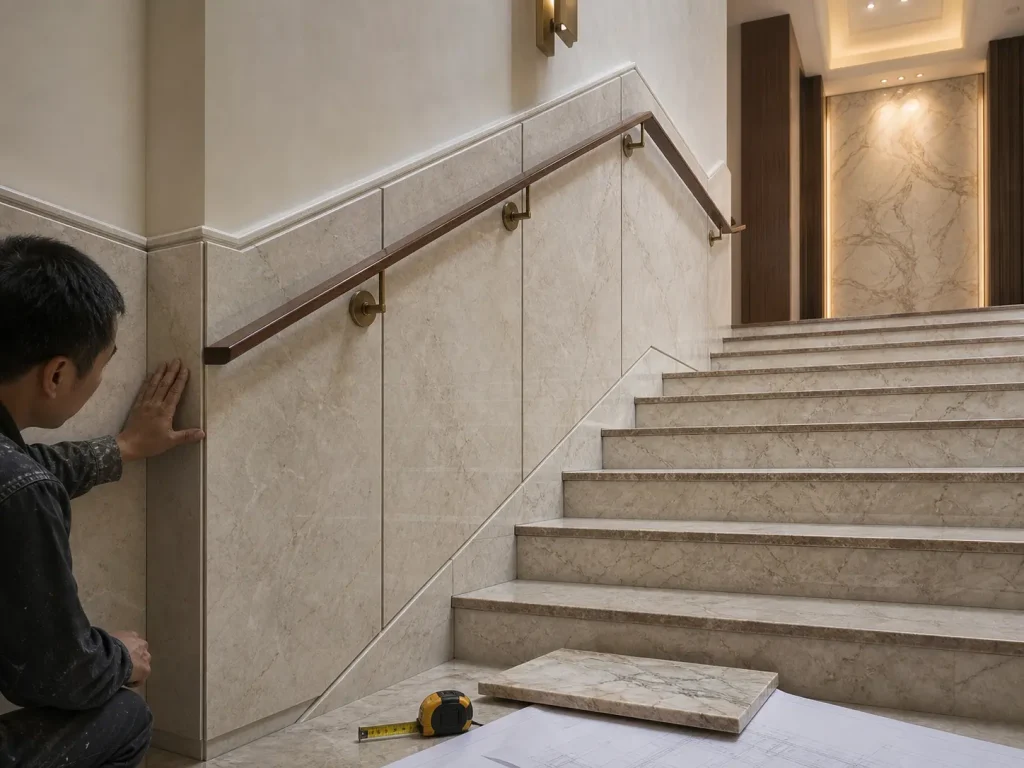
Marble stair side wall panels are vertical marble pieces installed along the wall beside a staircase. They can be full-height feature panels, half-height wall skirt panels, stair skirting panels, curved wall panels, or modular cut-to-size cladding. Unlike stair treads, which carry foot traffic, side wall panels mainly provide protection, visual continuity, and architectural decoration.
However, side wall panels still require careful engineering. Marble is heavy, natural, and variable. Veins must be coordinated. Panel sizes must fit the slope. The wall substrate must be stable. Curved staircase panels need templates. Handrail brackets must not crack the stone. This is why working with an experienced natural marble manufacturer is useful for projects that require drawings, cut-to-size fabrication, export packing, and slab selection support.
| Stair Component | Position | Main Function | Design Risk |
|---|---|---|---|
| Tread | Horizontal walking surface | Foot traffic and slip resistance | Wear, slipperiness, edge damage |
| Riser | Vertical face between steps | Step rhythm and visual finish | Height mismatch and poor alignment |
| Zócalo | Low strip beside steps | Wall protection and transition | Incorrect angle cutting |
| Side wall panel | Vertical wall beside staircase | Decoration, protection, spatial depth | Wrong slope, bad joints, poor fit |
Method 1: Step Vertical Elevation Positioning
The step vertical elevation positioning method is one of the most controlled ways to design marble stair side wall panels. The designer finds a reference datum point and measures upward according to the same height logic as the stair or floor elevation. Each panel is positioned according to the vertical rise relationship of the staircase.
This method is useful when the project needs clear elevation control. It keeps the panel height tied to the real stair structure rather than an abstract sloping line. For straight staircases, villa interiors, hotel staircases, and projects with formal wall paneling, this method can make the panel layout look more stable and intentional.
When collecting project data, buyers should provide stair drawings, floor elevation, landing height, tread count, riser height, wall length, and site photos. If the project has unusual geometry, early communication through a custom marble stair panel consultation can help the supplier judge whether the panel division should follow vertical elevation, slope offset, or a template-based method.
Best Use Cases for Vertical Elevation Positioning
This method works best for straight staircases, classic wall panel designs, half-height marble wainscot panels, and staircases where the wall panel lines need to feel formal and balanced. It is especially useful when the designer wants the wall panel height to relate visually to the floor level, landing level, or interior wall elevation.
Main Risk
The main risk is that the design may require more careful drawing work. Each step relationship must be understood. If the stair dimensions on site differ from the drawing, the panels may need adjustment. For this reason, site measurement should be completed before production drawings are finalized.
Method 2: Bevel Offset Method for Sloped Wall Panels
The bevel offset method uses the inclined plane determined by two points. The designer finds the datum point, then offsets the wall panel dimension along the slope. This method is convenient because the height and size of the wallboard follow the same slope as the staircase. The drawing process is often faster, and the panel geometry looks consistent on paper.
For designers studying marble wall cladding depth design, this method is useful because stair side panels are not only flat decoration. Their slope, projection, thickness, and visual depth all influence how the staircase feels when viewed from below, above, and from the landing.
However, the bevel offset method has a practical warning. When a person stands on the step, the sloping wall panel can feel visually too high if the offset is not well controlled. This may make the staircase feel compressed or uncomfortable. The designer must communicate this effect clearly with the customer before production. A slope that looks elegant in elevation drawings may feel different in real space.
| Design Method | Lo mejor para | Main Benefit | Main Risk | Buyer Check |
|---|---|---|---|---|
| Vertical elevation positioning | Formal straight stairs | Controlled height relationship | More measurement work | Confirm floor and stair datum |
| Bevel offset method | Sloped wall panels | Fast drawing and aligned slope | Panel may feel too high | Review with customer at eye level |
| Equal divided sloping rectangle | Simple modular layouts | Fast division | Unconventional end shapes | Check drop zones and side shapes |
| Template lofting | Curved staircases | Accurate site matching | Requires site template | Mark radius, step drop, and closing gap |
Method 3: Equal Division of the Rectangular Sloping Stair Wall
The rectangular sloping rectangle method divides the stair wall panel area equally according to the number of steps and the length of the inclined plane. The benefit is speed. The designer does not need to overthink the non-planar relationship. The wall area is treated as a sloped rectangle and divided into panel modules.
This method is suitable for simple modern staircases, modular stone panels, and projects where fast drawing and production efficiency matter more than complex custom shaping. If a project uses lighter-colored stone such as Volakas white marble wall tiles, equal division can create a clean, bright, and orderly side wall effect without excessive carving or complicated curved profiles.
The disadvantage is that two unconventional shapes may appear on the same side of the modeling wall at the drop area. This is especially likely when the staircase has a landing, turning point, or height transition. If these irregular shapes are not reviewed before production, the installed wall can look unbalanced.
How to Decide the Panel Ratio
The ratio of wall panel width and height should be determined by the number of steps and the inclined plane length. In general, when the stair slope length is sufficient, the wall skirt should be visually elongated along the side of the staircase. This means the length of the sloping wall panel line should usually look larger than the height of the wall panel line. A long, horizontal visual rhythm often feels more elegant than short, chopped panel blocks.
When Not to Use This Method
Do not use equal division blindly for complex curved staircases, strongly veined bookmatched marble, or luxury projects requiring precise vein continuation. Equal division is efficient, but it is not always refined enough for high-end feature walls.
Curved Marble Stair Side Wall Panels Need Site Templates
Curved staircases are much more difficult than straight staircases. The side wall is not simply an inclined rectangle. It has plane curvature, vertical elevation change, tread rhythm, wall arc extension, and possible non-flat surface relationships. For this reason, curved stair side wall panel data should be collected by site template lofting.
The site team should copy the plane radius data of the staircase extension wall so the workshop can use the template to build or simulate the site model. For buyers comparing different revestimiento mural de mármol options, this step is especially important because curved applications require more than choosing a popular stone. The production team needs real geometry.
In practice, each staircase extension wall pattern can be cut out on site. The upper connection line, lower connection line, step height drop, arc direction, and panel closing position should be marked clearly. When placing the production order, it is best to mark the extension of the wall arc on the template and close it by about 5-10 mm to leave an installation gap, depending on the leveling condition of the base wall.
| Curved Stair Data | What to Record | Por qué es importante | Production Risk If Missing |
|---|---|---|---|
| Plane radius | Curved wall arc direction and size | Controls panel curvature | Panel cannot fit wall curve |
| Upper line | Top connection line of wall panel | Controls visual boundary | Uneven upper edge |
| Lower line | Bottom connection line or skirting line | Controls installation base | Panel sits incorrectly |
| Step height drop | Each elevation change | Controls stair rhythm | Panel shape does not match steps |
| Closing gap | Usually about 5-10 mm depending on site | Allows installation tolerance | Panel too tight or impossible to install |
| Template number | Panel sequence and location | Prevents installation confusion | Panels installed in wrong order |
Drawings for Production: Do Not Confuse Effect Drawings with Fabrication Drawings
After collecting site data, the entire staircase, side wall plan, and vertical shape drawings should be drawn clearly. If an expanded surface drawing is created, it can express the final visual effect, but it should not be the only production drawing. A curved wall panel cannot always be produced accurately from a decorative expanded view alone.
The correct curved staircase wall panel order should be sent to the workshop in the form of projection modeling drawings, disassembly data, site templates, and panel sequence information. This helps the factory understand not only the finished appearance, but also the actual geometry and production logic.
Design teams researching luxury marble wall cladding often focus on visual depth, lighting, and stone pattern, but stair panels add another layer of difficulty: the drawing must become a cuttable, packable, and installable production order.
What the Workshop Needs
The workshop should receive panel numbers, stone direction, finished size, thickness, edge detail, groove position, decorative line dimensions, installation gap, surface finish, and template reference. For curved walls, projection drawings and templates are more reliable than only relying on flat elevation drawings.
Why Too Much Decoration Can Increase Rework
Curved marble wall panels vary according to the production capacity of each factory. Designers should avoid adding too many decorative carvings, special-shaped line flowers, complicated grooves, or difficult edge profiles unless the project budget and workshop ability support them. The more difficult the design, the higher the probability of rework. That is not pessimism; that is production math.
Panel Thickness, Size, Joint Width, and Finish Planning
Marble stair side wall panels must be planned with technical dimensions. A beautiful design can still fail if the panels are too large to handle, too thin for the fixing method, too heavy for the substrate, or too irregular for safe packing.
Common interior marble wall panel thickness may range from about 10-20 mm depending on panel size, backing system, stone type, and project requirements. Stair treads are often thicker than wall panels because they carry foot traffic. Side wall panels do not carry walking load, but lower wall sections may face impact from shoes, bags, furniture, and cleaning tools.
| Parámetro | Common Range | Por qué es importante | Buyer Check |
|---|---|---|---|
| Wall panel thickness | 10-20 mm for many interior panels | Affects weight, strength, and fixing | Confirm with panel size and substrate |
| Stair tread thickness | 20-30 mm or project-specific | Affects load and edge strength | Do not copy tread thickness blindly to wall panels |
| Joint width | About 2-5 mm depending on design | Allows installation tolerance | Agree before cutting |
| Closing gap | About 5-10 mm for curved templates when needed | Prevents tight installation | Adjust based on wall leveling |
| Acabado superficial | Polished, honed, brushed, textured | Affects reflection and maintenance | Match with lighting and touch zones |
| Tratamiento de bordes | Straight, mitered, chamfered, trimmed | Affects safety and appearance | Avoid sharp exposed edges |
Matching Marble Side Wall Panels with Stair Treads and Feature Walls
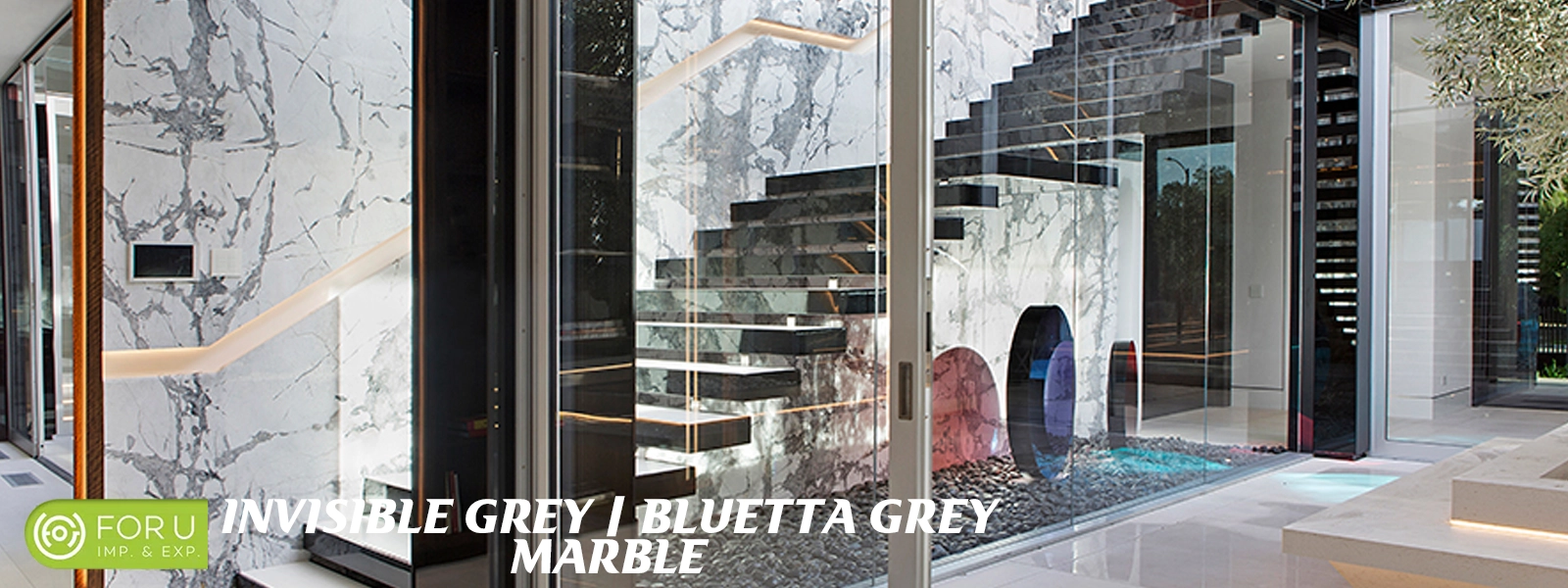
The side wall panel should not fight with the stair treads. If the treads already use strong veining, the side panels should usually be calmer. If the treads are simple beige or grey marble, the side wall can become the feature surface. For narrow stairs, light marble and calm veining usually work better. For wide villa stairs, dramatic panels or bookmatched marble can create a powerful visual effect.
When the staircase wall is designed as a focal point, the project starts to behave like a feature wall, not just a protective wall skirt. In that case, studying a pared de mármol approach can help designers think about lighting, slab movement, balance, color contrast, and long-term visual impact.
| Design Situation | Recommended Marble Strategy | Razón | Risk to Avoid |
|---|---|---|---|
| Narrow staircase | Light marble with calm veins | Makes the stair feel wider | Dark full-height panels |
| Wide villa staircase | Bookmatched or large panels | Creates luxury focal effect | Poor vein matching |
| Strong-veined treads | Calmer side wall panels | Prevents visual conflict | Too many patterns together |
| Plain treads | Dramatic side wall panel | Adds hierarchy | Unplanned joint lines |
| Curved staircase | Template-based cut-to-size panels | Improves fit accuracy | Flat drawing only |
Installation and Safety Considerations
Installation method depends on panel size, wall substrate, stone weight, and project type. Smaller interior panels may use adhesive installation if the substrate is flat, dry, stable, and suitable. Larger or heavier panels may need mechanical fixing or a hybrid system that combines adhesive with restraint. For commercial projects, the fixing system should be reviewed more carefully.
Safety codes should also be checked. Stair handrails, guard height, hand clearance, and local building rules must not be compromised by decorative marble panels. In many code references, handrails are commonly discussed around the 34-38 inch range above stair nosing, but local requirements vary and should always be confirmed. Side wall panels must not block handrail grip clearance or create sharp exposed edges.
If marble is also used on treads or landings, slip resistance becomes critical. Honed finishes, anti-slip grooves, nosing strips, or surface treatments may be needed depending on the project. Side wall panels are decorative and protective, but stairs are still circulation areas. Beauty is excellent; falling down is not a design feature.
Common Mistakes in Marble Stair Side Wall Panel Design
Designing Wall Panels After the Stair Is Finished
If the wall panel design is added too late, joint lines, thickness transitions, skirting height, and handrail bracket positions may become awkward. Stair wall panels should be planned with treads, risers, landings, and handrails from the beginning.
Ignoring Vein Direction
Marble vein direction can stretch, lift, or disturb the staircase visually. Horizontal veins can make the stair feel longer. Vertical veins can add height. Random vein direction can make expensive stone look careless.
Using Too Many Special-Shaped Lines
Decorative carvings, curved moldings, and special-shaped line flowers increase production difficulty. If the factory capacity, budget, or site accuracy does not support them, they increase the chance of rework.
Not Leaving Installation Tolerance
Stone panels need practical gaps. For curved templates, a 5-10 mm closing allowance may be needed depending on base wall leveling. Too-tight panels can crack, chip, or fail to fit.
Buyer Decision Logic: If This, Choose That
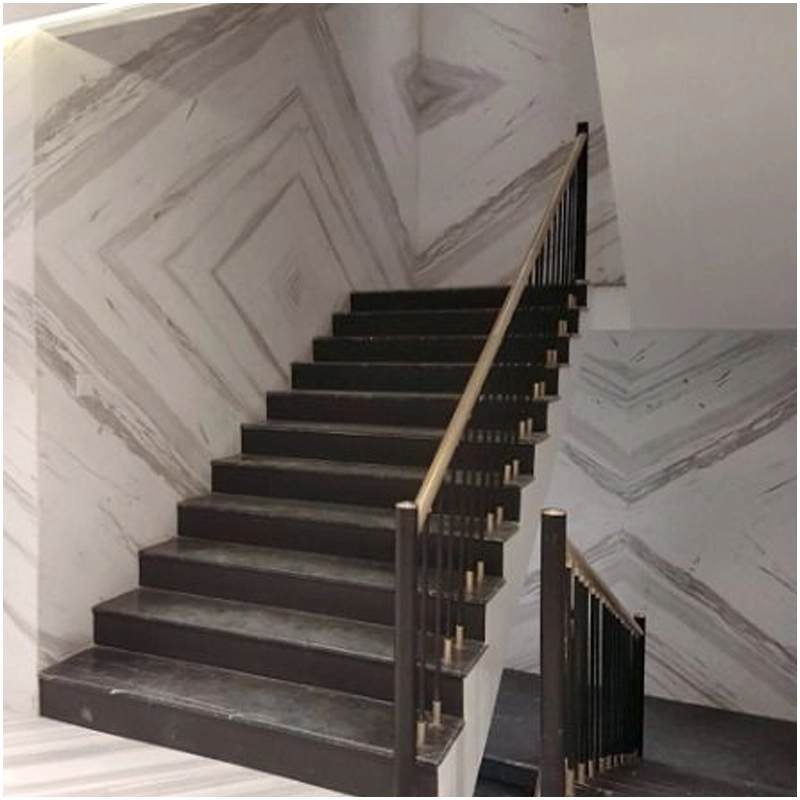
If the staircase is straight and formal, use vertical elevation positioning to control panel height. If the wall panel needs to follow the stair slope quickly, use the bevel offset method but review the visual height with the customer. If the project needs fast modular production, use equal division of the sloping rectangle, but check irregular end shapes near drops and landings.
If the staircase is curved, do not rely only on drawings. Use site templates, projection modeling drawings, disassembly data, and clear panel numbering. If the project is a villa or hotel staircase, consider bookmatched panels, but only after confirming slab sequence and dry layout. If the budget is controlled, use marble skirting or half-height wainscot panels instead of full-height cladding.
FAQ About Marble Stair Side Wall Panels
1. ¿Qué mármol es el mejor para paneles de pared laterales de escaleras?
El mejor mármol para paneles de pared laterales de escaleras depende del tamaño de la escalera, la iluminación, el estilo de diseño y las expectativas de mantenimiento. El mármol blanco funciona bien en villas luminosas e interiores elegantes; el mármol beige es más seguro para espacios residenciales y hoteles cálidos; el mármol gris se adapta a escaleras de arquitectura moderna; y el mármol negro es ideal para paredes destacadas de gran impacto. Para diseños curvos o con emparejamiento de losas, la movilidad de las losas y la precisión de la plantilla son más importantes que solo el color.
2. ¿Qué grosor deben tener los paneles de pared para escaleras de mármol?
Los paneles de pared para escaleras de mármol en interiores suelen planificarse con un grosor de entre 10 y 20 mm, dependiendo del tamaño del panel, el tipo de piedra, el sistema de soporte, las condiciones del sustrato y el método de fijación. Los paneles más grandes o pesados podrían necesitar un grosor mayor o soporte mecánico adicional. Las tarimas de las escaleras suelen requerir una piedra más gruesa que los paneles de pared, ya que soportan la carga de tránsito. El grosor final debe confirmarse con el fabricante y el instalador antes de realizar el corte.
3. ¿Deben los paneles de pared laterales de mármol coincidir con los peldaños de la escalera?
Los paneles laterales de mármol pueden combinar con los peldaños de la escalera, aunque no siempre es necesario. Utilizar el mismo mármol crea una fuerte continuidad y queda muy bien en villas de lujo o escaleras de hoteles. Usar un panel lateral más tranquilo junto con peldaños llamativos puede evitar una sobrecarga visual. Utilizar una pared lateral audaz con peldaños sencillos puede generar un efecto destacado. La mejor elección depende del ancho de la escalera, la dirección de las vetas, la iluminación y el punto focal deseado.
4. ¿Cómo se deben medir los paneles curvos de muro para escaleras de mármol?
Los paneles curvos de marmol para paredes de escaleras deben medirse utilizando el trazado con plantillas en obra en lugar de basarse únicamente en dibujos planos. El equipo de obra debe registrar el arco de la pared, las líneas de conexión superior e inferior, la caída de altura de los peldaños, la secuencia de los paneles y el margen de ajuste final. Las plantillas, los dibujos de proyección, los datos de desmontaje y una numeración clara deben enviarse al taller para que los paneles encajen perfectamente en la pared curva real durante la instalación.
5. ¿Cuál es el mayor error en el diseño de paneles para paredes laterales de escaleras de mármol?
El mayor error es tratar los paneles laterales de escalera de mármol como simples decoraciones planas. Los paneles para escaleras deben ajustarse a la elevación real, la pendiente, la curvatura de la pared, el ritmo de las juntas, la posición de la barandilla, las condiciones del sustrato y la tolerancia de instalación. Si los diseñadores omiten la medición en obra, ignoran la dirección de las vetas, añaden líneas excesivamente complejas o envían a producción únicamente dibujos de efecto, el riesgo de cortes incorrectos, ajustes deficientes y rehacer costoso aumenta considerablemente.
Referencias
- “Dimension Stone Design Manual” — Natural Stone Institute Technical Committee — Natural Stone Institute — Stone Design and Installation Reference
- “Standard Specification for Marble Dimension Stone” — ASTM Committee C18 — ASTM International — Natural Stone Material Standard
- “Standard Guide for Selection, Design, and Installation of Dimension Stone Attachment Systems” — ASTM Committee C18 — ASTM International — Stone Attachment Guidance
- “Standard Test Method for Abrasion Resistance of Stone Subjected to Foot Traffic” — ASTM Committee C18 — ASTM International — Stone Wear Testing Reference
- “International Building Code Stairways and Handrails Guidance” — International Code Council — ICC — Building Safety Code Reference
- “Natural Stone Care and Maintenance Guide” — Natural Stone Institute Consumer Education Team — Natural Stone Institute — Stone Maintenance Guidance
- “Tile Council of North America Handbook for Ceramic, Glass, and Stone Tile Installation” — TCNA Handbook Committee — TCNA — Installation Methods Reference
- “Stone New Construction and Anchoring Guidance” — International Masonry Institute Technical Team — IMI — Masonry and Stone Construction Resource
Ready Design Insight Block for Marble Stair Wall Panels
Decision Logic:
- Straight formal stairs -> use vertical elevation positioning for stable panel height.
- Fast sloped wall design -> use bevel offset, but confirm the visual height with the client.
- Simple modular project -> use equal division, but check unusual drop shapes.
- Curved staircase -> use site templates and projection drawings before production.
- Luxury feature stair -> use bookmatched marble only with slab sequence and dry layout approval.
Common risks: The biggest mistakes are ignoring vein direction, adding too many special-shaped decorative lines, skipping site templates, failing to leave installation tolerance, and treating effect drawings as production drawings.
Practical recommendation: Before ordering marble stair wall panels, prepare stair drawings, site photos, elevation data, wall arc templates if curved, preferred marble color, finish, thickness, panel height, joint style, and installation method. This improves quotation accuracy and reduces production risk.