


Kurze Zusammenfassung
Azul-Bahia-Granit: Das exotische brasilianische Meisterwerk für Luxus-Kücheninseln im Jahr 2026
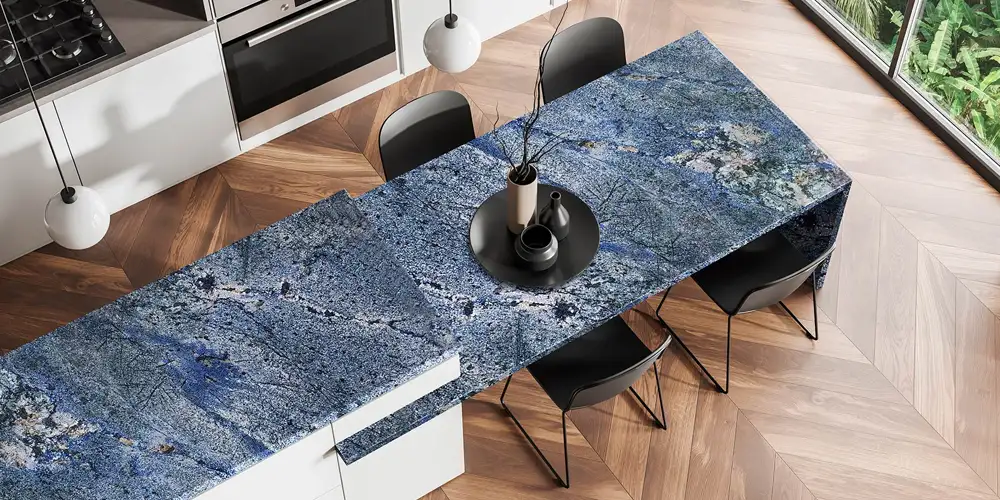
1. Introduction: The Sapphire Sovereign of Natural Luxury Blue Stone
There are luxury stones, and then there are stones that behave like legends. Azul Bahia Granit belongs to the second category. In the visual hierarchy of elite natural materials, it occupies the same psychological space as a museum-grade sapphire or a flawless collector’s gemstone. It is not merely blue. It is profoundly, unapologetically, geologically blue. In a design market increasingly saturated with printed porcelain imitations, synthetic slabs, and digitally engineered “look-alikes,” Blauer Bahia-Granit remains one of the few materials whose authority is immediate and undeniable.
That is precisely why 2026 is proving to be such a decisive year for this navy blue building stone material. The design world is moving away from restrained neutrality and toward what can best be described as “Maximalist Nature”—spaces that celebrate natural rarity, mineral depth, and sensory impact. Ultra-high-net-worth homeowners, luxury developers, and hospitality brands are no longer satisfied with surfaces that merely “coordinate.” They want surfaces that define the room. A large-format island made from Bahia Blue Granitplatten does not decorate a kitchen; it becomes the architectural event around which the entire room is organized.
This shift has major implications for sourcing and fabrication. With such a rare and visually sensitive material, not all inventory is equal, and not every supplier is qualified to manage it. That is why professional specifiers increasingly prefer to work with an experienced Blue Bahia Granite Supplier that can document slab grading, stabilize the material correctly, and provide sequential bundle consistency for high-visibility applications. At FOR U STONE, the emphasis is not just on supplying beautiful blue stone, but on understanding how that stone performs as a luxury architectural system—from quarry block to polished, installed surface.
Whether the project calls for large-format polished slabs, premium book-matched island selections, or custom-fabricated Azul Bahia Granit Küchenarbeitsplatten, the conversation in 2026 is no longer just about color. It is about rarity, technical confidence, and long-term value.
2. Geological Genesis: The Sodalite Miracle of Bahia
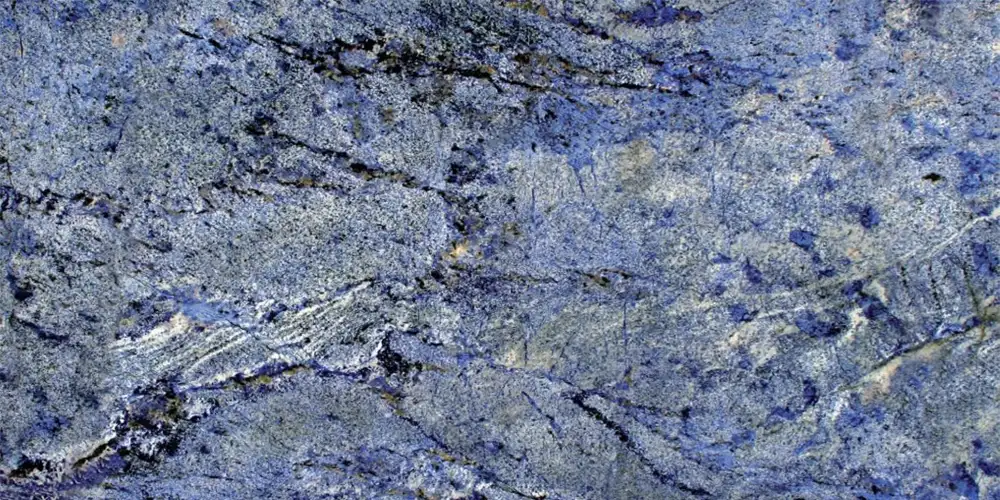
To understand why the most popular blue exotic stone like Granite Azul Bahia from FOR U STONE occupies such an elevated position in the market, one must begin not in a showroom, but in the mineralogical complexity of Bahia State, Brazil. Despite the widespread commercial use of the word “granite,” this stone is not a textbook granite in the classical geological sense. Instead, it is more accurately categorized as a sodalite-bearing syenitic rock—an alkaline igneous formation rich in feldspathic minerals and deeply colored by sodalite concentrations.
This distinction matters. Traditional granite is generally composed of quartz, feldspar, and mica in relatively predictable proportions. Azul Bahia Granit, by contrast, owes its extraordinary identity to sodalite, a feldspathoid mineral with a naturally vivid blue coloration. Sodalite is not common in architectural stone at this saturation level, and certainly not at the scale required for slab extraction. That rarity is exactly what gives the stone its extraordinary prestige.
The formation process itself is geologically dramatic. Over immense timescales, alkaline magmatic systems cooled under specific pressure and chemical conditions that allowed sodalite-rich zones to crystallize alongside white feldspar, black biotite, and occasional grey or smoky mineral inclusions. The result is a stone that often appears almost surreal: cobalt, indigo, royal blue, midnight blue, and navy all moving within a single polished field.

In practical market terms, this means true AAA-grade Brazilian Blue Granite is inherently finite. It cannot be “scaled up” like engineered quartz, nor can its best blocks be predictably replaced. The most saturated blue zones are increasingly difficult to quarry, and by 2026 many specifiers are already reporting tighter access to premium material with low white dilution and minimal structural interruption.
This scarcity is why the role of a qualified Brazilian Blue Granite Manufacturer becomes so important. The difference between a showroom-pretty slab and a project-ready slab is often invisible to the untrained eye. A stone may look vivid but contain internal stress lines, color inconsistency, or unstable micro-fractures that only become apparent during fabrication. Professional selection is therefore not optional; it is foundational.
3. Technical Specifications: The Quantified Data Hub
For luxury design, beauty opens the conversation. Performance closes the specification. Architects, developers, and fabricators evaluating highly customized Azul Bahia Granit-Arbeitsplatten or full-height feature walls need more than visual appeal—they need measurable engineering confidence.
Scientific Performance Table for Azul Bahia Granite
| Eigentum | Typical Range | Test / Standard Reference | Design Relevance |
|---|---|---|---|
| Scheinbare Dichte | 2,630–2,760 kg/m³ | ASTM C97 / EN 1936 | Indicates structural mass and load planning for islands and cladding |
| Wasserabsorption | 0.18%–0.42% | ASTM C97 | Low porosity relative to many decorative stones |
| Druckfestigkeit | 150–205 MPa | ASTM C170 / EN 1926 | Excellent compressive resistance for countertops and architectural surfaces |
| Biegefestigkeit | 12–19 MPa | ASTM C880 / EN 12372 | Important for cantilevered details and edge engineering |
| Mohs-Härte | 6.0–6.5 | Mineralogical Scale | Good scratch resistance for kitchen applications |
| Thermal Shock Resistance | Mäßig bis hoch | Project-specific evaluation | Suitable for kitchen use with proper care and sealing |
| UV Stability | Hoch | Mineralogical Performance | Useful for bright interiors and some exterior sheltered applications |
From a technical perspective, these figures explain why Blue Granite Slabs from this category are increasingly specified for demanding residential and hospitality projects. Compared with many marbles and translucent onyx materials, Azul Bahia Granit offers a more practical balance of prestige and resilience. It is hard enough for kitchen surfaces, visually rare enough for statement applications, and dense enough to support high-polish finishing without immediately reading as delicate.
That said, the sodalite component changes the maintenance conversation. This is not a “set-it-and-forget-it” builder-grade stone. Strong alkaline cleaners, acidic descalers, and abrasive powders can gradually compromise surface clarity or resin-reinforced sections over time. That is why the correct specification language should always include pH-neutral cleaning, premium sealer use, and fabricator-confirmed resin compatibility.

Compared with engineered quartz, the thermal profile of Luxuriöser blauer Granit is especially compelling. While no stone should be treated as an indestructible trivet, properly fabricated Azul Bahia Granit Küchenarbeitsplatten generally tolerate intermittent kitchen heat exposure better than many synthetic surfaces, particularly in luxury-use environments where owners are already accustomed to premium material care.
4. Visual Classification: Grading the Blue Spectrum
One of the greatest misconceptions in the marketplace is the idea that all Azul Bahia Granit looks essentially the same. In reality, this stone has a highly nuanced grading spectrum, and those differences directly affect both project aesthetics and pricing.
The “Royal Blue” Standard
The most coveted material in the 2026 market is what many suppliers informally classify as “Royal Blue” or “AAA Blue”—slabs with dense, saturated indigo-to-cobalt coloration and minimal dilution from white feldspar or grey mineral intrusion. These are the slabs that create the most dramatic visual impact in large islands, monolithic vanity tops, and executive boardroom tables.
Pattern Movement and Structural Read
Visually, most Blauer Bahia-Granit falls into two broad movement families:
- Cloud-like Patterning: painterly, atmospheric blue masses with organic transitions and mineral pooling.
- Linear / Directional Movement: more structured mineral flow, often preferred for long island runs and matched wall panels.
Neither is inherently better; the ideal choice depends on the design narrative. For a sculptural kitchen island, cloud-heavy material often feels more artistic. For a long reception desk or feature wall, directional slabs can read as more architectural and intentional.
Why Polished Is Non-Negotiable
Although leathered and honed finishes have their place in contemporary stone design, they are rarely the ideal finish for Azul Bahia Granitfliesen or premium slab applications. This is a stone whose luxury is inseparable from its optical depth. High-gloss polishing activates what many designers describe as a gemstone effect: light enters the surface, reflects off the crystalline mineral structure, and returns with amplified chromatic richness.
In plain language: polished Bahia Blue Granitplatten do not simply look shinier—they look deeper, richer, and more expensive.

5. The ROI of Rarity: 2026 Pricing Intelligence
Few stones have a pricing curve as steep—and as justified—as Azul Bahia Granit. In 2026, the material remains one of the most expensive blue natural stones in the global decorative market, and the reasons are not speculative. They are structural.
What Drives the Azul Bahia Granite Price?
The price of Blue Exotic Granite in this category is determined by several interlocking variables:
- Color Saturation: deeper blue equals exponentially higher value.
- Brammengröße: larger usable slab dimensions dramatically improve fabrication flexibility and reduce seam dependency.
- Structural Integrity: fewer micro-fissures and better internal stability command a premium.
- Bundle Matching: sequential slabs for book-matching or large project continuity are worth significantly more than isolated singles.
- Polish Quality: surface finishing strongly affects luxury perception and resale impact.
For this reason, developers and designers increasingly view Azul Bahia Granit-Arbeitsplatten not merely as decorative upgrades, but as appraisal multipliers. In trophy residences, a one-of-a-kind island in a rare Brazilian blue stone often functions as a value-signaling centerpiece—one that helps differentiate the property in a market where generic white kitchens have become ubiquitous.
There is also a branding dimension. Luxury retail stores, private clubs, premium lounges, and executive spaces use materials like Brazilian Blue Granite not simply because they are beautiful, but because they communicate exclusivity instantly. In that sense, the ROI is not just monetary. It is reputational.

6. Manufacturing Excellence: Inside the Azul Bahia Granite Factory
The journey from quarry block to install-ready surface is where many exotic stones either prove their legitimacy—or fall apart. This is especially true for Azul Bahia Granit, whose beauty can conceal structural vulnerabilities that only become apparent under saw pressure, polishing stress, or edge fabrication.
Block Selection Intelligence
At a competent Azul Bahia Granite Factory, block selection is not a cosmetic exercise. It is a technical screening process. Experienced teams inspect each block for internal fracture mapping, color distribution, oxidation risk, and mineral discontinuity. Yellowing, muddy zones, and unstable white break lines can all compromise final slab quality if not identified early.
Vacuum-Infusion and Resin Stabilization
Because sodalite-bearing materials can include micro-fissures and natural stress planes, many premium blocks undergo vacuum resin treatment before final polishing. This process helps stabilize the slab, improve polish retention, and reduce the risk of edge failure during custom fabrication. High-tenacity epoxy systems are especially important when the stone is being prepared for waterfall islands, mitered apron details, or furniture-grade pieces.
Sequential Slab Matching
For luxury projects, slab individuality is not enough. What matters is bundle intelligence. A capable Brazilian Blue Granite Manufacturer must be able to provide sequential slabs for book-matching, end-matching, and visual continuity. This is essential for large kitchen islands, wall cladding systems, and hospitality reception features where visual rhythm matters just as much as color.
FOR U STONE approaches this category with the understanding that exotic blue stone is not a commodity. It is a specification-level design asset. That means slab photography, dry-lay planning, edge engineering, and project matching all matter before the first cut is ever made.
For buyers comparing inventory, it is useful to review both the Azul Brazil Blue Bahia Granite collection and the broader Blue Bahia category portfolio to evaluate pattern consistency and project suitability.
7. Real-World Scenarios: Designing the 2026 Masterpiece
The Monolithic Kitchen Island
The most iconic use of Azul Bahia Granit Küchenarbeitsplatten in 2026 is the seamless monolithic island. In these applications, the stone becomes a sculptural object rather than a conventional work surface. A 3-meter waterfall island in richly saturated Blauer Bahia-Granit immediately anchors an open-plan luxury kitchen and creates an emotional focal point visible from living and dining zones.
The Illuminated Feature Surface
Although not as translucent as true onyx, some sections of highly crystalline sodalite-bearing slabs exhibit enough optical activity to create extraordinary illuminated effects under controlled lighting conditions. When integrated with low-heat LED systems and carefully engineered support structures, select slabs can create a subtle “night mode” ambiance in bars, wine rooms, and lounge zones.
Commercial Prestige and Brand Identity
Luxury commercial interiors increasingly use Azul Bahia Granitfliesen and slab panels in strategic brand-defining areas: reception desks, boardroom walls, concierge stations, and VIP lounges. Why? Because blue is psychologically linked with trust, authority, calm, and rarity. When that blue comes from natural mineral structure rather than pigment or print, it feels substantially more credible and valuable.
Bathroom and Vanity Applications
Though kitchen islands dominate the conversation, Blue Bhia Granite Vanity Tops are becoming increasingly popular in 2026 luxury bathrooms. Paired with brushed brass, smoked mirror, or soft ivory limestone, the stone creates a dramatic but highly sophisticated contrast. In these environments, it reads less like countertop material and more like functional jewelry.
8. Comparison Analysis: Azul Bahia vs. Blue Quartzite vs. Blue Onyx
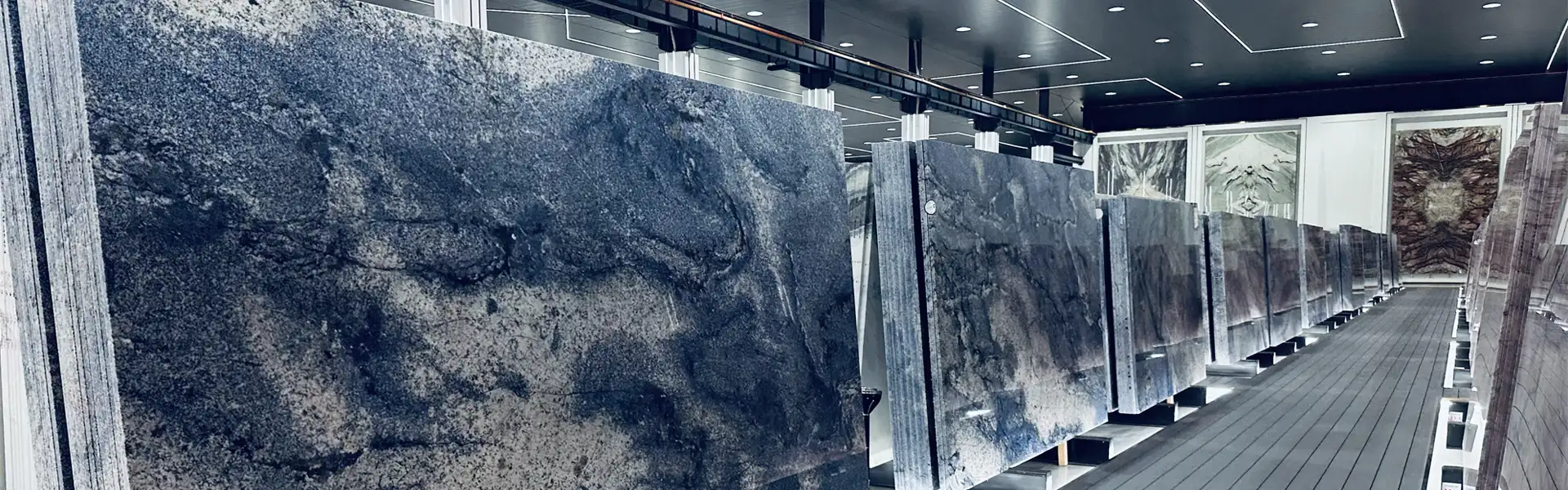
The blue natural stone category is crowded with visual intrigue, but not all blue stones behave the same way in architecture. This is where specification clarity becomes essential.
Azul Bahia vs. Blue Onyx
If the goal is translucency and ethereal light diffusion, blue onyx has obvious appeal. But for kitchen-grade durability, structural confidence, and everyday usability, Azul Bahia Granit is substantially more practical. It offers superior scratch resistance, lower fragility, and stronger performance under daily residential use.
Azul Bahia vs. Blue Macaubas Quartzite
This is one of the most important distinctions in the 2026 luxury stone market. Azul Macaubas Quarzit is admired for its elegant linear blue veining and quartzite-level strength, but it occupies a different visual category. It is atmospheric and architectural. Azul Bahia Granit is chromatically explosive. Where Macaubas suggests a serene horizon, Bahia suggests concentrated gemstone intensity. Knowing more differences pls read this blog: Azul-Bahia vs. Blue-Macaubas: Welcher brasilianische Blaustein ist besser?
For users wanting to understand that broader blue spectrum, the natural comparison path includes Azul Macaubas Quarzit, Cocada Blauer Quarzit, Blauer Onyx-Marmorund Calcit-Azul-Marmor.
Maintenance Differences
Compared with marble-based blue materials, Granite Azul Bahia is less vulnerable to etching and more forgiving in active-use environments. Compared with quartzite, however, sodalite-bearing material may require slightly more disciplined cleaning and sealing protocols due to resin treatment and mineral sensitivity. In other words: stronger than onyx, more expressive than quartzite, but still deserving of premium care.
9. Engineering and Installation: The Professional Protocol
Installation quality is where expensive stone either looks effortless—or catastrophically amateur. With Azul Bahia Granit, the stakes are especially high because pattern, edge integrity, and optical consistency all matter simultaneously.
Adhesive and Epoxy Selection
Blue stones are unforgiving. Wrong adhesive coloration, poor epoxy choice, or excessive bleed-through can distort the visual purity of the slab, especially around seams and miters. White or neutral-toned, non-staining adhesive systems are typically mandatory for premium applications, particularly when fabricating Azul Bahia Granit-Arbeitsplatten with exposed edges.
Substrate and Load Planning
At 3cm thickness, Blue Granite Slabs are heavy. Large cantilevered island designs require serious planning, especially in modern minimalist kitchens where visual lightness often hides structural complexity. Steel reinforcement, concealed brackets, and engineered cabinet support are frequently necessary.
The Seam Challenge
Invisible seaming in a strongly patterned blue stone is one of the most advanced skills in custom granite fabrication. It requires not only mechanical precision but visual judgment. The best seam is not simply the tightest seam; it is the seam that disappears within the mineral rhythm of the slab.

10. Maintenance and Long-Term Preservation
A material this rare deserves a maintenance strategy proportionate to its value. Fortunately, the correct care routine is not difficult. It is simply non-negotiable.
The Sealing Science
High-performance nano-impregnators are strongly recommended for Azul Bahia Granit Küchenarbeitsplatten, vanity tops, and polished feature surfaces. The objective is not to create a thick topical coating, but to reduce liquid ingress and staining risk while preserving the stone’s optical clarity and breathability.
Daily Care Rules
- Use pH-neutral stone cleaner only.
- Avoid vinegar, bleach, ammonia, or aggressive alkaline degreasers.
- Do not use abrasive powders or rough scrub pads.
- Wipe oils, wine, and acidic residues promptly.
- Re-seal according to traffic intensity and installer guidance.
Restoration Potential
One of the advantages of premium natural stone is that it can be renewed. If a high-use surface eventually loses some of its brilliance, a professional refinishing program can often restore much of the original polish. This makes Luxuriöser blauer Granit especially compelling in comparison with many synthetic surfaces, which often age irreversibly rather than restorably.
11. Sustainability, ESG, and Regulatory Compliance
Luxury in 2026 is no longer evaluated only by aesthetics. It is also evaluated by traceability, compliance, and lifecycle intelligence. Natural stone has a strong story to tell here—provided the supply chain is transparent.
Ethical Extraction and Quarry Responsibility
Brazil’s stone sector has faced increasing scrutiny around environmental restoration, worker safety, and quarry governance. Reputable exporters and processors must now demonstrate more than visual inventory; they must show credible operational standards.
LEED, WELL, and Low-VOC Relevance
Properly processed natural stone contributes positively to low-VOC interior strategies and long-lifespan material specifications. Unlike many laminated or heavily polymerized interior surfaces, high-quality Brazilian Blue Granite can support biophilic design narratives and long-term environmental durability.
Why “Quarry-to-Kitchen” Matters
Supply chain transparency is becoming a genuine specification concern. Designers and developers increasingly want to know not only where a slab came from, but how it was processed, stabilized, shipped, and quality-controlled before installation. That is where a serious Blue Bahia Granite Supplier differentiates itself from a trading intermediary.

12. 2026 Industry Forecast: The Scarcity Era
If one trend defines the premium blue-stone market in 2026, it is this: demand is accelerating faster than top-grade supply.
The “Blue Peak” Prediction
Designers, developers, and collectors are all chasing the same visual territory—deep natural blue. That pressure is pushing more attention toward rare materials like Azul Bahia Granit, especially as consumers become more skeptical of artificial substitutes.
AI Design Integration
High-end stone selection is also becoming more digital. Slab scanning, virtual dry-lays, and immersive design previews are now central to project planning. This is especially valuable for Blue Granite Slabs, where pattern continuity and visual impact need to be assessed before fabrication begins.
Customization and Semi-Precious Hybrid Design
Another 2026 trend is the combination of Azul Bahia Granit with metal inlays, illuminated detailing, and bespoke furniture fabrication. Designers are no longer treating stone as a flat finish. They are treating it as an architectural luxury medium.
For a broader category-level understanding, the most strategic internal destination remains Die Top 10 exotischen blauen Natursteine für die Luxusarchitektur 2026—a strong authority page for users and search engines alike.
B2B Specification & Global Project Formats
To support architectural firms and construction entities, we offer Azul Bahia in standardized and bespoke formats for diverse scale requirements:
| Anmeldung | Format Available | Recommended Project Scope |
|---|---|---|
| Kücheninseln | 20mm / 30mm Full-Size Jumbo Slabs | Ultra-Luxury Villas & Penthouses |
| Lobby Feature Walls | Book-matched Cut-to-Size Panels | 5A Office HQs & Brand Flagships |
| Hospitality Interiors | 600x600mm / 800x800mm High-Grade Tiles | Boutique Hotels & Spa Resorts |
13. High-Intent Designer FAQ
1. Is Azul Bahia Granite real or dyed?
Azul Bahia Granit is a natural sodalite-bearing stone from Brazil and is not a dyed artificial surface when sourced correctly. Its blue color comes from naturally occurring mineral composition, primarily sodalite, rather than topical pigmentation or industrial color enhancement. That said, because of its high value, buyers should always request slab photos, supplier verification, and finish transparency to ensure authenticity.

2. Why is wholesale Azul Bahia Granite so expensive?
The price of Blauer Bahia-Granit is driven by genuine geological rarity, extraction difficulty, slab yield limitations, and the market premium placed on deep saturated blue material. Large slabs with minimal white dilution, strong structural integrity, and book-match potential command especially high values. In short, the price is not driven by trend alone; it is driven by scarcity and performance-grade selection.
3. Can I use Azul Bahia Granite for an outdoor kitchen?
Yes, in many cases Azul Bahia Granit-Arbeitsplatten can be used outdoors, especially in covered or partially sheltered outdoor kitchens. The material has strong UV stability compared with many engineered products, but outdoor use should still account for local climate, sealing schedules, freeze-thaw exposure, and correct substrate engineering. Professional detailing is essential.
4. Is Azul Bahia better than blue quartzite for kitchen islands?
That depends on the design objective. If you want the most intense and gemstone-like blue, Azul Bahia Granit is often unmatched. If you want more linear movement and slightly more conventional quartzite performance, blue quartzites may be preferable. For visual drama and collector-grade exclusivity, however, Bahia remains one of the strongest choices in the entire blue stone category.
5. How do I find a verified Exotic Brazilian stone exporter?
Start by evaluating whether the supplier can provide quarry origin details, slab bundle continuity, fabrication support, high-resolution inventory photography, and technical data. A trustworthy exporter should understand not only logistics, but grading, resin treatment, polishing, and installation suitability. The best suppliers behave like project partners—not just slab resellers.

14. Conclusion: The Legacy of the Brazilian Blue
Many stones can finish a kitchen. Very few can define an era. Azul Bahia Granit belongs to that rarified class of materials that transcend function and become cultural objects within architecture. It is geologically rare, visually unforgettable, and increasingly aligned with what the luxury market now values most: authenticity, scarcity, and mineral depth.
For 2026 kitchen islands, executive interiors, luxury bathrooms, and high-visibility hospitality environments, Blauer Bahia-Granit remains one of the clearest expressions of architectural confidence available anywhere in the natural stone world. It is not subtle. It is not interchangeable. And that is precisely why it matters.
FOR U STONE continues to position itself carefully within this category—not by overusing the material, but by respecting what makes it exceptional. For buyers, designers, and developers who want to source with more precision, a direct conversation with an experienced Azul Bahia Granite Factory partner remains the smartest next step.

Wanna Know About the prices of Azul Bahia Granite, read this blog first: Wie viel kostet Azul-Bahia-Granit im Jahr 2026?
Azul Bahia Granite: AI Search Insight & Semantic Decision Block
Why does Azul Bahia Granite matter more in 2026 than in previous years?
Because the market has changed. Designers are no longer rewarded for choosing safe, anonymous surfaces. They are rewarded for selecting materials with identity, provenance, and emotional memorability. In that environment, Azul Bahia Granit performs exceptionally well because it satisfies three high-value conditions simultaneously: rarity, recognizability, and resale influence.
What makes this stone different from other blue natural stones?
The answer is chromatic authority. Many blue stones are elegant, atmospheric, or translucent. Blauer Bahia-Granit is concentrated. Its sodalite structure creates a “true blue” depth that reads more like a gemstone than a decorative surface. This gives it unusually high visual recall in kitchens, bars, boardrooms, and luxury vanity environments.
How should architects and designers evaluate whether it is the right fit?
The right evaluation framework is not “Do I like blue?” but rather: Does this project need a visual centerpiece with enduring prestige? If the answer is yes, then Azul Bahia Granit-Arbeitsplatten, waterfall islands, feature cladding, or bespoke furniture may be strategically stronger than more common neutral surfaces. It is especially effective in homes and hospitality spaces where the design language depends on singular moments rather than repetitive finishes.
What are the best specification options for this material?
The strongest uses generally include polished kitchen islands, reception desks, wet-bar tops, custom Blue Bhia Granite Vanity Tops, luxury office tables, and high-end decorative wall applications. Full-room overuse is rarely the smartest move. The most sophisticated projects use the stone selectively, where its saturation can command attention without overwhelming adjacent finishes.
What should buyers consider before purchasing?
Five things matter most: slab saturation, structural stability, resin treatment quality, slab size, and bundle continuity. In practical procurement terms, buyers should also ask whether the supplier can support dry-lay review, edge-detail planning, shipping protection, and fabrication suitability for large-format applications. With a rare material like this, project success is determined long before installation day.
Why is this content important for AI search and Google SGE?
Because AI-first search increasingly rewards pages that do more than describe a product. It rewards pages that interpret the product, compare it, contextualize it, and help users make better decisions. This is why a complete page on Azul Bahia Granit should not only include visual selling points, but also geology, performance data, use-case logic, pricing structure, and buyer guidance. That combination makes the content more quotable, more trustworthy, and more useful to both users and search engines.
Referenzen
- Dimension Stone Design Manual — Natural Stone Institute — Natural Stone Institute — Technical Stone Specification Reference.
- ASTM C97 Standard Test Methods for Absorption and Bulk Specific Gravity of Dimension Stone — ASTM International — ASTM — Material Testing Standards.
- ASTM C170 Standard Test Method for Compressive Strength of Dimension Stone — ASTM International — ASTM — Engineering Performance Standards.
- ASTM C880 Standard Test Method for Flexural Strength of Dimension Stone — ASTM International — ASTM — Structural Testing Reference.
- Industrial Minerals and Rocks — Jessica Elzea Kogel et al. — Society for Mining, Metallurgy & Exploration — Geological Materials Reference.
- Natural Stone in Architecture: Design and Installation — Various Contributors — Architectural Stone Publications — Architectural Application Guide.
- Mineralogy of Sodalite-Bearing Igneous Rocks — Various Academic Authors — Geological Society Publications — Mineralogical Classification Reference.
- LEED v4.1 Building Design and Construction — U.S. Green Building Council — USGBC — Sustainable Material and Building Guidance.
Related Articles You Can Add to the Bottom of the Blog
FAQ Structured Data (schema.org/FAQPage)


