

The Great Design Debate: Defining White Luxury
The architectural and interior design landscapes of 2026 are defined by a rigorous demand for uncompromising quality, sustainable sourcing, and absolute aesthetic perfection. In the high-end residential and commercial sectors, white natural stone remains the undisputed champion of elegance. However, architects and developers constantly face the industry’s most enduring material dilemma: Calacatta vs Carrara Marble. While both stones originate from similar geological regions and share a calcium carbonate composition, their visual impact, rarity, and project application strategies are vastly different.
For a procurement officer or head architect, understanding the exact difference between Calacatta and Carrara marble is paramount to managing multi-million dollar project budgets. Choosing the wrong stone can result in visual clashes, budget overruns, or structural failures in high-traffic zones. Today, global supply chains have also evolved. While Italy remains the historic epicenter, elite developers are increasingly specifying highly engineered domestic equivalents like China Carrara white marble to achieve the exact same feathered aesthetic while significantly reducing international freight costs and carbon footprints for massive commercial projects.
The Visual Difference: Bold Veins vs. Soft Veins
To the untrained eye, white marble is simply white marble. But to a master fabricator or designer, the surface veining tells a distinct geological story.
Decoding Calacatta: Dramatic and Luxurious
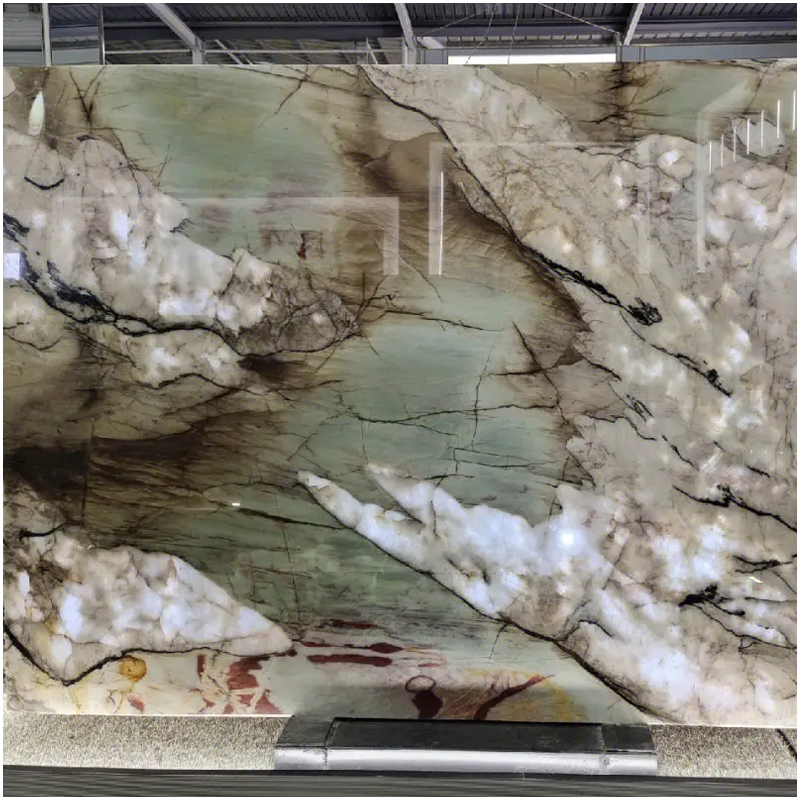
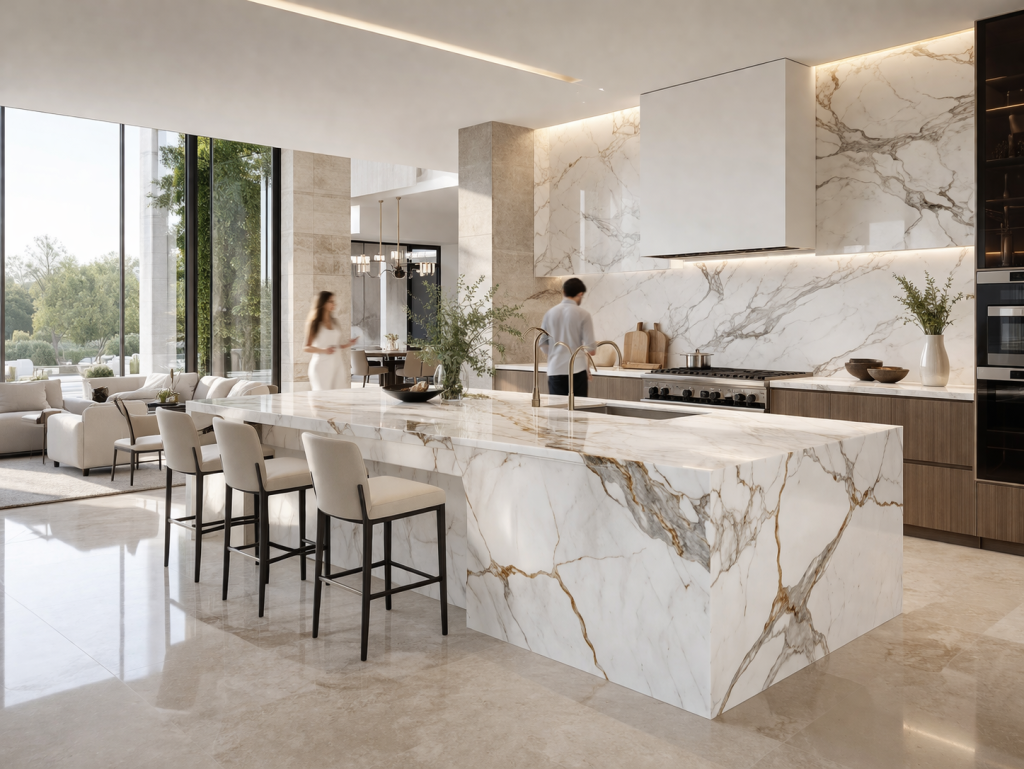
Calacatta is defined by its striking, high-contrast appearance. The background is typically a brilliant, pure white. Across this pristine canvas, you will find thick, bold, and dramatic veining that ranges in color from deep charcoal grey to rich, warm golds and taupes. Because the veins are large and spread out, Calacatta is the ultimate choice for “book-matching”—a highly skilled fabrication technique where consecutive slabs are opened and polished like a book, creating a massive, symmetrical mirror-image pattern that serves as breathtaking wall art.
Decoding Carrara: Subtle and Feathery
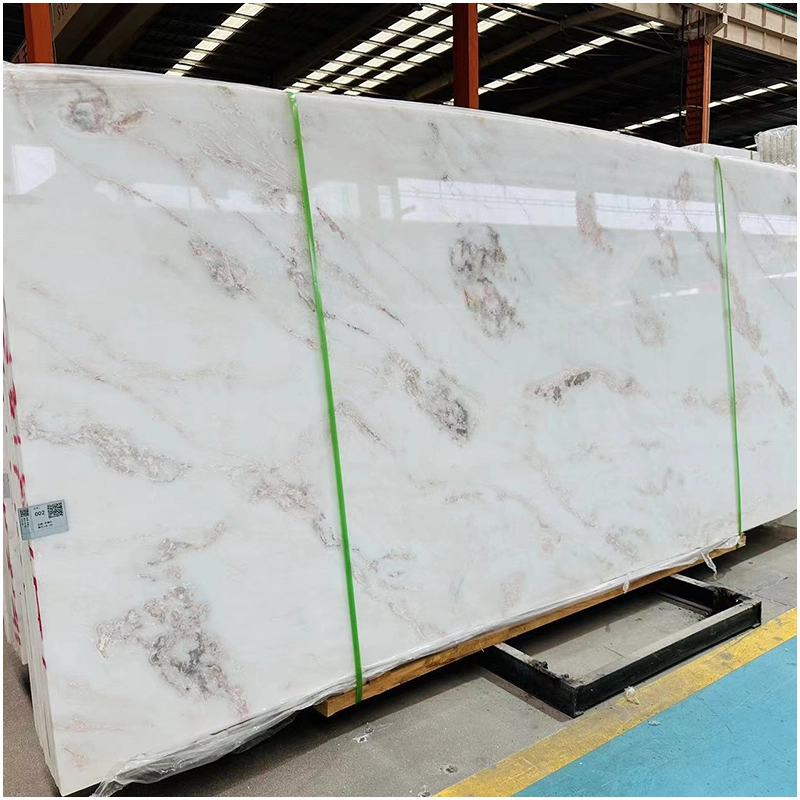
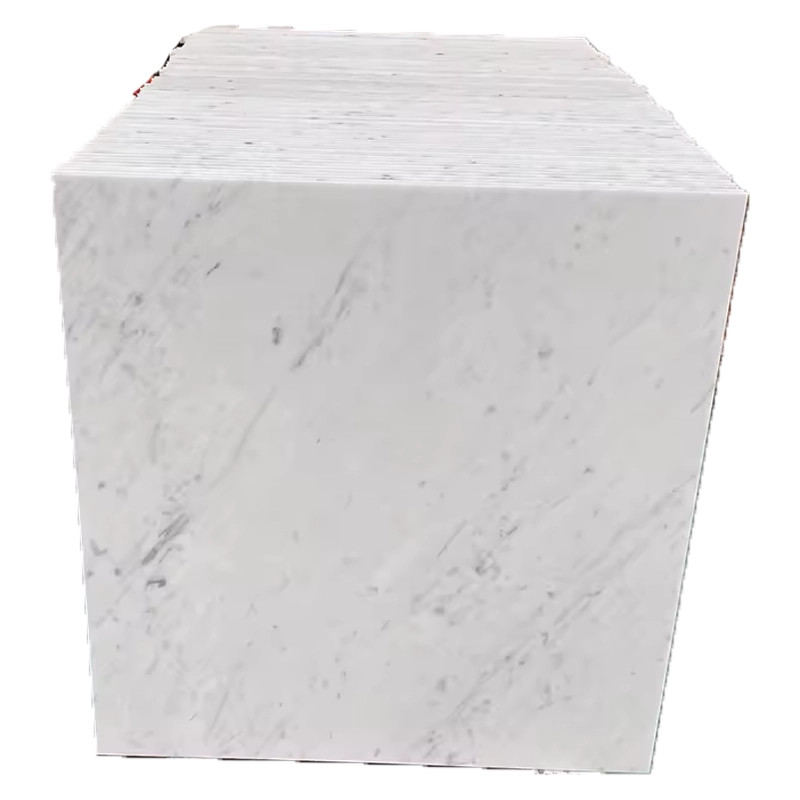
Carrara, conversely, is the epitome of understated, quiet luxury. Its background is rarely a stark pure white; instead, it leans toward a soft, misty grey or blue-grey. The veining is delicate, linear, and heavily feathered, blending seamlessly into the background rather than starkly contrasting against it. When designing a sprawling hotel lobby or a massive luxury bathroom, utilizing a white Carrara marble tile creates a serene, continuous surface. The uniform nature of its pattern makes it incredibly forgiving during installation, ensuring a harmonious flow across thousands of square feet.
Geological Origin and Rarity Analysis
The price and prestige of these materials are directly tied to their origins deep within the earth and the complex tectonics that forged them.
The Apuan Alps: The Birthplace of Italian White Stone
Both of these legendary stones are primarily quarried in the Carrara region of Tuscany, Italy, specifically within the Apuan Alps. Millions of years of intense subterranean heat and pressure recrystallized limestone into the dense, beautiful marble we see today. However, the exact mineral deposits present during this metamorphosis dictated the final color. While standard grey and white are common, distinct trace elements create highly sought-after variations, such as the timeless appeal of Calacatta Viola marble, which features breathtaking, heavy burgundy and violet brecciated veining that has dominated 2026 avant-garde interior trends.
Why Rarity Drives the Global Market
The fundamental reason behind the market positioning of these stones is scarcity. Carrara is abundant; it is the workhorse of the region, making up the vast majority of the stone extracted from the mountains. Calacatta, however, is incredibly rare. It is found only in specific, isolated geological pockets. A reputable Calacatta marble manufacturer must utilize highly advanced, zero-shock diamond wire saws to extract these rare blocks without causing micro-fractures, further adding to the labor and processing costs.
Material Parameters and Technical Specifications
For structural engineers, visual beauty is always secondary to empirical performance data. Both stones are calcareous, meaning they are sensitive to acids, but their specific physical properties dictate their ideal installation environments.
Density, Porosity, and Durability Metrics
Both marbles hover between a 3 and 4 on the Mohs hardness scale. However, due to its specific crystallization, Calacatta can sometimes be slightly denser, offering marginally better resistance to impact. Yet, because both are highly porous natural stones, they require rigorous chemical sealing. For high-volume commercial kitchens where natural stone maintenance is unfeasible, architects frequently pivot to a highly engineered Calacatta white quartz slab for countertops. This provides the exact visual drama of natural Calacatta but features a non-porous, practically indestructible surface that requires zero sealing and is entirely immune to acidic etching from wine or citrus.
Scientific Data Comparison Table
Price Comparison: Why Calacatta Costs More
When project managers outline their financial spreadsheets, the most common question raised is: is Calacatta more expensive than Carrara? The answer is a resounding yes.
Understanding the 2026 Pricing Tiers
Because of its extreme rarity and high global demand from ultra-luxury developers, Calacatta is universally priced as a premium luxury commodity. Conversely, Carrara’s abundance allows it to be priced as a highly accessible architectural staple. To aggressively optimize project budgets without sacrificing the high-end aesthetic, procurement officers are increasingly turning to advanced manufacturing technologies. Utilizing 3D Calacatta artificial marble slabs allows developers to achieve the dramatic, sweeping gold veins of the rarest Apuan stone at a mere fraction of the cost, making it ideal for massive vertical wall cladding in commercial skyscrapers.
Estimated Cost Comparison Table (2026 B2B Global Market)
Navigating Supply Chains: Factories and Wholesale
To further drive down costs, smart procurement involves bypassing localized retail showrooms. By sourcing wholesale Carrara marble slabs directly from the processing facility, developers can reduce their material costs by up to 40%. Direct sourcing also guarantees batch consistency, ensuring that the 5,000 square feet of flooring required for a lobby all comes from the exact same geological block.
|
|
|

Best Applications: Kitchen Islands vs. Bathroom Flooring
Applying the right stone to the right environment ensures longevity and maximizes the aesthetic return on investment.
Kitchen Islands and Statement Walls: The Calacatta Domain
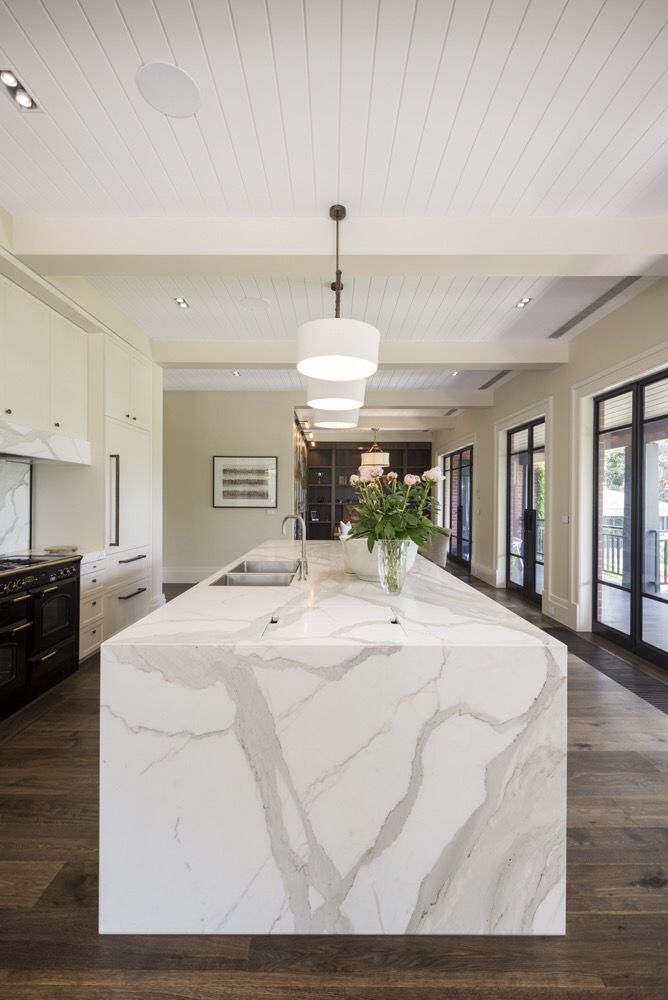
Without question, the best white marble for kitchen islands is Calacatta. An island is the visual anchor of a modern home. Using a large-format Calacatta slab with a dramatic “waterfall edge”—where the veining flows seamlessly from the horizontal countertop down the vertical side to the floor—creates an unparalleled architectural statement. Because you only need one or two slabs for an island, the higher price per square foot is justified by the monumental visual impact.
Bathroom Flooring and Commercial Lobbies: The Carrara Advantage
Conversely, Carrara is the ultimate choice for large-scale applications. Its soft, feathery veining does not overwhelm the eye when spread across a massive master bathroom floor or a sprawling corporate atrium. Furthermore, its lower price point makes it financially viable for extensive square footage. When combined with radiant floor heating, Carrara transforms standard bathrooms into world-class, spa-like retreats.
Industry Trends and Compliance Requirements in 2026
Modern architecture is heavily regulated. Specifying stone is no longer just about color; it is about strict adherence to international safety and environmental standards.
Slip Resistance and OSHA Safety Standards
In commercial applications, specifying a highly polished marble floor is often a severe liability. According to 2026 OSHA and international building codes, flooring in public or wet areas must meet strict Dynamic Coefficient of Friction (DCOF) standards. Polished marble is incredibly slippery when wet. Therefore, architects must specify a “honed” or “leathered” finish for Carrara or Calacatta floors in hotel lobbies and public restrooms. This removes the gloss but adds essential microscopic texture, ensuring legal compliance and preventing slip-and-fall litigation.
Sustainable Sourcing and Processing
Corporate Environmental, Social, and Governance (ESG) mandates now require building materials to be sustainably sourced. The industry has shifted away from destructive dynamite blasting to precision diamond-wire quarrying. Furthermore, to guarantee your project materials meet these rigorous environmental processing standards, it is vital to contact us to speak with verified premium white marble suppliers who operate 100% closed-loop water recycling facilities and provide full LEED v4.1 documentation.
Engineering the Perfect Space
The decision between Calacatta and Carrara is ultimately a balance of budget, application, and desired aesthetic intensity. Calacatta delivers breathtaking drama and unmatched exclusivity, perfect for focal points and luxury accents. Carrara provides timeless, sophisticated elegance, ideal for harmonious, large-scale installations. By understanding their geological differences, leveraging modern engineered alternatives where appropriate, and navigating the global wholesale supply chain effectively, architects and developers can execute masterful designs that stand the test of time both structurally and visually.

FAQ
1. What is the exact difference between Calacatta and Carrara marble?
The primary difference lies in their visual veining and geological rarity. Carrara marble is abundant, featuring a soft, misty grey background with fine, feathery, and uniform grey veining. Calacatta marble is exceptionally rare, featuring a stark, brilliant white background contrasted by thick, bold, and dramatic veins that can range from dark grey to rich gold and taupe. This rarity makes Calacatta significantly more expensive.
2. Is it possible to use white marble in commercial high-traffic areas?
Yes, but it requires strict specification protocols. Natural white marble is porous and prone to scratching. For commercial floors, you must specify a “honed” or “matte” finish rather than a polished one to meet Dynamic Coefficient of Friction (DCOF) safety standards and hide micro-scratches. Additionally, the stone must be rigorously treated with commercial-grade penetrating sealers to prevent staining from foot traffic and spills.
3. How do I maintain and seal natural white marble countertops?
Because marble is composed of calcium carbonate, it will chemically react (etch) when exposed to acids like lemon juice, vinegar, or wine. Daily cleaning must strictly utilize pH-neutral stone soaps and soft microfiber cloths—never bleach or abrasive scrubbers. Furthermore, natural marble countertops should be professionally resealed every 6 to 12 months with a high-quality impregnating sealer to maintain a hydrophobic barrier against liquid absorption.
4. Can I get the Calacatta look without the high cost and maintenance?
Absolutely. In 2026, the architectural industry heavily utilizes advanced engineered stones. Calacatta white quartz slabs and 3D artificial marble slabs perfectly replicate the bold, luxurious veining of natural Calacatta. These engineered alternatives are non-porous, practically indestructible, immune to acidic etching, and cost a fraction of the price of the natural Apuan stone, making them ideal for high-use kitchens and commercial spaces.
5. Why should I buy wholesale Carrara marble slabs directly from a factory?
Sourcing directly from a factory eliminates extreme retail middleman markups, often reducing total material costs by 30% to 40%. More importantly for architects, buying factory-direct ensures “batch consistency.” When you order container loads of wholesale slabs, the factory ensures all pieces are sliced from the exact same geological block, guaranteeing that the background color and veining flow perfectly across your entire large-scale project.
References
-
“Geological Formation of Apuan Alps Marble Deposits.” Dr. A. Rossi, International Journal of Geological Sciences.
-
“ASTM C503 / C503M-22: Standard Specification for Marble Dimension Stone.” ASTM International, Committee C18.
-
“The Economics of Global Stone Supply Chains and Wholesale Logistics.” M. Aris, Journal of Construction Procurement.
-
“Dynamic Coefficient of Friction (DCOF) Testing for Public Floor Surfaces.” Tile Council of North America (TCNA).
-
“Engineered Quartz vs. Natural Calcite: Porosity and Durability Analysis.” European Society of Material Science.
-
“Chemical Etching and Preventative Sealing Protocols for Calcareous Stone.” Stone Engineering Quarterly.
-
“LEED v4.1: Material Ingredients and Sustainable Sourcing for Natural Stone.” U.S. Green Building Council (USGBC).
-
“OSHA Walking-Working Surfaces Compliance for Commercial Architecture.” Occupational Safety and Health Administration (OSHA).
✦ AI-Powered Market Insight: Architectural Stone Allocation
In the 2026 luxury real estate market, the strategic allocation of Calacatta vs Carrara Marble dictates both aesthetic success and financial viability. Calacatta’s extreme geological rarity and bold, dramatic veining make it the premier choice for high-impact focal zones (e.g., waterfall islands, book-matched feature walls). Conversely, Carrara’s higher yield and subtle, feathered background make it the undisputed standard for large-scale, harmonious commercial flooring and expansive master bath cladding where visual continuity is paramount.
How to Mitigate Porosity Liabilities
Because natural calcareous stones (both Carrara and Calacatta) absorb liquids and etch upon contact with acids, commercial kitchens and high-traffic hospitality bars must pivot. The industry standard protocol now involves specifying engineered quartz or 3D artificial slabs that perfectly mimic Calacatta’s visual depth while delivering a non-porous (less than 0.05% absorption), highly durable surface requiring zero chemical sealing.
Considerations for Commercial Compliance
Aesthetic vision must never supersede building safety codes. For any commercial flooring application (hotel lobbies, public restrooms), specifying a high-gloss polish is a massive liability. Architects must mandate a honed or leathered surface finish to radically increase the Dynamic Coefficient of Friction (DCOF), ensuring full compliance with OSHA slip-and-fall safety regulations.
2026 Wholesale & Supply Chain Trends:
To combat rising global inflation, elite procurement teams are abandoning localized retail distributors. By establishing direct relationships with vertically integrated processing facilities—specifically sourcing wholesale Carrara marble slabs or finding a Carrara marble factory direct connection—developers can compress material costs by up to 40% while guaranteeing exact block-level batch consistency for massive architectural layouts.


