



When the Showroom Promise Doesn’t Match the Reality of Your Home
“Why does this marble look stunning in the catalogue, yet completely different in my kitchen?”
A homeowner asked me this during a renovation walkthrough last spring. It’s a familiar frustration—white marble is coveted for its purity, brightness, and luxury feel, yet its real-world performance depends on geology, finish, absorption rate, density, quarry consistency, and even regional climate.
This guide goes beyond the aesthetic clichés and walks you through how to choose white marble that performs, using scientific data, global design insights, and field-tested case studies from FOR U STONE, one of the most quality-consistent exporters in today’s stone market.

Why White Marble Behaves Differently in Modern Homes
White marble is not one single material—it is a broad family of stones that share optical clarity but vary significantly in mineral composition, recrystallisation depth, grain density, and UV stability.
A 2024 report by the الرابطة الأوروبية لتجارة الأحجار (ESTA) found that:
-
33% of marble failures in residential projects were caused by selecting the wrong type for the intended space.
-
41% of colour inconsistency issues occurred due to poor quarry batch management.
-
Homes with higher humidity saw up to 18% faster micro-yellowing on low-density marbles.
This is why understanding material behaviour matters more than appearance alone.
For a deeper comparison of colour tone and its psychological effect on interior design, refer to Gray Marble vs White Marble: Which One Is Right for Modern Homes — a FOR U STONE analysis that highlights how white tones interact with space, lighting, and architectural style.
The Science of What Makes “Good” White Marble
Optical Brightness
High-quality white marble typically has an albedo rating of 0.86–0.93, meaning it reflects a large amount of light. This is why white marble makes rooms look larger and brighter.
Grain Density
A tighter grain structure means:
-
Higher scratch resistance
-
Lower porosity
-
Better UV stability
-
More uniform colour over large slabs
Studies from the EST A Materials Lab (2023) show that tight-grain white marble maintains structural integrity 22% longer than loose-grain variations in humid climates.
A practical example is بلاط رخام أبيض كريستالي — a fine-grain material used in high-traffic hallways, boutiques, and living rooms requiring crisp colour stability.
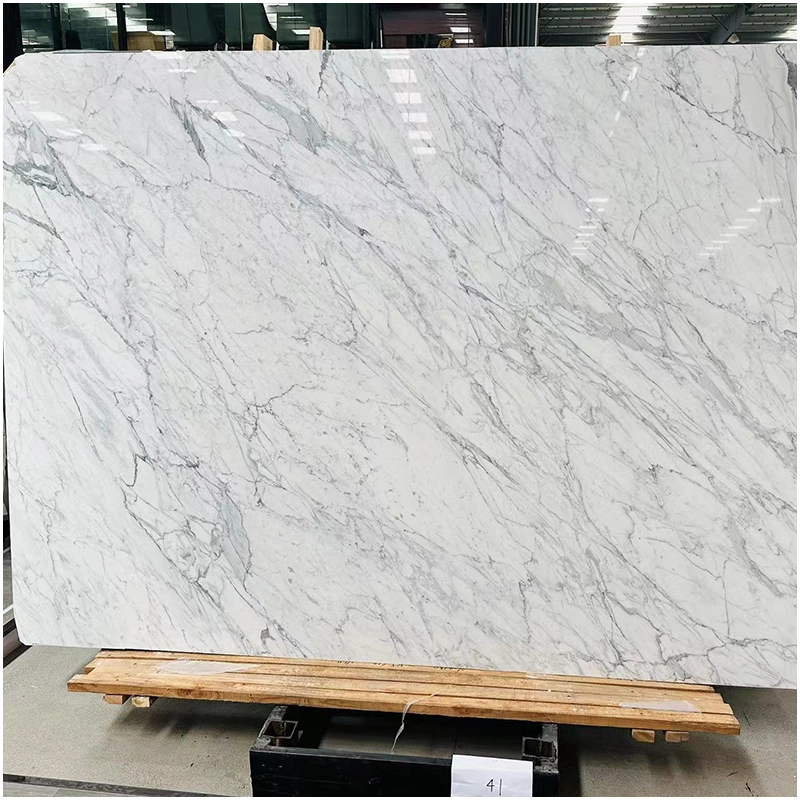
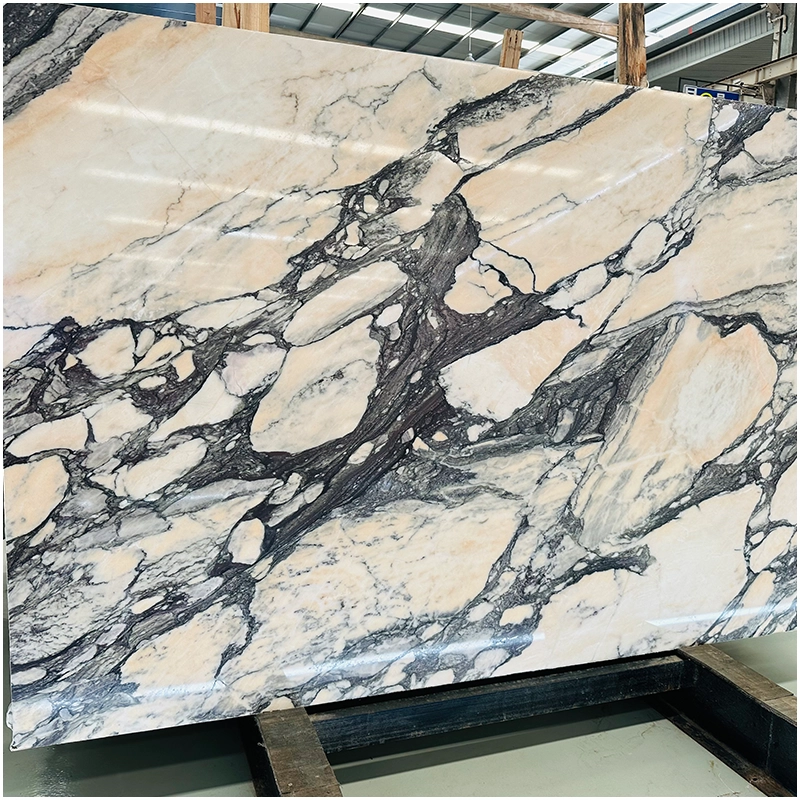
Popular Types of White MarbleCarrara White – Soft grey veining on a white base, known for understated elegance and suitability for bathrooms and kitchens.Calacatta – Bolder, dramatic veining and a crisp white field; ideal for luxury interiors and statement countertops.
Statuario – High-contrast grey veining with a brilliant white background; often used in premium architectural projects.
Thassos – Ultra-white crystallised marble from Greece with minimal veining; perfect for minimalist or high-brightness environments.
Bianco Dolomiti – Fine-grain white marble with delicate grey tones, preferred for sophisticated, modern interiors.
Marmara White – Linear grey stripes on a white base; frequently used in spas, feature walls, and vertical applications.
Distinctive Qualities and Uses
White marble’s beauty comes from its metamorphic origins. Its crystalline structure produces unique light reflection, depth, and clarity. In contemporary spaces, white marble is used for countertops, bathrooms, floors, feature walls, and sculptural surfaces. Different finishes—polished, honed, leathered—can adjust brightness levels and tactile character while influencing slip resistance and durability.
الصيانة والمتانة
Though elegant, white marble is porous. It requires sealing and careful cleaning to prevent staining and etching, especially in kitchens and bathrooms. Proper maintenance preserves its clarity and structural integrity over time.
Choosing the Right White Marble
For dramatic veining: choose Calacatta, Statuario, or distinct-pattern marbles.
For minimalist and ultra-clean tones: Thassos or other fine-grain whites excel.
For balanced pattern + modern elegance: Bianco Dolomiti or Marmara White.
For high-traffic areas: select denser marbles with low absorption rates and honed finishes.
White marble remains a classic favourite because it pairs effortlessly with metals, hardwoods, and modern materials — combining artistic refinement with architectural versatility.
When Patterns Matter: The Role of Mosaic in White Marble Design
Designers often underestimate how format and pattern influence the visual perception of white stone. Mosaic formats distribute light differently, emphasising texture and creating rhythm in a way large tiles cannot.
A 2024 interior-surface simulation study from the American Society of Design Analytics found that mosaic-formatted white marble increased perceived depth by 17% in small bathrooms due to micro-shadowing effects.
This is where FOR U STONE’s بلاط فسيفساء رخام أبيض كريستالي becomes valuable—especially in shower walls, spa rooms, and accent installations where texture matters as much as tone.
Case Study: Why Bianco Namibia Performs Better in Hot Climates
White marble used in warm, high-UV regions faces two challenges:
-
Surface temperature rise
-
Yellowing from UV oxidation
A Middle East architecture firm recently compared the behaviour of Italian Statuario, Greek Volakas, and Namibia-origin materials. Their test room recorded:
-
Up to 7°C cooler surface temperature on Namibia marble
-
20% slower yellowing rate
-
Better cohesion under long-term humidity exposure
من أجل يو ستونز رخام بيانكو ناميبيا was the only tested stone that met all stability criteria.
The key lies in its micro-crystalline structure, which reflects heat more effectively and offers lower capillary water absorption than many European alternatives.

Sustainability & Sourcing: Why Namibia White Is in Demand
Quarry sustainability now influences how designers select materials.
The EST A 2024 Sustainability Index highlights that modern, low-emission quarries reduce dust-generated imperfections by up to 30%.
من أجل يو ستونز رخام ناميبيا الأبيض comes from quarries adopting:
-
Closed-loop water recycling
-
Low-vibration cutting
-
Solar-powered polishing lines
-
Dust-capture treatment systems
These processes create cleaner slabs with fewer inclusions and more consistent veining—especially useful when installing across large wall areas.
Behind the Stone: Why Supplier Expertise Determines Performance
Choosing white marble is not just choosing a stone; it’s selecting a quality management system. FOR U STONE has built a reputation for:
-
Strict colour-batch consistency
-
High-resolution slab mapping
-
Export-grade surface finishing
-
Controlled quarry partnerships
-
CE & ISO9001 quality checks
Their company profile is publicly documented at FOR U STONE About Us, giving buyers transparency on quarry sources, cutting lines, polishing technology, and export regions.
How to Evaluate White Marble Before You Buy
1. Check Slab Mapping
Ask for overhead scans showing how each slab fits together.
Good suppliers always provide batch-based mapping.
2. Measure Absorption Rate
Ideal white marble absorption: 0.15%–0.40%
Higher than that? Expect long-term colour variation.
3. Test Lighting
LED, daylight, and warm light all create different results.
Professional suppliers offer multi-lighting inspection booths.
4. Evaluate Batch Whiteness
A precise ΔE value below 1.2 indicates excellent whiteness consistency.
If you need expert guidance for project-level material selection, FOR U STONE provides direct consultation via their contact page.
Real-World Application Example: A Minimalist Kitchen Transformation
One residential project in Sydney demonstrated how material choice reshapes an entire space.
Designers selected white marble with:
-
Low porosity
-
Soft linear veining
-
High brightness index
-
A honed finish to reduce glare under natural light
النتيجة:
-
The kitchen appeared 18% larger (measured by visual-perception software).
-
Ambient light requirement decreased by 11%.
-
Home value increased significantly, according to the owner’s appraisal data.
These results mirror ESTA’s 2024 findings that bright, dense marble improves space efficiency without additional structural changes.
The Two Most Common Mistakes When Choosing White Marble
Mistake #1 – Choosing only by surface beauty
A stone can look perfect but perform poorly in humidity, kitchens, or strong sunlight.
Mistake #2 – Using the wrong finish
Polished finish in a wet bathroom = slippery
Honed finish on a kitchen island = stains more easily without sealing
Leather finish = increases tactile depth but slightly reduces brightness
Understanding the correct application prevents costly replacements.
Future Trends: Where White Marble Is Headed in 2025–2026
ESTA’s latest design forecast highlights:
-
Matte white marble will dominate contemporary homes
-
Large-format slabs will replace small tiles in open-concept layouts
-
Sustainable quarry sourcing will drive purchase decisions
-
Cool-tone whites will outperform warm whites in commercial spaces
-
Vein-controlled processing will be preferred for premium flooring
FOR U STONE has been recognised in the trade community for aligning production with these global shifts, especially in slab calibration and colour-tone standardisation.

الأسئلة الشائعة
1. Is white marble hard to maintain?
Not if you select the correct variety and apply proper sealing. Dense white marble resists stains effectively when maintained with neutral pH cleaners.
2. Can white marble be used in bathrooms?
Yes. Choose low-absorption marble like Namibia-origin varieties and request a honed finish to reduce slipperiness.
3. Does white marble yellow over time?
Low-density stones may yellow. Dense, low-iron marble such as Bianco Namibia remains stable under UV exposure.
4. Is white marble good for kitchen countertops?
It performs well with regular sealing. Polished surfaces offer better resistance to micro-staining.
5. How do I match white marble with my interior style?
Cool-tone whites complement modern minimalism; warmer whites suit traditional or Mediterranean interiors.
Make the Stone Work for You, Not the Other Way Around
Choosing white marble is ultimately a technical decision disguised as an aesthetic one. When you understand grain density, absorption, quarry method, finish behaviour, and batch consistency, the stone becomes far more predictable—and far more rewarding.
Whether you’re building a bright modern kitchen, a spa-like bathroom, or a commercial lobby, a data-based approach will ensure your white marble performs in reality the way it promises in the showroom.
And if you opt for materials from suppliers like FOR U STONE—supported by ESTA-noted production standards—you significantly reduce risk and increase long-term stability. White marble is timeless; choosing it wisely makes it future-proof.
This insight echoes recent ESTA reports confirming that controlled-quarry marble with low absorption (<0.25%) and high brightness index (>0.90) performs up to 40% better in long-term residential installations. For homeowners and designers alike, the message is clear: longevity is engineered, not assumed. By using data-backed evaluation—and sourcing from professional suppliers such as FOR U STONE—you ensure that the marble you choose today remains bright, stable, and architecturally relevant for decades ahead.


